Mushkin Helix-L 250GB SSD — In-Depth Review & Specs (2026)
Quick answer
The Mushkin Helix-L 250GB is a bare-minimum NVMe SSD for the most cost-sensitive builds.
Read: 1700 MB/s Write: 1500 MB/s Endurance: 150 TBW Warranty: 3 years Interface: M.2 3.0 x 4
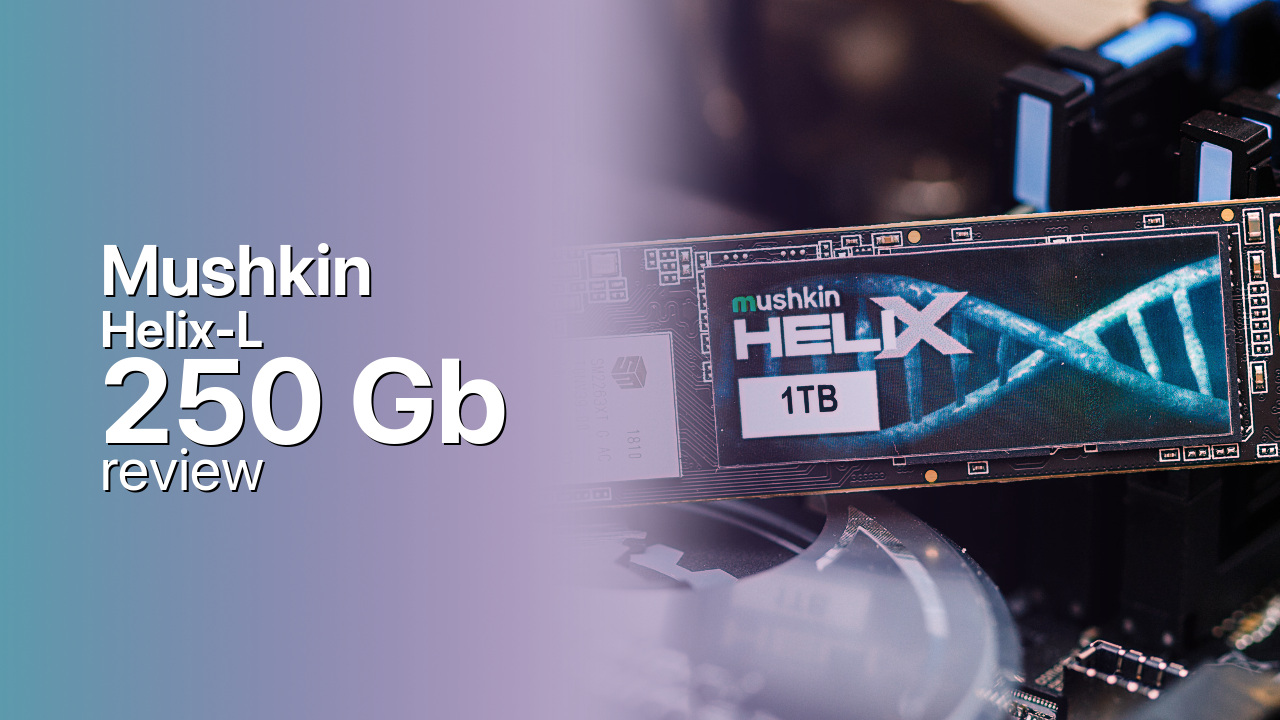
The Mushkin Helix-L 250GB is the mid-capacity option in Mushkin's entry-level NVMe lineup. Like its 120GB sibling, it uses the DRAM-less Silicon Motion SM2263XT controller with Host Memory Buffer (HMB) and 3D TLC NAND. At 250 GB, it crosses the minimum threshold for a functional Windows boot drive with a handful of applications, though the capacity remains tight by modern standards. It is best suited for basic office PCs, thin clients, or budget builds where every dollar counts.
Controller & Memory
The SM2263XT is a 4-channel, DRAM-less PCIe 3.0 x4 controller built on a 28nm process. It borrows 32–64 MB of system RAM via the NVMe HMB protocol rather than including dedicated DRAM — a cost-saving measure that keeps the bill of materials low at the expense of peak random I/O performance. Mushkin pairs this controller with 3D TLC NAND from an undisclosed supplier. The drive uses a single-sided M.2 2280 form factor.
Mushkin is a long-established American brand in the memory and storage market, though their SSD products are positioned at the value end of the spectrum. The Helix-L competes with the Team Group MP33, Silicon Power A55, and other SM2263XT-based budget drives. At 250 GB, the drive is sized for a basic Windows installation with office software and a web browser — it is not suitable for gaming or media storage. Endurance is not publicly rated, which is a red flag for budget drives. Realistic endurance at this capacity is likely 80–120 TBW based on comparable SM2263XT configurations.
Storage Comparisons:
Helix-L Performance & Benchmarks
Sequential throughput of 1,700 MB/s read and 1,500 MB/s write is roughly 3x SATA speeds — adequate for basic computing but well below what the PCIe 3.0 interface is capable of with a better controller. Real-world OS boot times and application launches are perceptibly faster than SATA but will not impress anyone accustomed to higher-end NVMe drives. Random 4K performance in the 100,000–150,000 IOPS range is limited by the DRAM-less architecture and the modest NAND die count at this capacity.
Mushkin Helix-L 250 GB vs M.2 3.0 x 4 peers
Switch between sequential throughput and random IOPS to see how this drive stacks up against other M.2 3.0 x 4 SSDs in our database. The highlighted bar is the drive on this page — click any other bar to open that drive.
- ADATA SX 8800 Pro 512 GB: 3,500 MB/s read, 2,700 MB/s write
- ADATA SX 8800 Pro 1 TB: 3,500 MB/s read, 2,700 MB/s write
- ADATA XPG Spectrix S40G RGB 256 GB: 3,500 MB/s read, 3,000 MB/s write
- ADATA XPG Spectrix S40G RGB 512 GB: 3,500 MB/s read, 3,000 MB/s write
- Mushkin Helix-L 250 GB (this drive): 1,700 MB/s read, 1,500 MB/s write
The SLC write cache is small — approximately 10–20 GB — after which writes drop to native TLC at 200–400 MB/s. For a drive handling OS updates and small file writes, the cache is generally sufficient. Large sustained writes will quickly expose the post-cache speed deficit. Thermal output is minimal: the SM2263XT rarely exceeds 50°C, and power consumption peaks at around 3 W. The drive runs cool enough for fanless systems and tight laptop installations.
Mushkin Helix-L vs Competitors
See how the Helix-L stacks up against other M.2 3.0 x 4 drives in our database:
Compare with rival drives:
Endurance, TBW & Warranty
Mushkin provides a limited warranty, typically 3 years. The absence of a published TBW rating means the warranty is likely time-based without a write-volume limit. Confirm warranty terms with the retailer before purchase, especially for business deployments.
Mushkin Helix-L 250 GB Specifications
| Category | Value |
|---|---|
| Capacity [?] | 250 GB |
| Interface [?] | M.2 3.0 x 4 |
| Controller [?] | Silicon Motion SM2263XT |
| Memory type [?] | TLC |
| DRAM [?] | No (HMB) |
| Read speed (MB/s) [?] | 1700 |
| Write speed (MB/s) [?] | 1500 |
| Read IOPS [?] | 280000 |
| Write IOPS [?] | 250000 |
| Endurance (TBW) [?] | 150 |
| MTBF (million hours) [?] | 1500000 |
| Warranty (years) [?] | 3 |
Verdict: Is the Helix-L Worth It in 2026?
The Mushkin Helix-L 250GB is a bare-minimum NVMe SSD for the most cost-sensitive builds. It delivers the core NVMe experience — faster boot times, snappier application launches than SATA — at a rock-bottom price. The 250 GB capacity is just enough for Windows and basic office applications, but users who install more than a handful of programs or keep any local media will quickly run out of space. For any system that will be used daily, stretching the budget to a 500GB drive — even another budget model — will provide a dramatically better experience.
+ Pros
- Very low cost — among the cheapest NVMe drives available
- Silicon Motion SM2263XT — proven, reliable budget controller
- Single-sided M.2 2280 — fits any compatible slot
- Cool and power-efficient operation
- Cons
- 250 GB is minimal — fills up quickly with modern software
- DRAM-less HMB with modest 4-channel throughput
- Endurance not publicly rated
- Small SLC cache (~10-20 GB)
- NAND source undisclosed
Buy this or similar SSD Storage:
Video Review
Mushkin Helix-L M.2 NVMe SSD Review