Intel 900P 280GB — Optane XPoint SSD Review (2026)
Quick answer
The Intel 900P 280GB is a specialized drive for workloads that demand consistent low-latency I/O — databases, virtualization, and professional content creation.
Read: 2500 MB/s Write: 2000 MB/s Endurance: 5110 TBW Warranty: 5 years Interface: PCIe 3.0 x 4 or U.2 2.5"
The Intel 900P 280GB is an Optane SSD built on 3D XPoint memory — a fundamentally different technology than NAND flash that delivers extraordinary endurance and consistent low-latency performance.
Controller & Memory
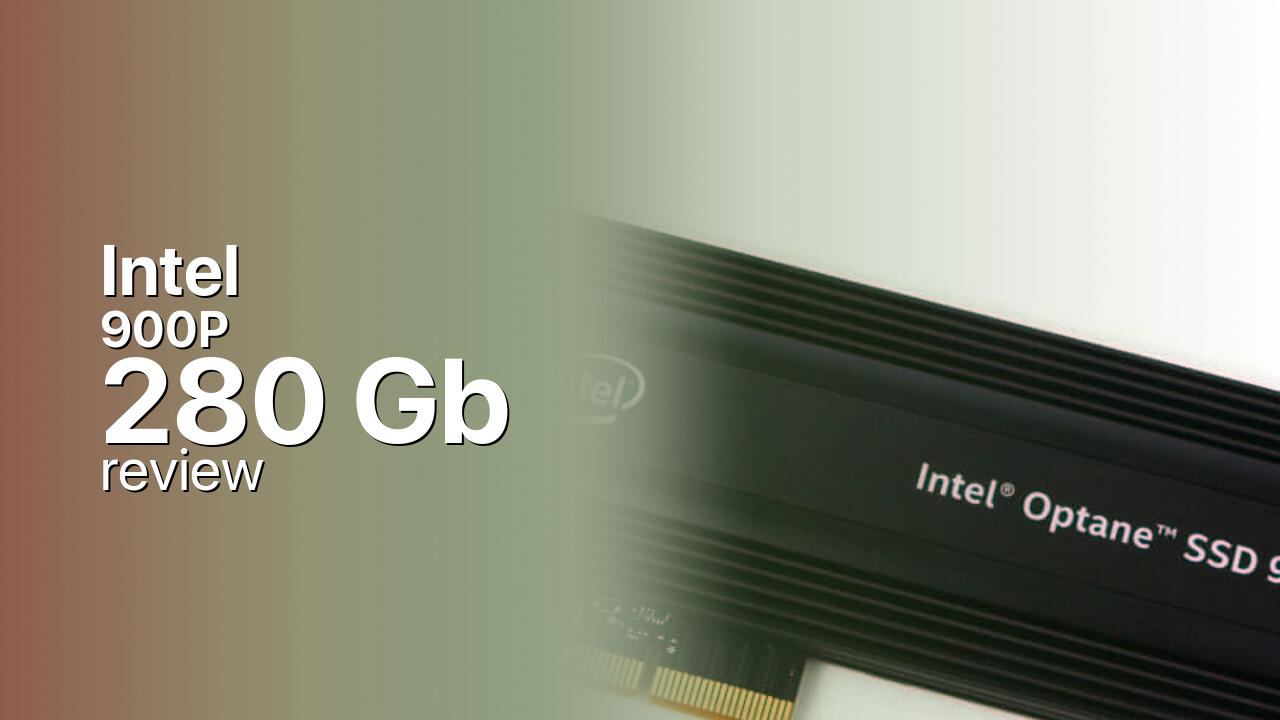
The Intel 900P 280GB uses Intel's custom 7-channel NVMe controller with 3D XPoint memory developed jointly by Intel and Micron. It is a PCIe 3.0 x4 NVMe drive available in both HHHL add-in card (AIC) and U.2 2.5" form factors. The 280GB capacity is the smaller of the two 900P options — the other is 480GB.
Sequential performance is rated at up to 2,500 MB/s reads and 2,000 MB/s writes, with 550K read IOPS and 500K write IOPS. These sequential numbers are modest compared to high-end Gen3 NAND drives, but the 900P's real strength is its consistent, latency-free performance under mixed workloads. At QD1, random read latencies are under 10 microseconds — roughly 5-7x faster than the best NAND SSDs.
3D XPoint memory does not use transistors to store data. It uses a cross-point array of wires and selector cells, eliminating read-modify-write cycles and erase-before-write operations. This means no SLC cache to exhaust, no performance degradation as the drive fills up, and no garbage collection overhead. The 900P delivers the same performance at 90% full as it does when empty.
The 900P's 5,110 TBW endurance rating is extraordinary — roughly 10x higher than comparable NAND drives. The 480GB model is rated at 8,760 TBW. Intel rates the drive for 1.6 million hours MTBF and backs it with a 5-year warranty. Unlike NAND drives, the 900P does not require TRIM or secure erase operations.
Key use cases include database workloads, virtualization, content creation scratch disks, and any application where consistent low latency matters more than peak sequential throughput. For pure gaming, a NAND NVMe drive offers better value. Note: Intel discontinued the Optane consumer line in 2022.
Storage Comparisons:
900P Performance & Benchmarks
The Intel 900P 280GB is rated at up to 2,500 MB/s sequential reads and 2,000 MB/s sequential writes. Random 4K performance reaches 550K IOPS reads and 500K IOPS writes. These sequential numbers are good but not class-leading for Gen3 NVMe — the Samsung 960 PRO, for example, delivers higher sequential throughput.
Intel 900P 280 GB vs PCIe 3.0 x 4 or U.2 2.5" peers
Switch between sequential throughput and random IOPS to see how this drive stacks up against other PCIe 3.0 x 4 or U.2 2.5" SSDs in our database. The highlighted bar is the drive on this page — click any other bar to open that drive.
- Intel 905P 380 GB: 2,600 MB/s read, 2,200 MB/s write
- Intel 905P 480 GB: 2,600 MB/s read, 2,200 MB/s write
- Intel 905P 960 GB: 2,600 MB/s read, 2,200 MB/s write
- Intel 900P 280 GB (this drive): 2,500 MB/s read, 2,000 MB/s write
- Intel 900P 480 GB: 2,500 MB/s read, 2,000 MB/s write
The 900P's real advantage is consistency and low-queue-depth performance. At QD1, the drive delivers sub-10-microsecond random read latencies — roughly 5-7x faster than the best NAND SSDs. TweakTown's testing showed the 900P delivering 7x the random read performance of competing NAND drives at QD1. This translates to tangible benefits in workloads like database queries, virtualization, and application compilation.
Unlike NAND drives, there is no SLC cache to exhaust, no performance drop when the drive fills up, and no read-modify-write penalty. Under mixed read/write workloads, the 900P maintains stable latency where NAND drives show spikes. AnandTech, Tom's Hardware, and StorageReview all highlighted the 900P's exceptional random I/O consistency.
The 900P draws up to 14W under burst write loads and idles at 5W — significantly more than NAND SSDs. This makes it a desktop-only product. The AIC version includes an integrated heatsink, and the U.2 version has a 2.5" enclosure with thermal management.
Endurance, TBW & Warranty
Intel backs the 900P 280GB with a 5-year limited warranty and a 5,110 TBW endurance rating. At 30 GB of writes per day, that is over 465 years of theoretical endurance — effectively unlimited for any real-world workload. The drive is rated for 1.6 million hours MTBF. The 5,110 TBW is one of the highest endurance ratings of any consumer SSD, reflecting 3D XPoint's fundamentally more durable storage mechanism compared to NAND flash.
Intel 900P 280 GB Specifications
| Category | Value |
|---|---|
| Capacity [?] | 280 GB |
| Interface [?] | PCIe 3.0 x 4 or U.2 2.5" |
| Controller [?] | Intel EAU01D76 |
| Memory type [?] | Intel 3D XPoint |
| DRAM [?] | No |
| Read speed (MB/s) [?] | 2500 |
| Write speed (MB/s) [?] | 2000 |
| Read IOPS [?] | 550000 |
| Write IOPS [?] | 500000 |
| Endurance (TBW) [?] | 5110 |
| MTBF (million hours) [?] | 1.6 |
| Warranty (years) [?] | 5 |
Verdict: Is the 900P Worth It in 2026?
The Intel 900P 280GB is a specialized drive for workloads that demand consistent low-latency I/O — databases, virtualization, and professional content creation. For gaming and general consumer use, it is not the best value: NAND NVMe drives offer similar real-world responsiveness at a much lower price. If you need the 900P's unique consistency characteristics, nothing else comes close. Note that Intel has discontinued the Optane consumer line, so availability is limited to remaining stock and secondary markets.
+ Pros
- 5,110 TBW endurance — among the highest of any consumer SSD
- Sub-10us random read latency at QD1 — 5-7x faster than NAND
- Consistent performance — no cache exhaustion or fill-up degradation
- 3D XPoint memory — fundamentally different from NAND
- 5-year warranty
- Available in AIC and U.2 form factors
- Cons
- Sequential speeds modest vs high-end Gen3 NAND
- Discontinued — limited availability, no future firmware updates
- Expensive per gigabyte
- High power consumption — 14W burst, 5W idle
- Overkill for gaming and general consumer use
- Heavy — 230g for AIC version
Buy this or similar SSD Storage:
Video Review
Intel Optane 900p 280GB AIC PCIe 3.0 x4 NVME SSD