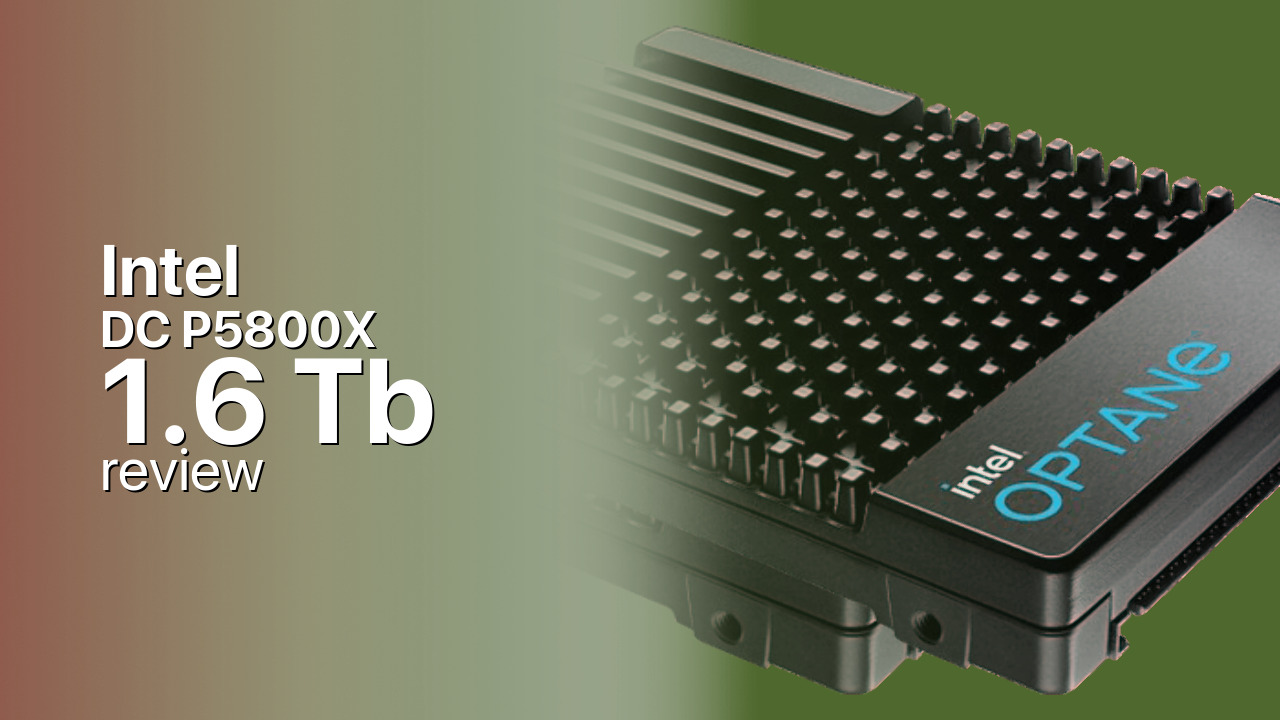
Intel DC P5800X 1.6TB — Enterprise Optane SSD Review (2026)
Quick answer
The Intel DC P5800X 1.6TB is the fastest and most durable consumer-accessible SSD ever made, but it's a discontinued enterprise product with a price tag to match.
Read: 7200 MB/s Write: 6200 MB/s Endurance: 292000 TBW Warranty: 5 years Interface: U.2 2.5" or E1.S
The Intel DC P5800X 1.6TB is the pinnacle of Optane storage — a PCIe 4.0 enterprise SSD with 100 drive writes per day endurance, nanosecond-scale latency, and performance that makes even the fastest NAND drives look sluggish in mixed workloads.
Controller & Memory
The Intel DC P5800X 1.6TB uses Intel's proprietary PCIe 4.0 x4 native controller paired with second-generation 3D XPoint memory. It's available in U.2 2.5" 15mm and E1.S form factors — this is an enterprise/data center drive, not a consumer M.2 stick. You'll need a U.2 port or a PCIe 4.0 U.2-to-PCIe adapter card to use it in a desktop.
Sequential performance is rated at up to 7,200 MB/s reads and 6,200 MB/s writes, with 1.5M IOPS for both reads and writes. These numbers are excellent for PCIe 4.0, but the P5800X's real advantage is its consistent, latency-free performance under mixed workloads. At QD1, random read latencies approach the nanosecond scale — something no NAND drive can match.
The endurance rating is extraordinary: 100 drive writes per day (DWPD) over 5 years. For the 1.6TB model, that's roughly 29,200 TBW — more than 100x what a typical consumer SSD offers. This makes the P5800X suitable for write-heavy enterprise workloads like databases, caching layers, and real-time analytics.
The P5800X line is also available in 400GB and 800GB capacities. All capacities share the same controller and XPoint memory technology.
Key differentiators include power-loss data protection, AES 256-bit encryption, end-to-end data protection, and Intel's custom NVMe driver for optimized performance. The drive includes an integrated heatsink in its 2.5" enclosure.
This is a discontinued product — Intel shut down its Optane division in 2022. Availability is limited to remaining stock and secondary markets. For current enterprise needs, the Samsung PM1743 and Kioxia CM7 are the closest PCIe 4.0 NAND alternatives, though neither matches Optane's latency characteristics.
Storage Comparisons:
DC P5800X Performance & Benchmarks
The Intel DC P5800X 1.6TB is rated at up to 7,200 MB/s sequential reads and 6,200 MB/s sequential writes, with 1.5M IOPS for both reads and writes. In CrystalDiskMark, expect sequential reads around 7.0–7.2 GB/s and writes around 5.8–6.2 GB/s.
Intel DC P5800X 1.6 TB vs U.2 2.5" or E1.S peers
Switch between sequential throughput and random IOPS to see how this drive stacks up against other U.2 2.5" or E1.S SSDs in our database. The highlighted bar is the drive on this page — click any other bar to open that drive.
- Intel DC P5800X 400 GB: 7,400 MB/s read, 7,400 MB/s write
- Intel DC P5800X 800 GB: 7,400 MB/s read, 7,400 MB/s write
- Intel DC P5800X 1.6 TB (this drive): 7,200 MB/s read, 6,200 MB/s write
The P5800X's standout metric is random I/O at low queue depths. At QD1, the drive delivers sub-10 microsecond latencies — roughly 10x faster than the best NAND drives. This makes it ideal for workloads like database queries, virtualization, and real-time analytics where consistent low latency matters more than peak throughput.
Unlike NAND drives, the P5800X has no SLC cache to exhaust and no performance degradation as the drive fills up. Performance is consistent from empty to 90%+ full. Independent reviews at Tom's Hardware, HotHardware, and StorageReview all confirmed the P5800X's exceptional random I/O performance and consistency.
For gaming and general consumer use, the P5800X is overkill and overpriced. Its strengths only become apparent in specialized enterprise and professional workloads.
Endurance, TBW & Warranty
Intel backs the DC P5800X with a 5-year limited warranty and a 100 DWPD (drive writes per day) endurance rating. For the 1.6TB model, this translates to roughly 29,200 TBW over the warranty period — effectively unlimited for any real-world workload. The drive is rated for 2 million hours MTBF.
The P5800X includes power-loss data protection, ensuring data in flight is safely committed to media during unexpected power events. Intel's warranty is handled through their enterprise support channels.
Intel DC P5800X 1.6 TB Specifications
| Category | Value |
|---|---|
| Capacity [?] | 1.6 TB |
| Interface [?] | U.2 2.5" or E1.S |
| Controller [?] | Intel |
| Memory type [?] | Intel Optane 2nd Gen |
| DRAM [?] | No |
| Read speed (MB/s) [?] | 7200 |
| Write speed (MB/s) [?] | 6200 |
| Read IOPS [?] | 1550000 |
| Write IOPS [?] | 1600000 |
| Endurance (TBW) [?] | 292000 |
| MTBF (million hours) [?] | 2 |
| Warranty (years) [?] | 5 |
Verdict: Is the DC P5800X Worth It in 2026?
The Intel DC P5800X 1.6TB is the fastest and most durable consumer-accessible SSD ever made, but it's a discontinued enterprise product with a price tag to match. It makes sense only for specialized workloads that demand consistent low-latency I/O — databases, virtualization, and professional content creation. For gaming and general use, a Samsung 980 Pro or WD Black SN850X offers better value. If you can find a P5800X at a reasonable price on the secondary market, it's a fascinating piece of technology — but know that Intel has discontinued the Optane line and firmware support is limited.
+ Pros
- 100 DWPD endurance — ~29,200 TBW, effectively unlimited
- Sub-10µs random latency at QD1 — 10x faster than NAND
- Consistent performance regardless of drive fill level
- Power-loss data protection and AES 256-bit encryption
- 7,200 MB/s reads on PCIe 4.0
- Cons
- Discontinued — limited availability, no future firmware updates
- Enterprise pricing — very expensive per gigabyte
- U.2/E1.S form factor — not M.2, needs adapter for most desktops
- Overkill for gaming and general consumer use
Buy this or similar SSD Storage:



Video Review
FASTEST Chia plotting - Rocket Lake & Gen 4 Intel Optane sets the world record k=32