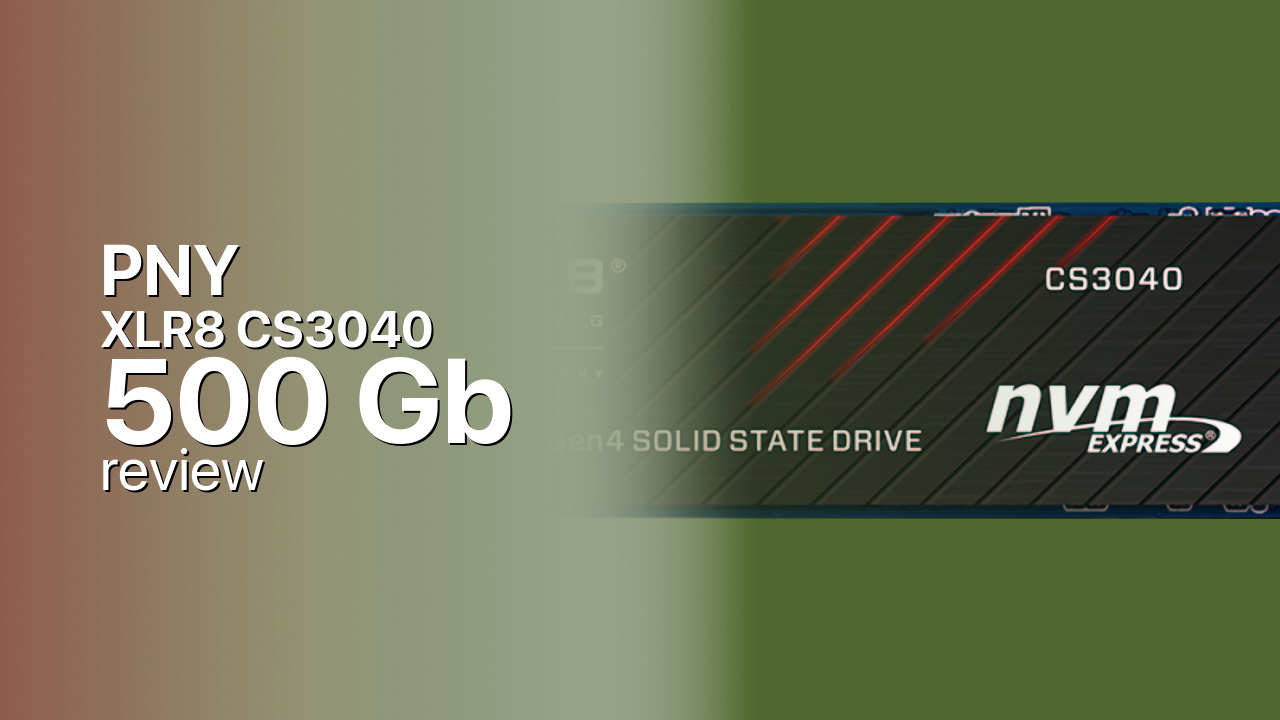
PNY XLR8 CS3040 500GB Review — Entry-Level PCIe 4.0 NVMe (2026)
Quick answer
The PNY XLR8 CS3040 500GB is a competent entry point into PCIe 4.0 storage, delivering 5,600 MB/s reads and a full DRAM cache at a price that undercuts flagship Gen4 drives.
Read: 5600 MB/s Write: 2600 MB/s Endurance: 900 TBW Warranty: 5 years Interface: M.2 4.0 x 4
The PNY XLR8 CS3040 500GB is an entry-level PCIe 4.0 NVMe SSD that pairs the proven Phison E16 controller with Toshiba 96L TLC, offering Gen4 speeds at a mainstream price point.
Controller & Memory
The PNY XLR8 CS3040 500GB is built around the Phison PS5016-E16-32 controller — a quad-core design running at 733 MHz that was the first PCIe 4.0 x4 NVMe platform to reach the consumer market. Toshiba BiCS4 96-layer 3D TLC NAND provides the storage medium, with a single 512MB SK Hynix DDR4-2400 DRAM package (H5AN4G8NBJR-UHC) handling the mapping table. The drive uses an M.2 2280 form factor on a double-sided PCB and supports NVMe 1.3.
Sequential performance is rated at up to 5,600 MB/s reads and 2,600 MB/s writes on the 500GB model. The write speed is notably half that of the 1TB and 2TB variants, which both reach 4,300 MB/s — a common pattern where smaller NAND configurations have fewer parallel channels. Random IOPS are not officially published by PNY for this capacity.
The CS3040 line ships in 500GB, 1TB, and 2TB capacities, with an optional heatsink variant designed to fit the PS5's expansion slot. The heatsink version carries PNY's PS5 branding and is officially listed on Sony's compatibility page. Without the heatsink, the bare drive is double-sided, which may not fit all laptop M.2 slots that require single-sided modules.
Security features include TCG Opal 2.0, Pyrite, Sanitize, and Crypto Erase. The drive also supports LDPC error correction and end-to-end data path protection.
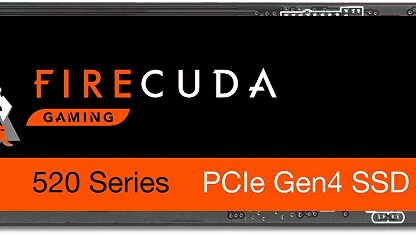
Direct competitors in the entry-level PCIe 4.0 space include the Corsair MP600 500GB (identical Phison E16 platform), the ADATA XPG Gammix S50 Lite 500GB, and the Seagate FireCuda 520 500GB. The CS3040 differentiates itself with the optional PS5-ready heatsink option.
Storage Comparisons:
XLR8 CS3040 Performance & Benchmarks
The PNY XLR8 CS3040 500GB is rated at up to 5,600 MB/s sequential reads and 2,600 MB/s sequential writes. Those read numbers put it squarely in the mid-tier PCIe 4.0 range, while the write speed reflects the 500GB capacity's narrower NAND channel configuration — the 1TB and 2TB models reach 4,300 MB/s writes.
PNY XLR8 CS3040 500 GB vs M.2 4.0 x 4 peers
Switch between sequential throughput and random IOPS to see how this drive stacks up against other M.2 4.0 x 4 SSDs in our database. The highlighted bar is the drive on this page — click any other bar to open that drive.
- Patriot Viper PV593 1 TB: 14,500 MB/s read, 14,000 MB/s write
- Patriot Viper PV593 2 TB: 14,500 MB/s read, 14,000 MB/s write
- Patriot Viper PV593 4 TB: 14,500 MB/s read, 14,000 MB/s write
- Patriot Viper PV573 2 TB: 14,000 MB/s read, 12,000 MB/s write
- PNY XLR8 CS3040 500 GB (this drive): 5,600 MB/s read, 2,600 MB/s write
In independent testing at ssd-tester, the CS3040 500GB recorded around 5,000 MB/s in CrystalDiskMark Q8T1 sequential reads and roughly 2,500 MB/s writes, tracking close to its rated specifications. AS SSD reported approximately 4,200 MB/s reads and 2,400 MB/s writes, which is typical overhead for that benchmark's more demanding workload. Real-world file transfers showed sustained throughput around 2,100 MB/s for large sequential copies and roughly 1,200 MB/s for dense directory structures with many small files.
Like all Phison E16-based drives, the CS3040 relies on a dynamic SLC cache for burst writes. The cache is generous enough for everyday workloads — OS booting, game loading, application launches — but sustained transfers larger than the cache will see write speeds drop to TLC direct-write levels. For a boot drive or game library, this is irrelevant; for frequent large-file workloads like 4K video editing, the 1TB or 2TB capacity would sustain higher throughput past the cache boundary.
PNY XLR8 CS3040 vs Competitors
See how the XLR8 CS3040 stacks up against other M.2 4.0 x 4 drives in our database:
Compare with rival drives:
Endurance, TBW & Warranty
PNY backs the XLR8 CS3040 500GB with a five-year limited warranty and a 900 TBW endurance rating. At 900 TBW, the 500GB drive can absorb roughly 500 GB of writes per day over its five-year warranty period — well beyond what any typical desktop user would generate. At a more moderate 40 GB per day, the drive would theoretically last over 60 years before hitting the TBW ceiling, though the warranty period is the governing limit regardless. The drive is also rated for a 2.0 million hour MTBF, which is a population-level reliability statistic rather than a guarantee for any individual unit. Warranty claims are handled through PNY's standard RMA process, typically via the retailer of first purchase.
PNY XLR8 CS3040 500 GB Specifications
| Category | Value |
|---|---|
| Capacity [?] | 500 GB |
| Interface [?] | M.2 4.0 x 4 |
| Controller [?] | Phison PS5016-E16-32 |
| Memory type [?] | Toshiba 3D TLC |
| DRAM [?] | 512MB SK Hynix DDR4-2400 |
| Read speed (MB/s) [?] | 5600 |
| Write speed (MB/s) [?] | 2600 |
| Read IOPS [?] | 350000 |
| Write IOPS [?] | 700000 |
| Endurance (TBW) [?] | 900 |
| MTBF (million hours) [?] | 2 |
| Warranty (years) [?] | 5 |
Verdict: Is the XLR8 CS3040 Worth It in 2026?
The PNY XLR8 CS3040 500GB is a competent entry point into PCIe 4.0 storage, delivering 5,600 MB/s reads and a full DRAM cache at a price that undercuts flagship Gen4 drives. The 2,600 MB/s write speed is the trade-off for the smaller capacity, and the double-sided PCB limits laptop compatibility. Buyers who need faster writes or single-sided compatibility should step up to the 1TB model or look at DRAM-less HMB alternatives like the WD Blue SN580. For a desktop boot drive or PS5 expansion with the optional heatsink, the CS3040 500GB holds up well.
+ Pros
- 5,600 MB/s sequential reads — mid-tier PCIe 4.0
- 512MB DRAM cache — better than HMB designs
- 900 TBW endurance rating
- 5-year warranty
- Optional PS5-compatible heatsink version
- Cons
- 2,600 MB/s writes — half the speed of 1TB variant
- Double-sided PCB — may not fit thin laptop slots
- No published random IOPS ratings
- No AES-256 hardware encryption
Buy this or similar SSD Storage:



Video Review
PNY XLR8 m.2 SSD Review vs Samsung 970 Evo Plus+