OWC Mercury M2 500GB Review — Mid-Range MLC PCIe 3.0 NVMe SSD (2026)
Quick answer
The OWC Mercury M2 500GB is the most balanced Mercury M2 variant — 500 GB is enough for a practical single-drive system, the MLC NAND offers better endurance than TLC competitors, and the standard M.2 form factor fits any NVMe slot.
Read: 1872 MB/s Write: 1087 MB/s Endurance: 370 TBW Warranty: 3 years Interface: M.2 3.0 x 4
The OWC Mercury M2 500GB steps up from the 250 GB model with more NAND dies for better sustained write performance — still built on the SM2260 controller and MLC flash in a standard M.2 2280 form factor.
Controller & Memory
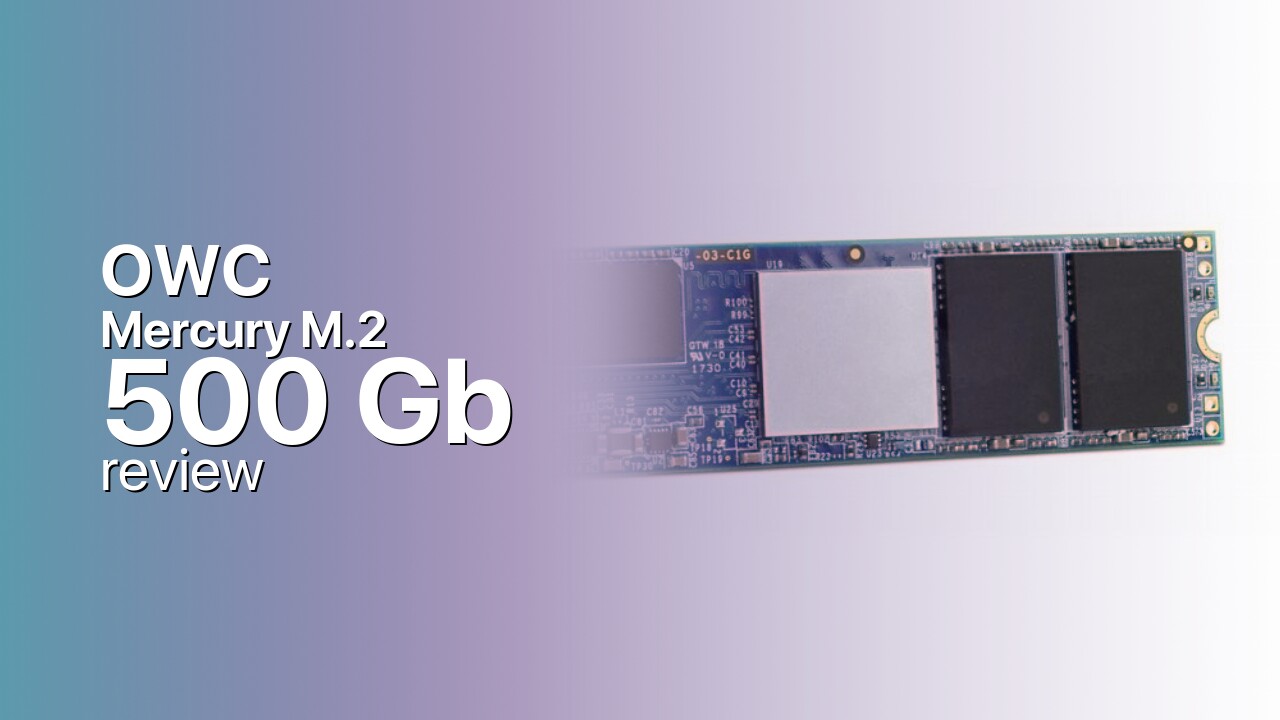
The Mercury M2 500GB shares the Silicon Motion SM2260 controller and MLC NAND with the 250 GB variant, but the doubled capacity means twice as many NAND dies for the controller's eight channels to address. This improves sustained write performance — while the rated 1,087 MB/s writes match the 250 GB model, the 500 GB's larger SLC cache and extra dies mean it maintains peak speeds longer during sustained transfers. Whether the drive includes a DRAM cache is not specified by OWC, though most SM2260-based drives included discrete DRAM.
At 500 GB, the Mercury M2 offers enough space for a Windows installation, a full application suite, and a modest game or media library. After the OS and core software, roughly 400–420 GB remains — enough for 5–10 modern games, a substantial photo collection, or several video projects. This is the most practical capacity in the Mercury M2 lineup for a single-drive system build, as the 250 GB is too cramped and the 1 TB and 2 TB models cost proportionally more.
The Mercury M2 uses a standard M.2 M-key connector, fitting any motherboard or laptop with an M.2 NVMe slot. It was OWC's general-purpose NVMe SSD line, distinct from the Mac-specific Aura Pro X2 series. The SM2260 controller, while an early NVMe design from Silicon Motion, provides competent PCIe 3.0 performance even if it can't match the speeds of later Gen3 controllers like the SM2262EN or Phison E12.
The Mercury M2 500GB competed with the Samsung 960 EVO 500 GB, Intel 760p 512 GB, and Plextor M8Se 512 GB. Its MLC NAND offered better endurance than the TLC-based competition, but the slower controller speeds and limited review coverage kept it from mainstream adoption. OWC appears to have since discontinued the Mercury M2 line.
Storage Comparisons:
Mercury M.2 Performance & Benchmarks
The OWC Mercury M2 500GB is rated at up to 1,872 MB/s sequential reads and 1,087 MB/s sequential writes over its PCIe 3.0 x4 NVMe interface. The read speed matches the 250 GB model, reflecting the SM2260 controller's fixed read throughput ceiling. The write speed is also rated identically, but the 500 GB variant sustains these writes longer thanks to more NAND dies and a larger SLC cache. The SM2260 is an eight-channel PCIe 3.0 x4 NVMe 1.2 controller that was Silicon Motion's first consumer NVMe design — capable but not class-leading. Random 4K performance typically reaches 130,000–150,000 IOPS reads and 120,000–140,000 IOPS writes, which is adequate for desktop responsiveness but below the 200,000+ IOPS achieved by the later SM2262EN. The MLC NAND is the Mercury M2's standout feature — it handles sustained writes better than TLC drives, maintaining higher speeds after the SLC cache fills. Where a TLC drive might drop to 300–500 MB/s after cache exhaustion, the MLC-based Mercury M2 maintains a more consistent write floor. For everyday desktop tasks, the drive performs competently. Under sustained workloads like large file transfers or video editing, the MLC advantage becomes more visible. Independent benchmark reviews of the Mercury M2 are scarce. For general-purpose computing, the 500 GB capacity and MLC endurance make it a serviceable choice, though modern NVMe drives at similar prices deliver significantly higher throughput.
OWC Mercury M.2 500 GB vs M.2 3.0 x 4 peers
Switch between sequential throughput and random IOPS to see how this drive stacks up against other M.2 3.0 x 4 SSDs in our database. The highlighted bar is the drive on this page — click any other bar to open that drive.
- ADATA SX 8800 Pro 512 GB: 3,500 MB/s read, 2,700 MB/s write
- ADATA SX 8800 Pro 1 TB: 3,500 MB/s read, 2,700 MB/s write
- ADATA XPG Spectrix S40G RGB 256 GB: 3,500 MB/s read, 3,000 MB/s write
- ADATA XPG Spectrix S40G RGB 512 GB: 3,500 MB/s read, 3,000 MB/s write
- OWC Mercury M.2 500 GB (this drive): 1,872 MB/s read, 1,087 MB/s write
OWC Mercury M.2 vs Competitors
See how the Mercury M.2 stacks up against other M.2 3.0 x 4 drives in our database:
Compare with rival drives:
Endurance, TBW & Warranty
OWC provides a three-year limited warranty for the Mercury M2 500GB, which is shorter than the five-year coverage offered by Samsung, Crucial, and Western Digital on their mainstream drives. The company does not publish a TBW (terabytes written) endurance rating for the Mercury M2 series. For a 500 GB drive using MLC NAND, endurance is likely in the 250–400 TBW range — MLC cells typically endure 3,000–5,000 program/erase cycles, roughly double the endurance of TLC. At a typical 30–60 GB per day write workload, the drive should last 11–37 years before reaching its estimated TBW limit, comfortably exceeding the three-year warranty period. OWC does not publish an MTBF figure. Warranty service flows through OWC's distributor network, and international buyers should verify local support availability. The three-year warranty is adequate but not competitive with the five-year standard. The lack of published endurance specs is a gap that makes the Mercury M2 harder to recommend over drives with documented TBW figures like the Samsung 960 EVO 500 GB (200 TBW published) or Intel 760p 512 GB (288 TBW published).
OWC Mercury M.2 500 GB Specifications
| Category | Value |
|---|---|
| Capacity [?] | 500 GB |
| Interface [?] | M.2 3.0 x 4 |
| Controller [?] | Silicon Motion SM2260 |
| Memory type [?] | MLC |
| DRAM [?] | Yes |
| Read speed (MB/s) [?] | 1872 |
| Write speed (MB/s) [?] | 1087 |
| Read IOPS [?] | 155000 |
| Write IOPS [?] | 190000 |
| Endurance (TBW) [?] | 370 |
| MTBF (million hours) [?] | 2000000 |
| Warranty (years) [?] | 3 |
Verdict: Is the Mercury M.2 Worth It in 2026?
The OWC Mercury M2 500GB is the most balanced Mercury M2 variant — 500 GB is enough for a practical single-drive system, the MLC NAND offers better endurance than TLC competitors, and the standard M.2 form factor fits any NVMe slot. But the 1,872 MB/s reads trail modern NVMe drives by a wide margin, the three-year warranty is shorter than the competition, and the lack of published TBW specs makes long-term reliability harder to assess. For most buyers, a modern NVMe like the Crucial P3 Plus 500 GB offers better performance, documented specs, and a longer warranty at a similar price. The Mercury M2 500GB appeals primarily to buyers who specifically value MLC NAND.
+ Pros
- MLC NAND for superior endurance vs TLC
- 500 GB practical for single-drive systems
- Standard M.2 2280 universal compatibility
- SM2260 eight-channel NVMe controller
- Better sustained writes than 250 GB model
- Cons
- 1,872 MB/s reads slow for PCIe 3.0
- No published TBW endurance rating
- 3-year warranty shorter than competition
- Appears to be discontinued
- Limited independent review coverage
Buy this or similar SSD Storage:



Video Review
M.2 vs NVME: What's the difference?