Samsung 980 Pro 500GB — PCIe 4.0 NVMe SSD Review (2026)
Quick answer
The Samsung 980 Pro 500GB is the right pick for builders who want proven PCIe 4.0 performance in a single-sided package that fits laptops, ITX boards, and the PS5.
Read: 6900 MB/s Write: 5000 MB/s Endurance: 300 TBW Warranty: 5 years Interface: M.2 4.0 x 4
The Samsung 980 Pro 500GB was one of the first consumer PCIe 4.0 NVMe SSDs to pair Samsung's Elpis controller with 6th-gen V-NAND TLC, and it still holds up as a fast, reliable drive for gaming and everyday workloads.
Controller & Memory
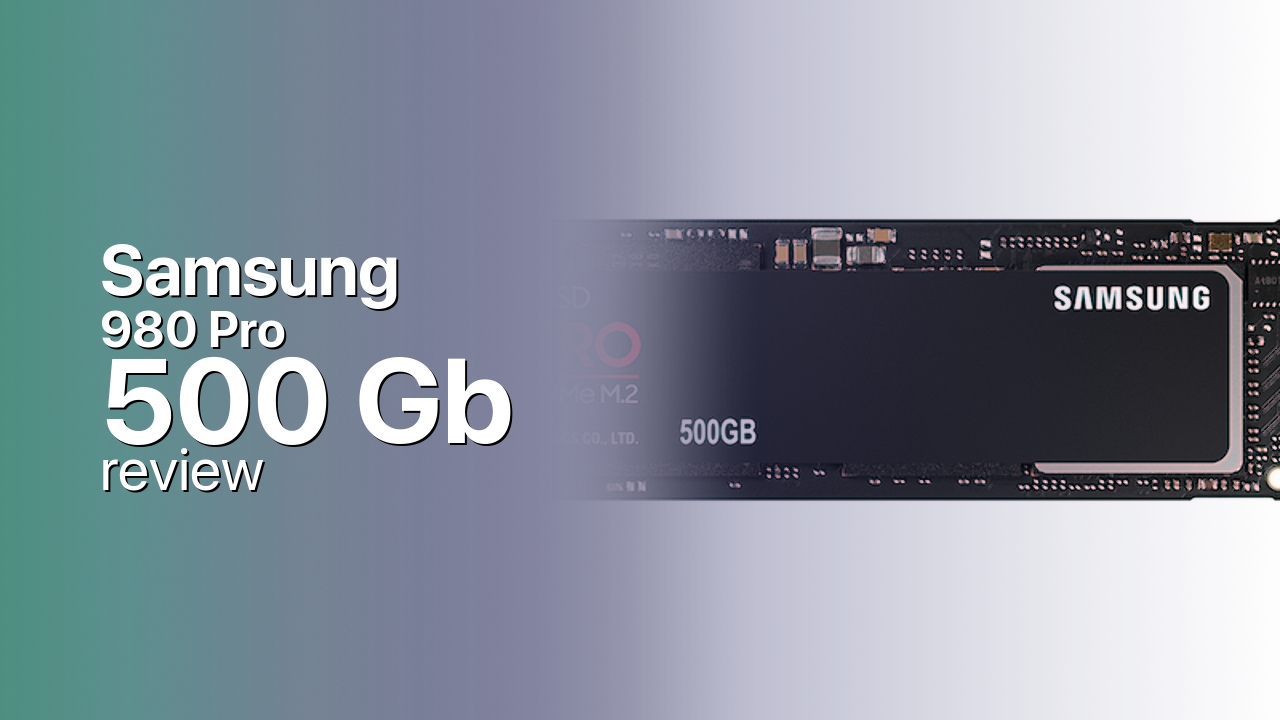
The 980 Pro 500GB is built around Samsung's custom Elpis controller (S4LV003), paired with 512MB of LPDDR4 DRAM and two packages of 6th-gen 3D TLC V-NAND. The drive is single-sided, which means all components sit on one side of the M.2 2280 PCB — a practical advantage for laptops and tight builds where clearance behind the slot is limited.
Samsung rates the 500GB model at up to 6,900 MB/s sequential reads and 5,000 MB/s sequential writes, with random IOPS reaching 800K reads and 1M writes at QD32. The SLC TurboWrite cache on this capacity is sized at roughly 4GB static plus up to ~90GB dynamic, so burst writes stay fast for typical consumer workloads. Once the cache fills, direct-to-TLC write speed drops to about 1,000 MB/s — still well above SATA, but worth knowing if you regularly move very large files.
The 980 Pro line is also available in 250GB, 1TB, and 2TB capacities. The 250GB variant is notably slower (6,400/2,700 MB/s), while the 1TB and 2TB models match or slightly exceed the 500GB's write speed. If you need more than 500GB, the 1TB model offers the best balance of performance and capacity.
For competition, the WD Black SN750 (PCIe 3.0) and Crucial P5 are the closest price-tier rivals, but neither matches the 980 Pro's sequential throughput. The Seagate FireCuda 510 and Corsair MP600 are the more direct PCIe 4.0 competitors. The 980 Pro also meets Sony's PS5 expansion slot requirements: PCIe 4.0 NVMe, sequential reads above 5,500 MB/s, and M.2 2280 form factor.
Storage Comparisons:
980 Pro Performance & Benchmarks
Samsung rates the 980 Pro 500GB at up to 6,900 MB/s sequential reads and 5,000 MB/s sequential writes. In practice, CDM sequential reads land around 6,800–6,900 MB/s and writes around 4,900–5,000 MB/s on a Ryzen X570 testbed. Random 4K performance at QD32 hits roughly 800K IOPS reads and 1M IOPS writes.
Samsung 980 Pro 500 GB vs M.2 4.0 x 4 peers
Switch between sequential throughput and random IOPS to see how this drive stacks up against other M.2 4.0 x 4 SSDs in our database. The highlighted bar is the drive on this page — click any other bar to open that drive.
- Patriot Viper PV593 1 TB: 14,500 MB/s read, 14,000 MB/s write
- Patriot Viper PV593 2 TB: 14,500 MB/s read, 14,000 MB/s write
- Patriot Viper PV593 4 TB: 14,500 MB/s read, 14,000 MB/s write
- Patriot Viper PV573 2 TB: 14,000 MB/s read, 12,000 MB/s write
- Samsung 980 Pro 500 GB (this drive): 6,900 MB/s read, 5,000 MB/s write
The drive uses Samsung's TurboWrite SLC caching: a 4GB static cache plus a dynamic pseudo-SLC pool that can grow to ~90GB depending on free space. During sustained writes that exceed the cache, throughput drops to about 1,000 MB/s (direct-to-TLC speed). For typical consumer use — game loads, OS boot, application launches — the cache rarely exhausts, and the drive feels consistently fast.
Independent reviews at Tom's Hardware, AnandTech, and StorageReview all confirm the 980 Pro trades blows with the Corsair MP600 and Seagate FireCuda 510 for the PCIe 4.0 performance crown. In real-world game load tests, the 980 Pro is within a second or two of any Gen4 drive — the difference is measurable in benchmarks but invisible in practice.
Samsung 980 Pro vs Competitors
See how the 980 Pro stacks up against other M.2 4.0 x 4 drives in our database:
Compare with rival drives:
Endurance, TBW & Warranty
Samsung backs the 980 Pro 500GB with a 5-year limited warranty capped at 300 TBW (terabytes written). At a typical consumer write rate of 20–30 GB/day, that's over 27 years of endurance — far more than anyone will actually use. The drive is rated for 1.5 million hours MTBF, which is a population-level reliability figure, not a per-unit guarantee.
The 300 TBW rating is lower than the 1TB model's 600 TBW (TBW scales with capacity), but still well above what any typical user will write in the drive's lifetime. Samsung's warranty is direct-to-manufacturer via their support portal.
Samsung 980 Pro 500 GB Specifications
| Category | Value |
|---|---|
| Capacity [?] | 500 GB |
| Interface [?] | M.2 4.0 x 4 |
| Controller [?] | Samsung Elpis |
| Memory type [?] | Samsung 3D TLC |
| DRAM [?] | 512MB LPDDR4 |
| Read speed (MB/s) [?] | 6900 |
| Write speed (MB/s) [?] | 5000 |
| Read IOPS [?] | 800000 |
| Write IOPS [?] | 1000000 |
| Endurance (TBW) [?] | 300 |
| MTBF (million hours) [?] | 1.5 |
| Warranty (years) [?] | 5 |
Verdict: Is the 980 Pro Worth It in 2026?
The Samsung 980 Pro 500GB is the right pick for builders who want proven PCIe 4.0 performance in a single-sided package that fits laptops, ITX boards, and the PS5. It's less compelling if you need more than 500GB — step up to the 1TB model for higher endurance and the same speed. If PCIe 4.0 isn't a requirement, the WD Black SN750 offers similar real-world performance at a lower price. For pure sequential throughput on Gen4, the 980 Pro remains one of the fastest and most consistent drives available.
+ Pros
- 6,900 MB/s sequential reads on PCIe 4.0
- Single-sided PCB fits laptops and PS5
- 5-year warranty, 300 TBW endurance
- Samsung Elpis controller with 512MB LPDDR4
- AES 256-bit hardware encryption
- Cons
- 300 TBW is lower than 1TB and 2TB siblings
- Direct-to-TLC write speed drops to ~1,000 MB/s
- No included heatsink on standard model
- 500GB capacity may be tight for game libraries
Buy this or similar SSD Storage:



Video Review
Samsung 980 PRO Review - Samsung's First PCIe Gen4 SSD