Samsung 990 Pro 4TB — PCIe 4.0 NVMe SSD Review (2026)
Quick answer
The 4 TB Samsung 990 Pro is the highest-capacity consumer PCIe 4.0 drive from a tier-one manufacturer, and it earns that position by delivering peak Gen4 throughput, class-competitive endurance, and Samsung's mature software ecosystem.
Read: 7450 MB/s Write: 6900 MB/s Endurance: 2400 TBW Warranty: 5 years Interface: M.2 4.0 x 4
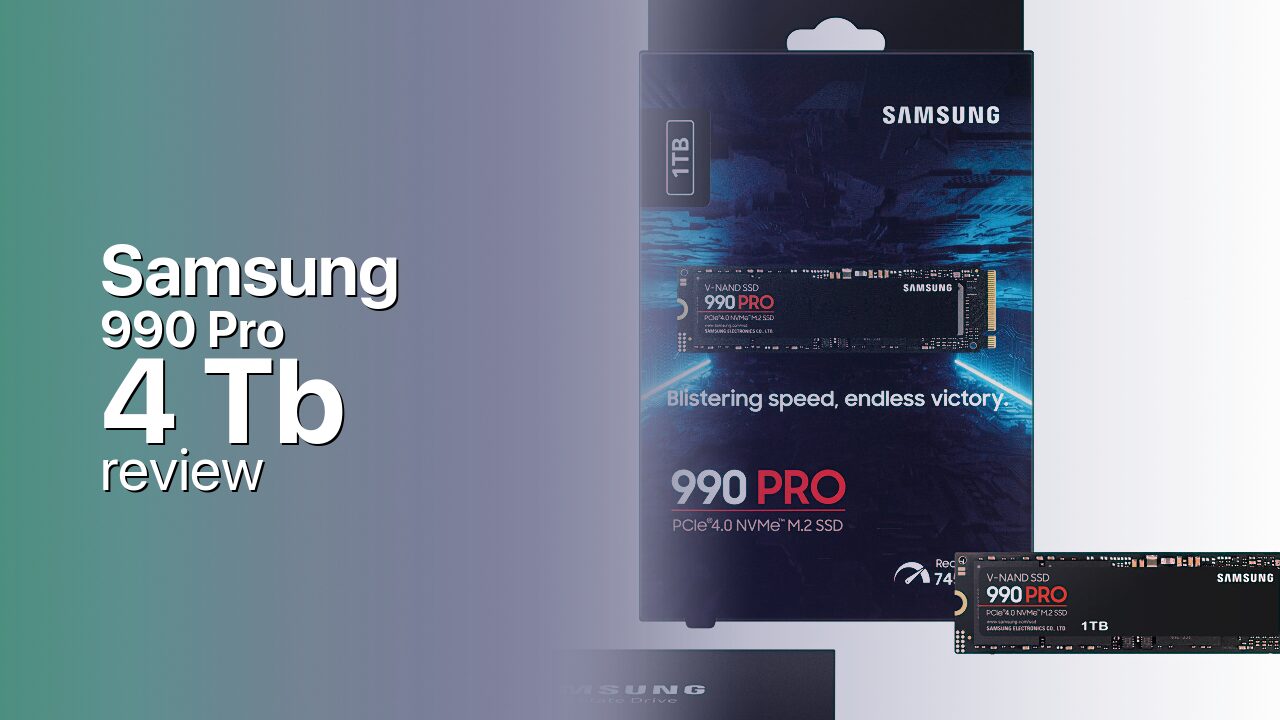
The Samsung 990 Pro 4 TB takes the company's Pascal controller and V-NAND TLC to the highest consumer capacity in the lineup, delivering 7,450 MB/s reads with endurance to match its footprint.
Controller & Memory
Samsung's 990 Pro builds on the 980 Pro's foundation with a new in-house controller — codenamed Pascal — manufactured on an 8 nm process. The eight-channel PCIe 4.0 x4 design draws less power than the 980 Pro's Elpis while delivering higher peak throughput, and the 4 TB variant pairs the controller with Samsung's seventh-generation V-NAND TLC and 4 GB of LPDDR4 DRAM. Samsung also claims a nickel-coated heat spreader on the controller and a copper film on the NAND packages, a subtle thermal design choice that helps the drive sustain peak performance longer without a bulky heatsink. The PCB is single-sided, keeping it compatible with thin laptops and the PS5 expansion bay.
The 4 TB capacity is the ceiling of the 990 Pro consumer stack, sitting above the 1 TB and 2 TB variants. Capacity scaling is relatively flat on this platform: all three capacities share the same 7,450 MB/s sequential read and 6,900 MB/s sequential write ratings, and the 4 TB model carries the highest random IOPS at 1,600,000 read and 1,550,000 write. Endurance scales linearly from 600 TBW on the 1 TB to 2,400 TBW on the 4 TB, maintaining the 600-TBW-per-terabyte ratio Samsung established with the 980 Pro. The 4 TB also includes a heatsink variant (990 Pro with Heatsink) for buyers who want a factory-installed thermal solution.
In the premium PCIe 4.0 segment, the 990 Pro 4 TB faces the WD Black SN850X 4 TB, the SK Hynix Platinum P41 2 TB, and the Solidigm P44 Pro 2 TB — though none of the last two reaches the 4 TB mark at retail. Samsung's key differentiator is software: the Samsung Magician utility provides firmware updates, drive health monitoring, over-provisioning tools, and an optional performance-optimisation mode for content creation workloads. The 990 Pro is also one of the few drives validated for 8K video editing workflows by major NLE vendors, a niche that the 4 TB capacity serves particularly well.
Storage Comparisons:
990 Pro Performance & Benchmarks
Samsung rates the 4 TB 990 Pro at 7,450 MB/s sequential reads and 6,900 MB/s sequential writes, both effectively saturating the PCIe 4.0 x4 interface. Random performance peaks at 1,600,000 IOPS read and 1,550,000 IOPS write at queue depth 32, placing the 4 TB variant at the top of the 990 Pro stack — the 1 TB and 2 TB models are rated slightly lower at 1,400K/1,550K and 1,400K/1,550K IOPS respectively.
Samsung 990 Pro 4 TB vs M.2 4.0 x 4 peers
Switch between sequential throughput and random IOPS to see how this drive stacks up against other M.2 4.0 x 4 SSDs in our database. The highlighted bar is the drive on this page — click any other bar to open that drive.
- Patriot Viper PV593 1 TB: 14,500 MB/s read, 14,000 MB/s write
- Patriot Viper PV593 2 TB: 14,500 MB/s read, 14,000 MB/s write
- Patriot Viper PV593 4 TB: 14,500 MB/s read, 14,000 MB/s write
- Patriot Viper PV573 2 TB: 14,000 MB/s read, 12,000 MB/s write
- Samsung 990 Pro 4 TB (this drive): 7,450 MB/s read, 6,900 MB/s write
Independent reviewers consistently find the 990 Pro 4 TB delivers real-world sequential throughput within 1–2% of rated figures, and the Pascal controller's improved efficiency means the drive throttles later and recovers faster than the 980 Pro under sustained write loads. Samsung's Intelligent TurboWrite 2.0 provisions a large pseudo-SLC buffer that scales with free capacity: on a near-empty 4 TB drive, the cache can absorb hundreds of gigabytes before transitioning to native TLC write speeds around 1,800–2,000 MB/s. For the content creators and data hoarders who buy a 4 TB drive, this is a meaningful advantage — the buffer is rarely exhausted in workflows that involve intermittent large file transfers rather than sustained dump-and-run operations. Against the SN850X, the 990 Pro generally leads on random I/O consistency while trading blows on peak sequential writes depending on the benchmark and test conditions.
Samsung 990 Pro vs Competitors
See how the 990 Pro stacks up against other M.2 4.0 x 4 drives in our database:
Compare with rival drives:
Endurance, TBW & Warranty
Samsung covers the 990 Pro 4 TB with a five-year limited warranty, bounded by a 2,400 TBW endurance rating. At 20 GB/day, that endurance budget spans 328 years — far beyond any realistic service life. The TBW-to-capacity ratio of 600 TBW per terabyte matches the 980 Pro generation and remains competitive with the WD Black SN850X at the same ratio. Samsung's warranty claims are handled directly through the company's RMA portal in most regions, and the brand's retail ubiquity means replacements are typically processed faster than boutique SSD vendors can manage. The 990 Pro also carries a 1.5-million-hour MTBF rating, standard for flagship consumer NVMe drives and consistent with Samsung's in-house controller validation. Users should note that the TBW limit is tracked via the drive's SMART data, and exceeding it voids warranty coverage even within the five-year window.
Samsung 990 Pro 4 TB Specifications
| Category | Value |
|---|---|
| Capacity [?] | 4 TB |
| Interface [?] | M.2 4.0 x 4 |
| Controller [?] | Samsung Pascal |
| Memory type [?] | Samsung 3D TLC |
| DRAM [?] | LPDDR4 |
| Read speed (MB/s) [?] | 7450 |
| Write speed (MB/s) [?] | 6900 |
| Read IOPS [?] | 1600000 |
| Write IOPS [?] | 1550000 |
| Endurance (TBW) [?] | 2400 |
| MTBF (million hours) [?] | 1500000 |
| Warranty (years) [?] | 5 |
Verdict: Is the 990 Pro Worth It in 2026?
The 4 TB Samsung 990 Pro is the highest-capacity consumer PCIe 4.0 drive from a tier-one manufacturer, and it earns that position by delivering peak Gen4 throughput, class-competitive endurance, and Samsung's mature software ecosystem. It is the right pick for content creators who need a single fast volume for active projects, gamers with multi-terabyte libraries, and professionals whose workflow demands 4 TB of NVMe without the cost and complexity of U.2 or add-in-card enterprise drives. Buyers who can live with 2 TB should compare against the Solidigm P44 Pro and SK Hynix P41 — both offer comparable performance at lower absolute cost, though neither reaches the 4 TB capacity point. For anyone who simply needs the most storage possible on a single consumer M.2 stick without stepping down to QLC, the 990 Pro 4 TB is currently in a class of one.
+ Pros
- 7,450 MB/s sequential reads — effectively saturating PCIe 4.0 x4
- 4 TB capacity on a single-sided M.2 2280 — no QLC compromise
- Samsung Pascal 8 nm controller with improved power efficiency
- 2,400 TBW endurance — 600 TBW per terabyte, class-competitive
- Samsung Magician software suite with firmware updates and drive tools
- Available with factory heatsink option for PS5 and desktop builds
- Validated for 8K video editing workflows by major NLE vendors
- Cons
- Write IOPS trail some PCIe 5.0 drives in synthetic benchmarks
- No 8 TB consumer variant — enterprise PM9A3 required for higher capacities
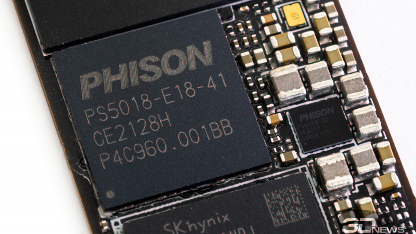
- Price premium over Phison E18-based 4 TB alternatives
- Samsung Magician Windows-only for full feature set
Buy this or similar SSD Storage:



Video Review
Samsung 990 PRO NVMe SSD Review - Versus 22 Other Drives