Asura Genesis Xtreme 1TB Review — Phison E12 RGB NVMe with 1655 TBW (2026)
Quick answer
The Asura Genesis Xtreme 1TB is a strong PCIe 3.0 NVMe SSD that delivers near-saturating interface speeds with the well-proven Phison E12 controller.
Read: 3400 MB/s Write: 3000 MB/s Endurance: 1655 TBW Warranty: 7 years Interface: PCIe 3.0 x 4
The Asura Genesis Xtreme 1TB is a PCIe 3.0 NVMe SSD with RGB lighting and a Phison E12 controller delivering near-saturating speeds with 1655 TBW endurance.
Controller & Memory
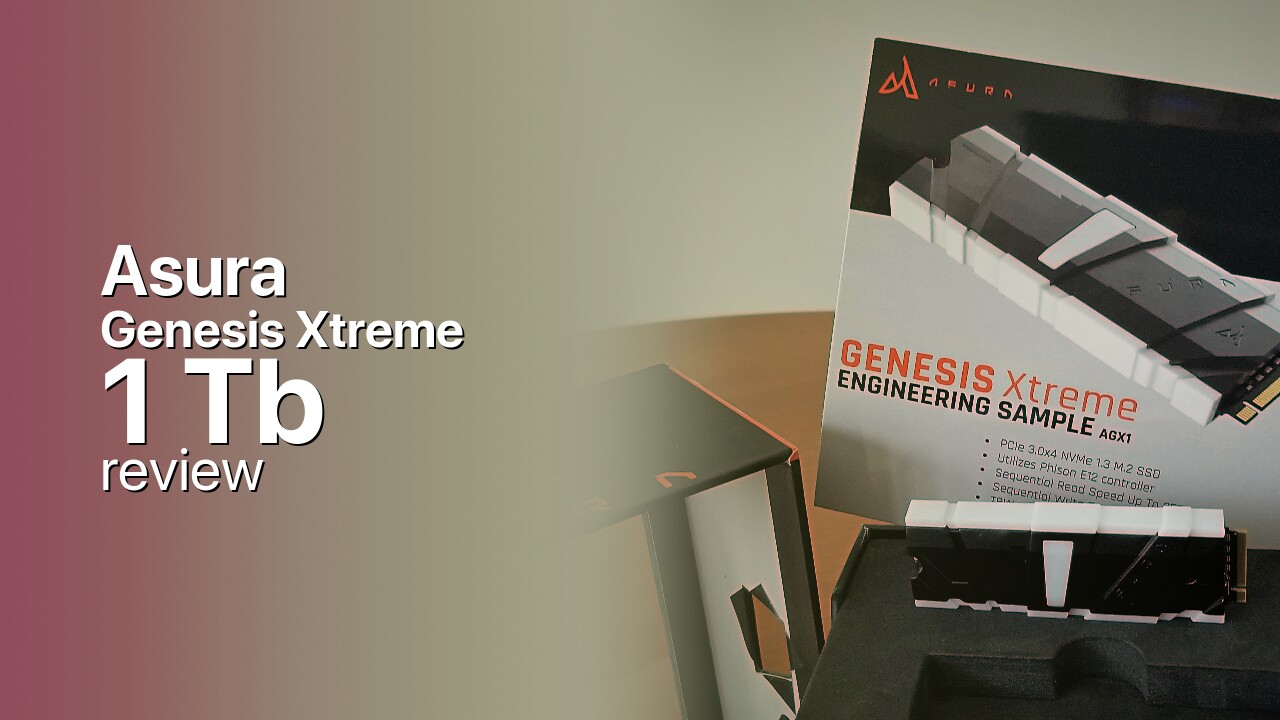
The 1 TB Genesis Xtreme pairs Phison's PS5012-E12 controller — an eight-channel PCIe 3.0 x4 design — with Toshiba 64-layer 3D BiCS3 TLC NAND and 1 GB of SK Hynix DDR4 DRAM on an M.2 2280 PCB. The Phison E12 was one of the most popular high-end PCIe 3.0 controllers, and Asura's implementation uses a premium component set. The standout feature is the modular dual heatsink with RGB LED diffuser, designed for builders who want visible storage.
Asura rates the Genesis Xtreme at 3,400 MB/s sequential reads and 3,000 MB/s sequential writes — figures that essentially saturate the PCIe 3.0 x4 interface. The 1 TB capacity benefits from having multiple NAND packages for parallelism, helping the drive reach its rated figures. Random 4K performance is rated at 340,000 read IOPS. The drive is rated at 1,655 TBW — an exceptionally high endurance figure for a 1 TB TLC SSD.
The Genesis Xtreme occupies a unique niche. Asura differentiates itself with the RGB heatsink design and included accessories — the drive ships with USB adapters (Type-C, microUSB, and Apple Lightning), effectively turning the SSD into a portable external drive when removed from the M.2 slot. The RGB heatsink is Gigabyte Fusion ready.
The Phison E12 is known to run warm under sustained loads, and the dual heatsink design provides effective thermal management. The heatsink assembly adds significant height, which could cause clearance issues with large CPU coolers or low-profile ITX builds.
Direct competitors include the Corsair MP510 960GB (Phison E12, no RGB), the Seagate FireCuda 510 1TB (Phison E12, similar tier), and the ADATA XPG Gammix S11 Pro 1TB (Phison E12, with heatsink option).
Storage Comparisons:
Genesis Xtreme Performance & Benchmarks
The Asura Genesis Xtreme 1TB is rated at 3,400 MB/s sequential reads and 3,000 MB/s sequential writes — figures that essentially saturate the PCIe 3.0 x4 interface. The Phison E12 controller is a mature, eight-channel design that consistently delivers near-theoretical-maximum throughput on PCIe 3.0. The 1 TB capacity, with its multiple NAND chips for parallelism, is well-positioned to reach these rated figures.
Asura Genesis Xtreme 1 TB vs PCIe 3.0 x 4 peers
Switch between sequential throughput and random IOPS to see how this drive stacks up against other PCIe 3.0 x 4 SSDs in our database. The highlighted bar is the drive on this page — click any other bar to open that drive.
- Asura Genesis Xtreme 1 TB (this drive): 3,400 MB/s read, 3,000 MB/s write
- Asura Genesis Xtreme 256 GB: 3,400 MB/s read, 3,000 MB/s write
- Asura Genesis Xtreme 512 GB: 3,400 MB/s read, 3,000 MB/s write
- Asura Genesis Xtreme 2 TB: 3,400 MB/s read, 3,000 MB/s write
- Drevo D1 Xtreme 256 GB: 3,100 MB/s read, 1,600 MB/s write
The drive uses a dynamic SLC cache for write acceleration. The Phison E12's SLC cache management is well-optimized. Once the cache exhausts during sustained writes, throughput drops to direct-to-TLC speeds — typically in the 400-600 MB/s range for Toshiba 64-layer TLC on the E12. For everyday use, the SLC cache is more than sufficient.
Random 4K performance is rated at 340,000 IOPS reads. The 1 GB of SK Hynix DDR4 DRAM helps maintain consistent random I/O under mixed workloads. The Phison E12 is well-regarded for its random write performance. In real-world testing by The SSD Review on an engineering sample, the 1 TB variant delivered strong performance across synthetic and application benchmarks.
The modular dual heatsink provides effective thermal management for the Phison E12, which is known to run warm under sustained loads. The RGB LED diffuser adds visual appeal. For most usage scenarios, the thermal overhead from RGB is negligible.
Asura Genesis Xtreme vs Competitors
See how the Genesis Xtreme stacks up against other PCIe 3.0 x 4 drives in our database:
Compare with rival drives:
Endurance, TBW & Warranty
Asura covers the Genesis Xtreme 1TB with a five-year limited warranty, whichever comes first based on TBW (terabytes written) or warranty period. The drive is rated at 1,655 TBW — an exceptionally high endurance figure for a 1 TB TLC SSD. At a sustained workload of 40 GB per day, a 1,655 TBW drive would take roughly 113 years to exhaust, well beyond the five-year warranty period. The drive does not carry a published MTBF rating.
Asura Genesis Xtreme 1 TB Specifications
| Category | Value |
|---|---|
| Capacity [?] | 1 TB |
| Interface [?] | PCIe 3.0 x 4 |
| Controller [?] | Phison PS5012-E12 |
| Memory type [?] | Toshiba TLC |
| DRAM [?] | 1GB DDR4 |
| Read speed (MB/s) [?] | 3400 |
| Write speed (MB/s) [?] | 3000 |
| Read IOPS [?] | 645000 |
| Write IOPS [?] | 645000 |
| Endurance (TBW) [?] | 1655 |
| MTBF (million hours) [?] | 1.8 |
| Warranty (years) [?] | 7 |
Verdict: Is the Genesis Xtreme Worth It in 2026?
The Asura Genesis Xtreme 1TB is a strong PCIe 3.0 NVMe SSD that delivers near-saturating interface speeds with the well-proven Phison E12 controller. Its 1,655 TBW endurance rating is exceptional for a 1 TB TLC drive. The RGB heatsink adds visual appeal and thermal management. The Corsair MP510 960GB offers similar Phison E12 performance without the RGB, and the Seagate FireCuda 510 1TB is a strong alternative. The Genesis Xtreme is best suited for RGB-focused builds where users want top-tier PCIe 3.0 performance.
+ Pros
- 3,400/3,000 MB/s near-saturates PCIe 3.0 x4
- 1,655 TBW exceptional endurance for 1TB TLC
- 1 GB SK Hynix DDR4 DRAM cache
- RGB heatsink with effective thermal management
- Includes USB adapters for external use
- Cons
- RGB heatsink adds significant height
- Heatsink assembly difficult to disassemble
- Asura is a lesser-known brand
- Phison E12 runs warm under sustained loads
- No SSD toolbox software from Asura
Buy this or similar SSD Storage:



Video Review
Asura Genesis Xtreme