Micron 2450 1TB — Top-Range PCIe 4.0 NVMe for Mobile Platforms (2026)
Quick answer
The Micron 2450 1TB is the capacity at which this drive becomes genuinely compelling.
Read: 3500 MB/s Write: 3000 MB/s Endurance: 600 TBW Warranty: 3 years Interface: M.2 4.0 x 4
The Micron 2450 1TB is the flagship of Micron's OEM-focused PCIe 4.0 SSD line, offering the same ultra-low power draw as its smaller siblings but with double the endurance — making it the only 2450 capacity suited for write-heavy mobile workloads.
Controller & Memory
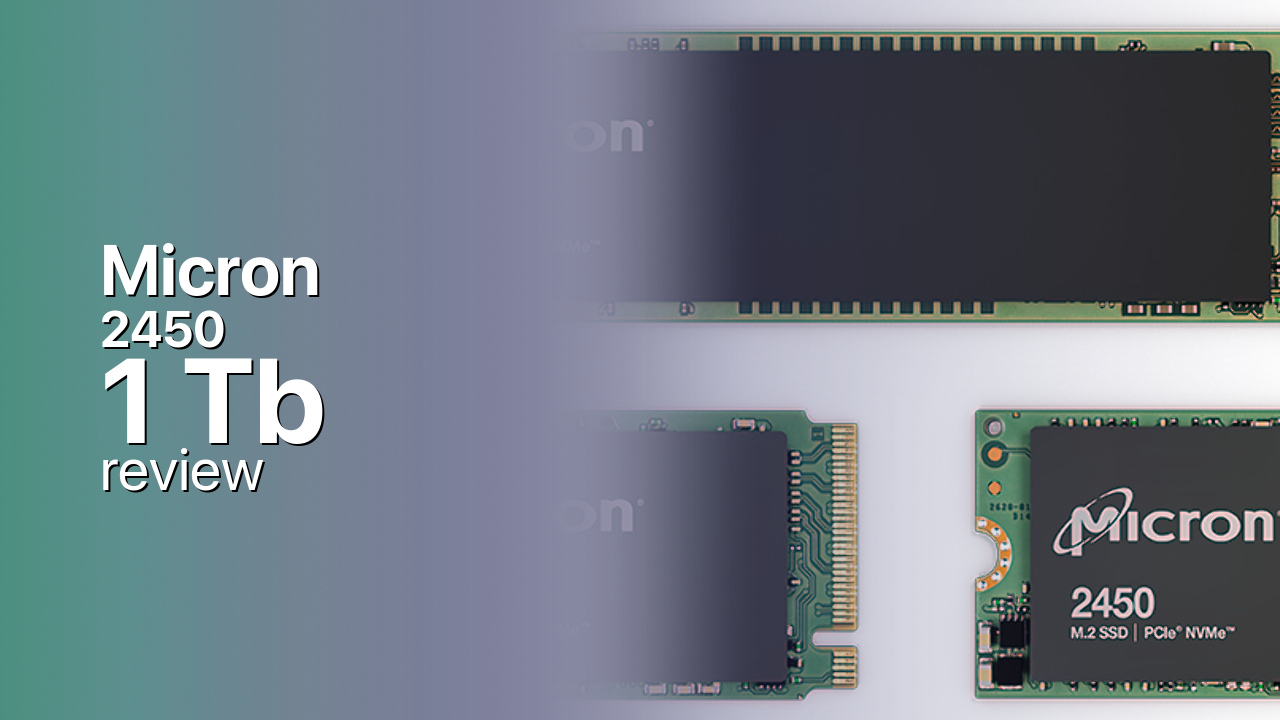
The Micron 2450 1TB combines a Phison PS5019-E19 controller with Micron's 176-layer 3D TLC NAND in a DRAM-less, HMB-assisted design. At 1TB, this drive matches the 512GB model's sequential speeds — 3,500 MB/s reads and 3,000 MB/s writes — but doubles the endurance to 600 TBW, which is the single most important reason to choose the 1TB variant over the cheaper capacities.
The 2450 series ships in M.2 2230, 2242, and 2280 form factors. The 2230 option is particularly valuable: it fits the Steam Deck, Microsoft Surface Pro, and other compact devices where a standard 2280 drive won't physically fit. Finding a 1TB drive in the 2230 form factor is uncommon — most manufacturers only offer smaller capacities at that size — which makes the 2450 1TB genuinely unique in the market.
Power efficiency is this drive's defining characteristic. It draws under 3 mW in sleep mode and under 400 mW in active idle, earning it a place on Intel's Modern Standby Partner Portal. For laptop users, this means measurably better battery life compared to desktop-class NVMe drives that idle at 3–5 watts.
At 1TB capacity, the drive is large enough for a full Windows installation, productivity software, and a reasonable game library — a combination the 256GB and 512GB models struggle with. The 600 TBW endurance rating means you could write roughly 548 GB per day over the 3-year warranty period, far beyond any typical laptop workload.
Competing in the budget mobile segment, the 2450 1TB faces the WD Blue SN580 1TB (faster, 5-year warranty), the Samsung 980 1TB (similar DRAM-less design, 5-year warranty), and the Kioxia Exceria G2 1TB.
Storage Comparisons:
2450 Performance & Benchmarks
The Micron 2450 1TB is rated at up to 3,500 MB/s sequential reads and 3,000 MB/s sequential writes, with up to 450,000 IOPS random reads and 500,000 IOPS random writes. The sequential speeds are identical to the 512GB model — both saturate the same fraction of the PCIe 4.0 x4 interface — but the 1TB model achieves higher random read IOPS (450K vs 380K) thanks to having twice as many NAND dies available for parallel operations.
Micron 2450 1 TB vs M.2 4.0 x 4 peers
Switch between sequential throughput and random IOPS to see how this drive stacks up against other M.2 4.0 x 4 SSDs in our database. The highlighted bar is the drive on this page — click any other bar to open that drive.
- Patriot Viper PV593 1 TB: 14,500 MB/s read, 14,000 MB/s write
- Patriot Viper PV593 2 TB: 14,500 MB/s read, 14,000 MB/s write
- Patriot Viper PV593 4 TB: 14,500 MB/s read, 14,000 MB/s write
- Patriot Viper PV573 2 TB: 14,000 MB/s read, 12,000 MB/s write
- Micron 2450 1 TB (this drive): 3,500 MB/s read, 3,000 MB/s write
At 3,500 MB/s reads, the 2450 1TB is fast enough for any everyday workload. Boot times, application launches, and file transfers feel snappy. The 3,000 MB/s write speed handles large file copies without bottlenecking — a 50 GB file transfers in roughly 17 seconds during burst mode before the SLC cache begins to exhaust.
Being a DRAM-less drive with HMB, the 2450's sustained write performance depends heavily on SLC cache size. Phison E19-based DRAM-less drives typically allocate 20–40 percent of free capacity as dynamic SLC cache. On a 1TB drive, that means roughly 200–400 GB of pseudo-SLC buffer — generous enough that most users will never fill it. Once exhausted, direct-TLC write speeds fall to the 600–1,000 MB/s range, which is still serviceable for most tasks.
Random 4K read performance at 450K IOPS is strong for a DRAM-less design. The HMB-assisted architecture keeps the flash translation table in system RAM, minimizing the latency penalty that DRAM-less drives normally pay. The 500K random write IOPS figure reflects cached performance; sustained random writes will drop as the SLC cache depletes.
Thermally, the 2450 1TB is a non-concern. Its low power envelope produces minimal heat, and passive cooling in any laptop chassis keeps it well within safe operating limits.
Micron 2450 vs Competitors
See how the 2450 stacks up against other M.2 4.0 x 4 drives in our database:
Compare with rival drives:
Endurance, TBW & Warranty
Micron covers the 2450 1TB with a 3-year limited warranty and a 600 TBW endurance rating — double the 512GB model's 300 TBW and more than triple the 256GB model's 180 TBW. At 600 TBW, you could write roughly 548 GB per day across the three-year warranty window before hitting the rated limit. At a typical laptop workload of 20–50 GB per day, the 1TB model would take 33 to 82 years to reach 600 TBW — meaning endurance will not be the factor that limits this drive's lifespan. The 3-year warranty remains shorter than the 5-year coverage offered by Western Digital, Samsung, and Kioxia on their 1TB drives, which is the 2450's most significant warranty disadvantage. As an OEM-focused product, the 2450's warranty claims typically route through the laptop manufacturer rather than Micron directly. Micron rates the drive at 2 million hours MTTF, a population-based reliability statistic indicating expected failure rates across a large batch of drives — not a guaranteed individual lifespan.
Micron 2450 1 TB Specifications
| Category | Value |
|---|---|
| Capacity [?] | 1 TB |
| Interface [?] | M.2 4.0 x 4 |
| Controller [?] | Phison PS5019-E19 |
| Memory type [?] | Micron 3D TLC |
| DRAM [?] | HMB |
| Read speed (MB/s) [?] | 3500 |
| Write speed (MB/s) [?] | 3000 |
| Read IOPS [?] | 450000 |
| Write IOPS [?] | 500000 |
| Endurance (TBW) [?] | 600 |
| MTBF (million hours) [?] | 2000000 |
| Warranty (years) [?] | 3 |
Verdict: Is the 2450 Worth It in 2026?
The Micron 2450 1TB is the capacity at which this drive becomes genuinely compelling. The 600 TBW endurance and 1TB storage space make it the only 2450 variant that can handle sustained write workloads and large game libraries without constant capacity management. Its multi-form-factor support — especially the rare 1TB-in-2230 option — makes it uniquely suited for Steam Deck upgrades, Surface Pro expansions, and compact laptop builds. The 3-year warranty remains a competitive weakness against the 5-year coverage from WD Blue SN580 and Samsung 980. If your device accepts M.2 2280 and you don't need the ultra-low power draw, those competitors offer better value. But for compact-form-factor builds where no other 1TB PCIe 4.0 option fits, the 2450 1TB is essentially in a category of its own.
+ Pros
- 600 TBW endurance — highest in the 2450 lineup
- Available in M.2 2230, 2242, and 2280 form factors
- Sub-3 mW sleep draw extends laptop battery life
- 1TB capacity fits OS, apps, and game library
- 176-layer Micron 3D TLC NAND
- 450K random read IOPS — highest in 2450 range
- Cool operation under passive cooling
- Cons
- 3-year warranty vs 5 years from competitors
- DRAM-less design limits sustained random write performance
- OEM-focused — limited retail availability
- 3,000 MB/s writes lag behind 1TB competitors
Buy this or similar SSD Storage:
Video Review
Micron Portfolio of Client SSDs