Corsair MP600 Pro 2TB Review — Gen4 NVMe SSD (2026)
Quick answer
Content creators, gamers, and power users who want 2 TB of fast PCIe 4.0 storage with a bundled heatsink will find the Corsair MP600 Pro 2 TB a reliable choice — 1,400 TBW endurance and a five-year warranty provide long-term confidence.
Read: 7000 MB/s Write: 6550 MB/s Endurance: 1400 TBW Warranty: 5 years Interface: M.2 4.0 x 4
The Corsair MP600 Pro 2 TB is the capacity most reviewers actually tested — a Phison E18-powered PCIe 4.0 NVMe with Micron 96-layer TLC and double the endurance of the 1 TB variant.
Controller & Memory
The 2 TB MP600 Pro uses the same Phison PS5018-E18 eight-channel controller as the rest of the range, paired with eight Micron 96-layer 3D TLC NAND packages and a single SK Hynix 1 GB DDR4-2666 DRAM chip. Unlike the 1 TB model which is single-sided, the 2 TB is double-sided — NAND packages are split across both sides of the PCB. That makes it incompatible with some laptop M.2 slots that only accept single-sided drives, though desktop and PS5 installation are unaffected.
The 2 TB is the flagship of the standard MP600 Pro range (the Hydro X Edition also uses the 2 TB PCB but adds a custom water block). It is also available in a 1 TB capacity with lower writes (5,500 MB/s) and half the endurance (700 TBW). NVMe 1.4 over PCIe 4.0 x4, AES 256-bit hardware encryption, and an MTBF of 1.7 million hours round out the spec sheet.
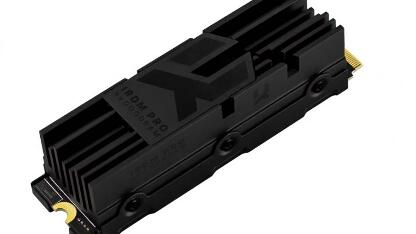
Direct competitors at 2 TB include the Samsung 980 Pro 2 TB, WD Black SN850 2 TB, and Sabrent Rocket 4 Plus 2 TB — all PCIe 4.0 drives with DRAM cache and comparable rated speeds. The MP600 Pro ships with an aluminum heatsink pre-installed and Corsair's SSD Toolbox software for health monitoring and firmware updates, though the Toolbox is less polished than Samsung Magician or the WD Dashboard.
Storage Comparisons:
MP600 Pro Performance & Benchmarks
The 2 TB model is rated for up to 7,000 MB/s sequential read and 6,550 MB/s sequential write — the numbers most often quoted in Corsair's marketing, since the 2 TB is the range's top performer. Random performance comes in at up to 660,000 read IOPS and 800,000 write IOPS, both meaningfully higher than the 1 TB model's 360K/780K figures. The write-IOPS advantage is due to the additional NAND channels that a fully populated eight-package layout enables.
Corsair MP600 Pro 2 TB vs M.2 4.0 x 4 peers
Switch between sequential throughput and random IOPS to see how this drive stacks up against other M.2 4.0 x 4 SSDs in our database. The highlighted bar is the drive on this page — click any other bar to open that drive.
- Patriot Viper PV593 1 TB: 14,500 MB/s read, 14,000 MB/s write
- Patriot Viper PV593 2 TB: 14,500 MB/s read, 14,000 MB/s write
- Patriot Viper PV593 4 TB: 14,500 MB/s read, 14,000 MB/s write
- Patriot Viper PV573 2 TB: 14,000 MB/s read, 12,000 MB/s write
- Corsair MP600 Pro 2 TB (this drive): 7,000 MB/s read, 6,550 MB/s write
Independent reviewers consistently report that the MP600 Pro 2 TB hits its rated sequential numbers in burst transfers, but the SLC cache is relatively small at roughly 115 GB before the drive writes directly to TLC at around 1,500-2,000 MB/s. Cache recovery is slower than on the Samsung 980 Pro — Tom's Hardware noted that after filling the cache, the drive can take several minutes of idle time before cache performance is restored. Thermal throttling triggers at 68 °C with a penalty of roughly 50 MB/s per degree above that threshold. The included aluminum heatsink keeps the drive well below this point in a typical desktop with modest airflow.
Corsair MP600 Pro vs Competitors
See how the MP600 Pro stacks up against other M.2 4.0 x 4 drives in our database:
Compare with rival drives:
Endurance, TBW & Warranty
Corsair covers the MP600 Pro 2 TB with a five-year limited warranty, capped at 1,400 TBW — whichever limit is reached first. At a typical consumer write workload of 35 GB per day (Corsair's own benchmark), the drive would take roughly 110 years to exhaust its TBW rating. Even at a heavy 100 GB/day workload, that is still 38 years of writes. The 1.7 million hour MTBF is a population-level reliability metric, not a guarantee for any individual unit. RMA is handled through Corsair's support portal directly, and the SSD Toolbox provides SMART data and firmware update capability. The five-year warranty length is standard for this tier of consumer NVMe, matching the Samsung 980 Pro and WD Black SN850.
Corsair MP600 Pro 2 TB Specifications
| Category | Value |
|---|---|
| Capacity [?] | 2 TB |
| Interface [?] | M.2 4.0 x 4 |
| Controller [?] | Phison PS5018-E18-41 |
| Memory type [?] | Micron 3D TLC |
| DRAM [?] | SKHynix 1GB DDR4-2666 |
| Read speed (MB/s) [?] | 7000 |
| Write speed (MB/s) [?] | 6550 |
| Read IOPS [?] | 660000 |
| Write IOPS [?] | 800000 |
| Endurance (TBW) [?] | 1400 |
| MTBF (million hours) [?] | 1.7 |
| Warranty (years) [?] | 5 |
Verdict: Is the MP600 Pro Worth It in 2026?
Content creators, gamers, and power users who want 2 TB of fast PCIe 4.0 storage with a bundled heatsink will find the Corsair MP600 Pro 2 TB a reliable choice — 1,400 TBW endurance and a five-year warranty provide long-term confidence. Those who prioritise peak random-read IOPS for database or heavy multitasking workloads will get slightly more from the Samsung 980 Pro 2 TB, which also recovers its SLC cache faster after sustained writes. For the majority of desktop builds where the difference between top Gen4 drives is within the margin of measurement noise, the MP600 Pro's included heatsink and its availability in a water-cooled Hydro X variant give it a practical edge that benchmarks do not capture.
+ Pros
- 7,000/6,550 MB/s sequential read/write
- 800K random write IOPS with full eight-channel NAND
- 1,400 TBW endurance at 2 TB
- Bundled aluminum heatsink included
- AES 256-bit hardware encryption
- 5-year warranty with direct Corsair RMA
- Cons
- Double-sided PCB may not fit some laptops
- SLC cache (~115 GB) is smaller than some rivals
- Slow SLC cache recovery after filling
- Thermal throttle limit at 68 °C is aggressive
- SSD Toolbox software feels dated
Buy this or similar SSD Storage:



Video Review
Worth the Premium Price? - Corsair MP600 PRO Review