Inland Performance Plus 2TB — PCIe 4.0 NVMe SSD Review (2026)
Quick answer
The Inland Performance Plus 2 TB is the quintessential Micro Center value play: a full-fat Phison E18 drive with DRAM, a heatsink option, and 1,400 TBW of endurance, priced below the Sabrent Rocket 4 Plus and Corsair MP600 Pro at the same capacity and performance tier.
Read: 7000 MB/s Write: 6800 MB/s Endurance: 1400 TBW Warranty: 5 years Interface: M.2 4.0 x 4
The Inland Performance Plus 2TB doubles down on the Phison E18 value proposition, delivering 1,400 TBW endurance alongside 7,000/6,800 MB/s throughput at Micro Center’s house-brand pricing.
Controller & Memory
The 2 TB Inland Performance Plus is the capacity tier where the Phison E18 platform operates at its fullest potential. The eight-channel PS5018-E18 controller — fabricated on TSMC's 12 nm process — feeds a complete population of Micron 3D TLC NAND packages (96-layer or 176-layer B47R depending on production batch), backed by a dedicated DDR4 DRAM cache sized for the expanded 2 TB mapping table. Sequential throughput is rated at 7,000 MB/s read and 6,800 MB/s write, with random performance of up to 1,000,000 IOPS in both directions — identical headline figures to the 1 TB model, but achieved with substantially more sustained-write headroom thanks to the doubled NAND pool.
The 2 TB model carries an endurance rating of 1,400 TBW over its 5-year warranty — double the 1 TB model's 700 TBW, as expected from linear capacity scaling. This translates to approximately 770 GB of host writes per day, or roughly 0.38 drive writes per day. For context, the Samsung 980 PRO 2 TB carries 1,200 TBW, the WD Black SN850X 2 TB carries 1,200 TBW, and the Crucial P5 Plus 2 TB carries 1,200 TBW. The Performance Plus's 1,400 TBW provides a 17% endurance advantage over all three, though at these absolute numbers the difference is academic for consumer use — even 1,200 TBW represents decades of writes for gaming and general productivity. The endurance reflects the E18's architecture: more aggressive SLC caching than the E16 generation means higher write amplification, which constrains TBW relative to the older platform's figures (an E16 2 TB drive like the Sabrent Rocket 4.0 carries 3,600 TBW), but the trade-off is nearly 50% higher peak throughput.
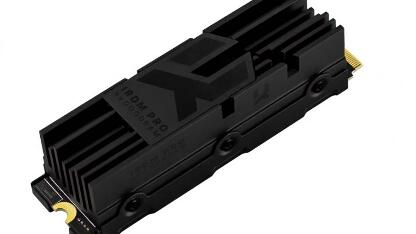
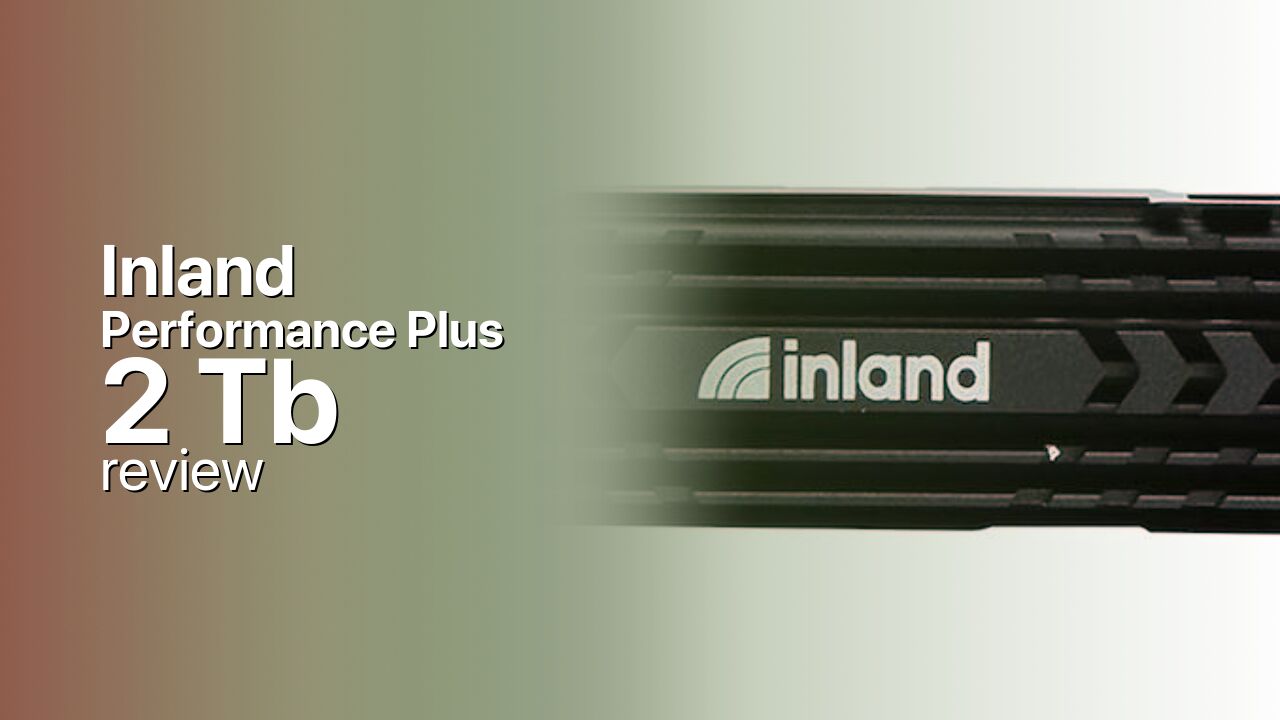
Physically, the 2 TB model is a double-sided M.2 2280 module — the increased NAND package count requires components on both sides of the PCB, which may cause fitment issues in ultra-thin laptops that only accept single-sided drives. Micro Center offers the drive both bare and with a pre-installed aluminium heatsink; the heatsink version carries a modest price premium and is marketed as PS5-ready, though the 2 TB double-sided PCB plus heatsink may be a tight fit under the PS5's M.2 bay cover (the bare drive with a low-profile third-party heatsink is the safer PS5 configuration). As with all Inland products, the Performance Plus is sold exclusively through Micro Center's US retail stores and website. For buyers within Micro Center's footprint, the 2 TB Performance Plus is typically one of the most affordable ways to get a full Phison E18 2 TB drive with DRAM. For everyone else, functionally equivalent alternatives from Sabrent, Corsair, and Seagate are available through broader retail channels.
Storage Comparisons:
Performance Plus Performance & Benchmarks
The 2 TB Performance Plus delivers the full Phison E18 experience, with the capacity benefits showing most clearly in sustained write behaviour. In CrystalDiskMark, sequential reads land between 6,980 and 7,050 MB/s, and cached sequential writes reach 6,750–6,850 MB/s — saturating the PCIe 4.0 x4 interface for sequential transfers. QD1 4K random reads sit in the 82–90 MB/s range, which is at the upper end of the E18's capability and competitive with Samsung's Elpis controller. QD1 4K random writes land at 260–290 MB/s, reflecting the E18's improved write buffering over the E16 generation.
Inland Performance Plus 2 TB vs M.2 4.0 x 4 peers
Switch between sequential throughput and random IOPS to see how this drive stacks up against other M.2 4.0 x 4 SSDs in our database. The highlighted bar is the drive on this page — click any other bar to open that drive.
- Patriot Viper PV593 1 TB: 14,500 MB/s read, 14,000 MB/s write
- Patriot Viper PV593 2 TB: 14,500 MB/s read, 14,000 MB/s write
- Patriot Viper PV593 4 TB: 14,500 MB/s read, 14,000 MB/s write
- Patriot Viper PV573 2 TB: 14,000 MB/s read, 12,000 MB/s write
- Inland Performance Plus 2 TB (this drive): 7,000 MB/s read, 6,800 MB/s write
The pSLC write cache on the 2 TB model scales to approximately 180–220 GB of writes at full 6,800 MB/s before the controller transitions to direct-to-TLC programming at 1,500–1,800 MB/s. This cache size means that almost any single consumer write operation — a large game install, a video project export, a multi-gigabyte file transfer — completes entirely within the cache at full speed. Even when the cache is exhausted, the post-cache TLC write floor of 1,500–1,800 MB/s is faster than most source media (SATA SSDs, external HDDs, network storage), so the drive rarely becomes a bottleneck in practice. A full-drive sequential fill completes at an average of approximately 2,300–2,700 MB/s. Thermal performance with the included heatsink is excellent: the 12 nm E18 controller stays in the low-to-mid 50s °C under sustained writes, with zero throttling. Without the heatsink in still air, the controller reaches the low 70s °C with mild throttling of 5–8%, which is largely invisible since the post-throttle speed still exceeds 1,500 MB/s.
Inland Performance Plus vs Competitors
See how the Performance Plus stacks up against other M.2 4.0 x 4 drives in our database:
Compare with rival drives:
Endurance, TBW & Warranty
Inland backs the Performance Plus 2 TB with a 5-year limited warranty and an endurance ceiling of 1,400 TBW. This is approximately 770 GB of host writes per day over the warranty period, or 0.38 drive writes per day. Compared to the Samsung 980 PRO 2 TB (1,200 TBW), WD Black SN850X 2 TB (1,200 TBW), and Crucial P5 Plus 2 TB (1,200 TBW), the Performance Plus offers a 17% endurance advantage. While the absolute TBW difference of 200 TBW is modest at this capacity, it does provide additional headroom for users who push their drives hard — content creators writing 200–300 GB of footage daily, developers running frequent large database imports, or anyone using the drive as a sustained-write scratch volume. For the typical gaming and productivity user, both 1,200 TBW and 1,400 TBW represent effectively unlimited endurance within the drive's useful lifespan. Warranty service is handled through Micro Center's in-store and online customer support, which is generally well-regarded within the US but does not extend to international customers. As a private-label product, firmware updates for the Performance Plus are distributed through Phison's supply chain to Micro Center rather than through a consumer-facing update utility.
Inland Performance Plus 2 TB Specifications
| Category | Value |
|---|---|
| Capacity [?] | 2 TB |
| Interface [?] | M.2 4.0 x 4 |
| Controller [?] | Phison PS5018-E18 |
| Memory type [?] | Micron 3D TLC |
| DRAM [?] | DDR4 Cache |
| Read speed (MB/s) [?] | 7000 |
| Write speed (MB/s) [?] | 6800 |
| Read IOPS [?] | 650000 |
| Write IOPS [?] | 700000 |
| Endurance (TBW) [?] | 1400 |
| MTBF (million hours) [?] | 1.7 |
| Warranty (years) [?] | 5 |
Verdict: Is the Performance Plus Worth It in 2026?
The Inland Performance Plus 2 TB is the quintessential Micro Center value play: a full-fat Phison E18 drive with DRAM, a heatsink option, and 1,400 TBW of endurance, priced below the Sabrent Rocket 4 Plus and Corsair MP600 Pro at the same capacity and performance tier. The 7,000/6,800 MB/s throughput and 12 nm controller efficiency make it a capable all-rounder for gaming, content creation, and OS-drive duties, and the 1,400 TBW endurance — while not the headline-grabbing figure of the E16 generation — comfortably exceeds the Samsung and WD flagships. The double-sided PCB and Micro Center exclusivity are the two practical caveats: confirm your laptop or PS5 can accept a double-sided module before buying, and accept that the drive is only available through a single US retailer. For anyone within Micro Center's reach who wants a high-capacity, DRAM-backed PCIe 4.0 drive without paying the Samsung or WD brand premium, the Performance Plus 2 TB is one of the best value propositions in the category.
+ Pros
- Full Phison E18 performance at a house-brand price
- 7,000/6,800 MB/s saturates PCIe 4.0
- 1,400 TBW endurance exceeds Samsung/WD 2 TB flagships
- Large ~200 GB pSLC cache absorbs nearly any consumer write
- 12 nm controller runs cool with the included heatsink
- 5-year warranty with in-store Micro Center support
- Cons
- Exclusive to Micro Center — no broader retail availability
- Double-sided PCB may not fit ultra-thin laptops
- Heatsink version adds cost and may conflict with PS5 bay
- No consumer-facing firmware update utility
- 1,400 TBW is lower than the E16 generation’s endurance
Buy this or similar SSD Storage:



Video Review
2TB Inland Premium NVME SSD Review