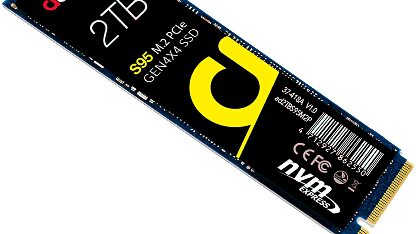
Addlink S90 Lite 2TB Review — Affordable PCIe 4.0 NVMe SSD (2026)
Quick answer
Buy the Addlink S90 Lite 2 TB if you want the cheapest possible 2 TB PCIe 4.0 NVMe drive from a brand that offers a 5-year warranty.
Read: 5000 MB/s Write: 4400 MB/s Endurance: 1200 TBW Warranty: 5 years Interface: M.2 4.0 x 4
The Addlink S90 Lite 2 TB is a budget PCIe 4.0 drive that sacrifices sustained write performance for capacity and price — and for the right buyer, that trade-off makes perfect sense.
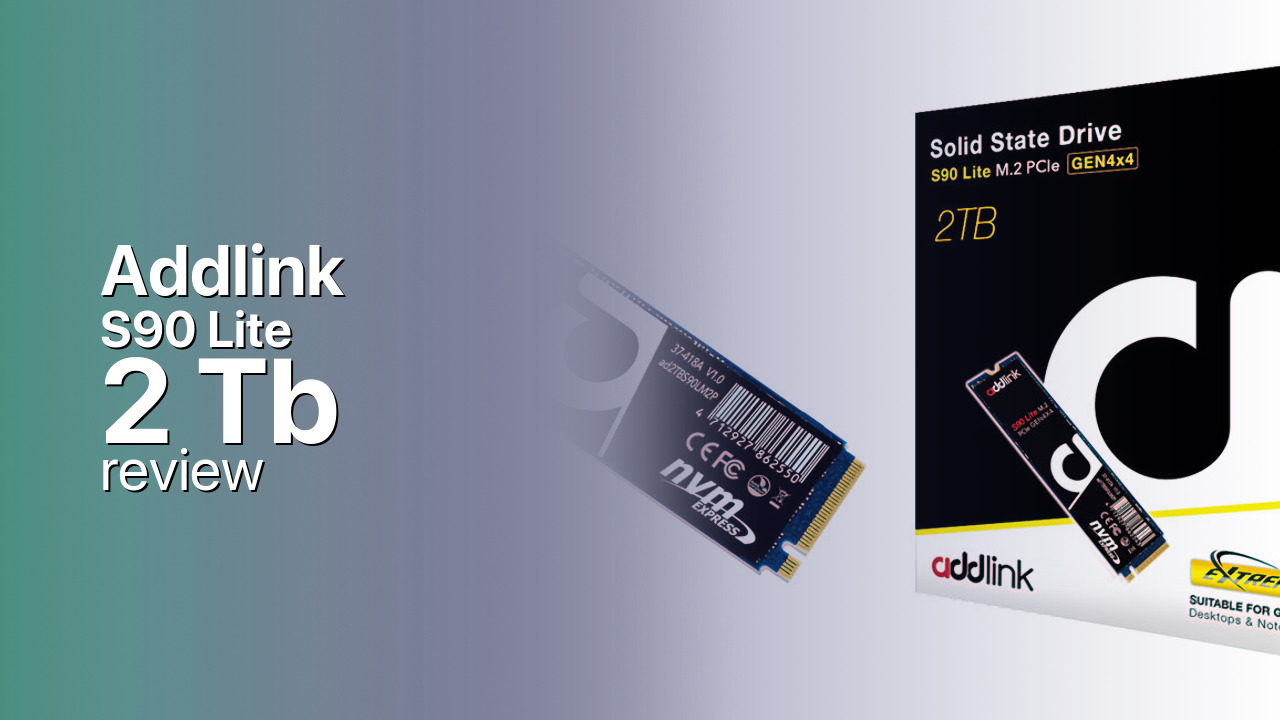
Controller & Memory
The S90 Lite is built on the Phison E21T controller, a four-channel DRAM-less PCIe 4.0 design that uses NVMe Host Memory Buffer (HMB) to manage the flash translation layer. It pairs that controller with TLC NAND — the vendor and layer count vary by production batch, and independent reviewers have noted that Addlink has swapped between TLC and QLC on this model without changing the SKU, a practice that makes specific NAND claims unreliable. The drive uses a single-sided M.2 2280 PCB, which fits in any standard desktop or laptop slot without clearance issues.
Addlink ships the S90 Lite in 512 GB, 1 TB, 2 TB, and 4 TB capacities. Sequential throughput is rated at up to 5,000 MB/s reads and 4,400 MB/s writes, with random IOPS reported at approximately 780,000 read and 800,000 write. The 2 TB variant reviewed here sits in the lineup's sweet spot — enough capacity for a single-drive system, and better sustained write performance than the smaller capacities thanks to greater NAND die parallelism.
The S90 Lite competes in the crowded budget PCIe 4.0 segment against the Silicon Power UD90, TeamGroup MP44L, and Kingston NV2. All are DRAM-less PCIe 4.0 drives targeting the same price-per-gigabyte buyer. The S90 Lite's differentiators are its 4 TB capacity ceiling — rare at this price point — and its 5-year warranty. The primary weakness noted by independent reviewers is sustained write performance, where the DRAM-less E21T platform and limited SLC cache cause write speeds to drop sharply under continuous load. For a game library or media archive where writes are infrequent, this is a non-issue; for users who regularly move large files, it is the drive's defining limitation.
Storage Comparisons:
S90 Lite Performance & Benchmarks
The S90 Lite 2 TB is rated for 5,000 MB/s sequential reads and 4,400 MB/s sequential writes — figures that clear the PCIe 3.0 ceiling and enter Gen 4 territory, though they fall well short of high-end PCIe 4.0 drives like the Samsung 990 Pro (7,450 MB/s). Random performance is reported at approximately 780,000 IOPS read and 800,000 IOPS write at high queue depths, numbers that are competitive within the DRAM-less PCIe 4.0 segment.
Addlink S90 Lite 2 TB vs M.2 4.0 x 4 peers
Switch between sequential throughput and random IOPS to see how this drive stacks up against other M.2 4.0 x 4 SSDs in our database. The highlighted bar is the drive on this page — click any other bar to open that drive.
- Patriot Viper PV593 1 TB: 14,500 MB/s read, 14,000 MB/s write
- Patriot Viper PV593 2 TB: 14,500 MB/s read, 14,000 MB/s write
- Patriot Viper PV593 4 TB: 14,500 MB/s read, 14,000 MB/s write
- Patriot Viper PV573 2 TB: 14,000 MB/s read, 12,000 MB/s write
- Addlink S90 Lite 2 TB (this drive): 5,000 MB/s read, 4,400 MB/s write
The Phison E21T's defining characteristic is its SLC cache behavior. Burst writes up to the cache size — which scales with free capacity — complete at full rated speed. Once the cache fills, native TLC write speeds settle in a range that independent reviewers have described as "very poor sustained performance" (Tom's Hardware). This is standard for DRAM-less PCIe 4.0 drives in this price band; the Silicon Power UD90 and TeamGroup MP44L exhibit the same post-cache drop. For a drive used as a game library, the cache is large enough that game installs from Steam or similar platforms rarely exhaust it. For a video editing scratch disk or a drive that will see sustained writes of 100 GB or more at a time, the S90 Lite is the wrong tool — a DRAM-equipped drive like the Addlink S95 or WD Black SN770 will hold write speeds far better under sustained load.
Addlink S90 Lite vs Competitors
See how the S90 Lite stacks up against other M.2 4.0 x 4 drives in our database:
Compare with rival drives:
Endurance, TBW & Warranty
Addlink backs the S90 Lite with a 5-year limited warranty, which is strong for a budget PCIe 4.0 drive. Endurance ratings are not publicly documented for this model — Addlink does not publish TBW figures on the S90 Lite product page or in the specification sheet, which is unusual for a 5-year-warrantied drive and makes it difficult for buyers to know whether their usage pattern will exhaust the warranty before the 5-year term expires. At 2 TB with TLC NAND, typical endurance for this controller class falls in the 600–1,200 TBW range, which at 50 GB/day provides 32 to 65 years of service. Buyers should be aware of the NAND lottery — independent reviewers have confirmed that Addlink has shipped S90 Lite drives with both TLC and QLC NAND under the same model number, and QLC variants will have significantly lower endurance than TLC. Warranty claims are handled through Addlink's support channels; the company is based in Taiwan with global RMA coverage.
Addlink S90 Lite 2 TB Specifications
| Category | Value |
|---|---|
| Capacity [?] | 2 TB |
| Interface [?] | M.2 4.0 x 4 |
| Controller [?] | Phison PS5021-E21T |
| Memory type [?] | 3D TLC |
| DRAM [?] | HMB SLC |
| Read speed (MB/s) [?] | 5000 |
| Write speed (MB/s) [?] | 4400 |
| Read IOPS [?] | 400000 |
| Write IOPS [?] | 800000 |
| Endurance (TBW) [?] | 1200 |
| MTBF (million hours) [?] | 1500000 |
| Warranty (years) [?] | 5 |
Verdict: Is the S90 Lite Worth It in 2026?
Buy the Addlink S90 Lite 2 TB if you want the cheapest possible 2 TB PCIe 4.0 NVMe drive from a brand that offers a 5-year warranty. The 5,000 MB/s reads make it a strong game library or media archive drive, and the single-sided PCB installs anywhere. Skip it if you need consistent sustained write performance — the DRAM-less Phison E21T platform and aggressive SLC caching mean write speeds crater under continuous load, and the NAND lottery means your specific unit may use QLC with lower endurance than expected. For a few dollars more, the Addlink S95 offers a DRAM-equipped PCIe 4.0 platform with better sustained writes and published endurance. For a pure game library where writes are rare and reads are everything, the S90 Lite 2 TB is hard to beat on price per gigabyte.
+ Pros
- 5,000 MB/s reads — genuine PCIe 4.0 throughput at a budget price
- Up to 4 TB capacity — rare at this price point
- 5-year warranty on a budget PCIe 4.0 drive
- Single-sided M.2 2280 PCB fits any standard slot
- Phison E21T controller runs cool and power-efficient
- Cons
- Very poor sustained write performance after SLC cache exhaustion
- Endurance ratings not publicly documented
- NAND lottery — TLC and QLC shipped under the same SKU
- DRAM-less HMB design limits mixed-workload consistency
- No heatsink included despite PCIe 4.0 thermal demands
Buy this or similar SSD Storage:
Video Review
Can an Amazon 1TB SSD compete with a Samsung EVO? Actually... yes | Hardware