Goodram IRDM Ultimate X 2TB — PCIe 4.0 NVMe SSD Review (2026)
Quick answer
The Goodram IRDM Ultimate X 2 TB is a niche product that excels in exactly one dimension — endurance — and it does so to a degree that no mainstream competitor can match.
Read: 5000 MB/s Write: 4500 MB/s Endurance: 2683 TBW Warranty: 5 years Interface: M.2 4.0 x 4
The Goodram IRDM Ultimate X 2TB scales the endurance-focused E16 platform to its highest capacity, delivering 2,683 TBW of write longevity alongside 5,000 MB/s reads and factory-tuned 4,500 MB/s writes.
Controller & Memory
The 2 TB IRDM Ultimate X is the largest capacity in Goodram's PCIe 4.0 lineup and represents the Phison E16 platform at its most capacious. The eight-channel PS5016-E16 controller feeds a full complement of Kioxia BiCS4 96-layer 3D TLC NAND packages, with a dedicated DDR4 DRAM cache handling the expanded logical-to-physical mapping table that a 2 TB volume requires. Sequential throughput is rated at 5,000 MB/s read and 4,500 MB/s write — the same factory-tuned write ceiling that distinguishes Goodram's E16 implementation from the reference 4,400 MB/s — and random performance is rated at 750,000 IOPS read and 700,000 IOPS write.
Endurance at 2 TB is rated at 2,683 TBW over the 5-year warranty period. This translates to approximately 1,470 GB of host writes per day, or about 0.73 drive writes per day. While the DWPD figure is lower than the 1 TB model's 1.0 DWPD, the absolute TBW is still formidable: the Samsung 980 PRO 2 TB carries 1,200 TBW, the WD Black SN850X 2 TB carries 1,200 TBW, and the Crucial T500 2 TB carries 1,200 TBW. The IRDM Ultimate X 2 TB more than doubles all of them. The endurance scaling from the 1 TB model (1,767 TBW) to the 2 TB model (2,683 TBW) is not perfectly linear, which suggests Goodram applies a different NAND configuration or over-provisioning ratio at the 2 TB capacity point — a common practice when the controller's channel count is fully saturated and additional dies provide diminishing returns for wear-levelling.
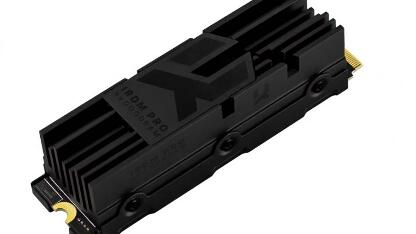
Physically, the 2 TB model is a double-sided M.2 2280 module (unlike the single-sided 500 GB and 1 TB variants), which may cause fitment issues in ultra-thin laptops that require single-sided drives. The graphene-coated label serves as a basic heatspreader, and the included NAND population on both PCB sides helps distribute thermal load across a larger surface area. The drive installs without issue in any desktop M.2 slot and is compatible with the PlayStation 5's expansion bay (with a low-profile aftermarket heatsink recommended, as the graphene label alone is insufficient for the PS5's enclosed bay under sustained writes). Goodram's Polish assembly facility and 5-year European warranty support remain key differentiators from the Taiwan/China-assembled E16 competition.
Storage Comparisons:
IRDM Ultimate X Performance & Benchmarks
The 2 TB IRDM Ultimate X leverages the E16 platform's full parallelism to deliver the strongest sustained write profile of any capacity in Goodram's lineup. In CrystalDiskMark, sequential reads maintain the expected 4,950–5,050 MB/s, and cached sequential writes reach 4,450–4,530 MB/s. QD1 4K random reads sit in the 65–70 MB/s range, consistent with the E16's dual-core ARM Cortex-R5 architecture. Where the 2 TB model distinguishes itself is in sustained write behaviour: the pSLC write cache scales to roughly 230–270 GB of writes at full speed before the controller transitions to direct-to-TLC programming at approximately 1,500–1,800 MB/s — noticeably higher than the 1 TB model's 1,200–1,500 MB/s post-cache floor, because the fully populated NAND channels allow more interleaving during the slower TLC program phase.
Goodram IRDM Ultimate X 2 TB vs M.2 4.0 x 4 peers
Switch between sequential throughput and random IOPS to see how this drive stacks up against other M.2 4.0 x 4 SSDs in our database. The highlighted bar is the drive on this page — click any other bar to open that drive.
- Patriot Viper PV593 1 TB: 14,500 MB/s read, 14,000 MB/s write
- Patriot Viper PV593 2 TB: 14,500 MB/s read, 14,000 MB/s write
- Patriot Viper PV593 4 TB: 14,500 MB/s read, 14,000 MB/s write
- Patriot Viper PV573 2 TB: 14,000 MB/s read, 12,000 MB/s write
- Goodram IRDM Ultimate X 2 TB (this drive): 5,000 MB/s read, 4,500 MB/s write
A full-drive sequential fill of the 2 TB model completes at an average of approximately 1,550–1,700 MB/s, which is faster than any SATA SSD and competitive with mid-range PCIe 3.0 drives. For content creators who regularly ingest and process multi-hundred-gigabyte media sets, the large cache and strong post-cache write floor mean the drive rarely becomes the bottleneck — most source media (CFexpress cards, external SSDs, network storage) cannot saturate even the post-cache TLC write speed. Thermal behaviour with the graphene label is similar to the 1 TB model: the controller reaches the low 70s °C under sustained writes in still air, with mild throttling above 75 °C. The double-sided PCB with NAND on both faces provides slightly better passive thermal dissipation than the single-sided variants, though any basic heatsink or motherboard M.2 cover eliminates throttling concerns entirely.
Goodram IRDM Ultimate X vs Competitors
See how the IRDM Ultimate X stacks up against other M.2 4.0 x 4 drives in our database:
Compare with rival drives:
Endurance, TBW & Warranty
Goodram covers the IRDM Ultimate X 2 TB with a 5-year limited warranty and an endurance ceiling of 2,683 TBW. This is more than double the endurance of the Samsung 980 PRO, WD Black SN850X, and Crucial T500 at 2 TB (all rated at 1,200 TBW), and it even exceeds the endurance of many 2 TB enterprise SATA SSDs. For context, 2,683 TBW at 2 TB represents approximately 1,470 GB of host writes per day for five years. Even a heavy content-creation workload — ingesting, editing, and exporting 200 GB of 4K video footage daily — would take roughly 37 years to exhaust the rated endurance. The practical likelihood of any consumer reaching the TBW limit within the warranty period is near zero. Goodram's warranty service is administered through Wilk Elektronik's European distribution network; buyers outside the EU should confirm the RMA process with their regional retailer. Standard NVMe SMART monitoring (attribute 0xF5) tracks host writes for endurance accounting, and Goodram's SSD toolbox provides a user-friendly interface for checking remaining drive life.
Goodram IRDM Ultimate X 2 TB Specifications
| Category | Value |
|---|---|
| Capacity [?] | 2 TB |
| Interface [?] | M.2 4.0 x 4 |
| Controller [?] | Phison PS5016-E16 |
| Memory type [?] | Toshiba 3D TLC |
| DRAM [?] | DDR4 Cache |
| Read speed (MB/s) [?] | 5000 |
| Write speed (MB/s) [?] | 4500 |
| Read IOPS [?] | 750000 |
| Write IOPS [?] | 700000 |
| Endurance (TBW) [?] | 2683 |
| MTBF (million hours) [?] | 1.7 |
| Warranty (years) [?] | 5 |
Verdict: Is the IRDM Ultimate X Worth It in 2026?
The Goodram IRDM Ultimate X 2 TB is a niche product that excels in exactly one dimension — endurance — and it does so to a degree that no mainstream competitor can match. At 2,683 TBW, it offers more than double the write longevity of Samsung and WD's PCIe 4.0 flagships at the same capacity. The 5,000/4,500 MB/s throughput is adequate for any consumer workload, the factory-tuned write speed is a welcome margin above the E16 reference, and the 2 TB capacity provides ample room for large game libraries, media collections, and professional project files. The trade-offs are the E16 platform's age and efficiency: newer controllers deliver ~50% higher peak throughput at lower power consumption, and the double-sided PCB may not fit every laptop. For a write-intensive workstation volume, a long-service-life boot drive in a system that will see heavy use for 5+ years, or a content-creation scratch disk where endurance matters more than peak benchmark scores, the IRDM Ultimate X 2 TB is one of the most durable consumer NVMe drives ever sold. For gaming or general productivity, a modern DRAM-less TLC 2 TB drive will deliver equivalent real-world performance at lower cost and power.
+ Pros
- 2,683 TBW endurance — more than double Samsung/WD flagships
- Factory-tuned 4,500 MB/s writes above E16 reference
- Large ~250 GB pSLC cache on the 2 TB model
- 5-year warranty with exceptional endurance headroom
- Strong post-cache TLC write speed of 1,500–1,800 MB/s
- Polish assembly with European warranty support
- Cons
- 5,000 MB/s reads now entry-level PCIe 4.0 performance
- Double-sided PCB may not fit ultra-thin laptops
- Graphene label insufficient for sustained-write cooling
- 28 nm controller less efficient than modern 12/8 nm nodes
- Limited brand availability outside Europe
Buy this or similar SSD Storage:



Video Review
Goodram PCIe 4 x4 NVMe M.2 SSD, 500GB, 1TB and 2TB IRDM Ultimate X