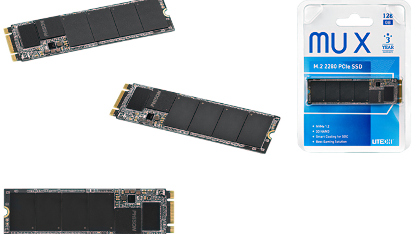
OWC Mercury M2 2TB Review — Maximum-Capacity MLC PCIe 3.0 NVMe SSD (2026)
Quick answer
The OWC Mercury M2 2TB is the ultimate Mercury M2 — two terabytes of MLC NAND storage with the highest endurance in the family.
Read: 1872 MB/s Write: 1087 MB/s Endurance: 1480 TBW Warranty: 3 years Interface: M.2 3.0 x 4
The OWC Mercury M2 2TB is the largest capacity in OWC's general-purpose NVMe lineup — two full terabytes of MLC NAND flash on the SM2260 controller, offering the highest endurance in the Mercury M2 family.

Controller & Memory
The Mercury M2 2TB packs the maximum NAND density onto the SM2260 controller's eight channels, delivering the best sustained write performance and the largest SLC cache in the Mercury M2 family. The rated speeds of 1,872 MB/s reads and 1,087 MB/s writes are consistent across the lineup, but the 2 TB variant's sheer NAND volume means it can sustain peak writes through the longest transfers. Whether the drive includes a DRAM cache is not specified by OWC.
At 2 TB, this drive is designed for users who need massive internal storage without resorting to external drives. After Windows and essential applications, roughly 1.8 TB remains — enough for 30+ modern games, extensive photo and video libraries, large audio sample collections, or development environments with multiple virtual machines. For content creators, photographers, and power users who depend on fast internal storage, the 2 TB capacity eliminates the capacity management that plagues smaller drives.
The Mercury M2 uses a standard M.2 M-key connector for broad compatibility with desktop motherboards, laptops, and NAS devices that support NVMe. The MLC NAND is the drive's defining feature — in an era where most consumer SSDs use TLC or QLC, the Mercury M2's MLC flash offers superior endurance and sustained write performance. The three-year warranty, however, is shorter than the five-year standard from major brands.
At this capacity, the Mercury M2 2TB has few direct competitors — most mainstream brands capped their MLC-based drives at 1 TB. The Samsung 960 EVO 1 TB (TLC) and Crucial P1 1 TB (QLC) are the closest alternatives, though they offer less storage. The Mercury M2 appears to have been discontinued, making it a niche find for buyers who specifically want large-capacity MLC storage.
Storage Comparisons:
Mercury M.2 Performance & Benchmarks
The OWC Mercury M2 2TB is rated at up to 1,872 MB/s sequential reads and 1,087 MB/s sequential writes over its PCIe 3.0 x4 NVMe interface. The read speed is fixed by the SM2260 controller and matches all smaller capacities. The 2 TB variant's advantage lies entirely in sustained write performance — with the most NAND dies and the largest SLC cache in the family, it absorbs the most data at peak speeds before falling back to direct MLC writes. The SM2260 is an eight-channel PCIe 3.0 x4 NVMe 1.2 controller, Silicon Motion's first consumer NVMe design. Random 4K performance typically reaches 130,000–150,000 IOPS reads and 120,000–140,000 IOPS writes. The MLC NAND is the 2 TB variant's strength — after the SLC cache fills, MLC maintains higher direct-write speeds than TLC or QLC drives. For sustained workloads like video editing, database operations, or large file transfers, the 2 TB Mercury M2 outlasts smaller capacities before any performance degradation. Independent benchmark reviews of the Mercury M2 are scarce. For users who need 2 TB of internal storage with MLC endurance, the drive is serviceable, though modern NVMe alternatives at this capacity deliver significantly higher throughput.
OWC Mercury M.2 2 TB vs M.2 3.0 x 4 peers
Switch between sequential throughput and random IOPS to see how this drive stacks up against other M.2 3.0 x 4 SSDs in our database. The highlighted bar is the drive on this page — click any other bar to open that drive.
- ADATA SX 8800 Pro 512 GB: 3,500 MB/s read, 2,700 MB/s write
- ADATA SX 8800 Pro 1 TB: 3,500 MB/s read, 2,700 MB/s write
- ADATA XPG Spectrix S40G RGB 256 GB: 3,500 MB/s read, 3,000 MB/s write
- ADATA XPG Spectrix S40G RGB 512 GB: 3,500 MB/s read, 3,000 MB/s write
- OWC Mercury M.2 2 TB (this drive): 1,872 MB/s read, 1,087 MB/s write
OWC Mercury M.2 vs Competitors
See how the Mercury M.2 stacks up against other M.2 3.0 x 4 drives in our database:
Compare with rival drives:
Endurance, TBW & Warranty
OWC provides a three-year limited warranty for the Mercury M2 2TB. The company does not publish a TBW (terabytes written) endurance rating for the Mercury M2 series. For a 2 TB drive using MLC NAND, endurance is likely in the 1,000–1,600 TBW range — the largest capacity in the lineup spreads wear across the most flash cells, and MLC's 3,000–5,000 P/E cycle endurance is roughly double that of TLC. At a professional usage rate of 80–160 GB per day, the drive would take 17–55 years to reach its estimated TBW limit, far exceeding the three-year warranty. OWC does not publish an MTBF figure. Warranty service flows through OWC's distributor network, and international buyers should verify local support availability. The three-year warranty is shorter than the five-year standard. The lack of published endurance specs is a gap, but the 2 TB's MLC NAND almost certainly exceeds the published TBW of competing TLC drives like the Samsung 960 EVO 1 TB (400 TBW). For users who write heavily — video editing, database work, VM hosting — the 2 TB Mercury M2's estimated endurance is among the highest available in a consumer M.2 NVMe drive.
OWC Mercury M.2 2 TB Specifications
| Category | Value |
|---|---|
| Capacity [?] | 2 TB |
| Interface [?] | M.2 3.0 x 4 |
| Controller [?] | Silicon Motion SM2260 |
| Memory type [?] | MLC |
| DRAM [?] | Yes |
| Read speed (MB/s) [?] | 1872 |
| Write speed (MB/s) [?] | 1087 |
| Read IOPS [?] | 155000 |
| Write IOPS [?] | 190000 |
| Endurance (TBW) [?] | 1480 |
| MTBF (million hours) [?] | 2000000 |
| Warranty (years) [?] | 3 |
Verdict: Is the Mercury M.2 Worth It in 2026?
The OWC Mercury M2 2TB is the ultimate Mercury M2 — two terabytes of MLC NAND storage with the highest endurance in the family. For users who need massive internal storage with MLC durability, it's a rare option in the consumer market. But the 1,872 MB/s reads trail modern NVMe drives significantly, the three-year warranty is shorter than the competition, and the drive appears to have been discontinued. Most buyers are better served by modern 2 TB NVMe drives like the Crucial P3 Plus or WD Blue SN580, which offer dramatically higher performance and documented specs. The Mercury M2 2TB is for buyers who specifically prioritize MLC endurance above all else.
+ Pros
- 2 TB eliminates all capacity concerns
- MLC NAND for superior endurance vs TLC/QLC
- Best sustained writes in Mercury M2 family
- Standard M.2 2280 universal compatibility
- Highest estimated endurance in lineup
- Cons
- 1,872 MB/s reads slow for PCIe 3.0
- No published TBW endurance rating
- 3-year warranty shorter than competition
- Appears to be discontinued
- Limited independent review coverage
Buy this or similar SSD Storage:



Video Review
Review: OWC Express 4M2 SSD enclosure - 8TB!