Intel Optane DC P5800X 400GB — The Fastest SSD Ever Made (2026)
Quick answer
The Intel Optane DC P5800X 400 GB is a category-defying product that has no direct successor and no true peer.
Read: 7400 MB/s Write: 7400 MB/s Endurance: 73000 TBW Warranty: 5 years Interface: U.2 2.5" or E1.S
The Intel Optane DC P5800X 400GB is the highest-performance solid-state drive ever produced, pairing second-generation Optane persistent memory with a PCIe 4.0 interface for 7,400 MB/s symmetric throughput and an extraordinary 100 drive-writes-per-day endurance rating.
Controller & Memory
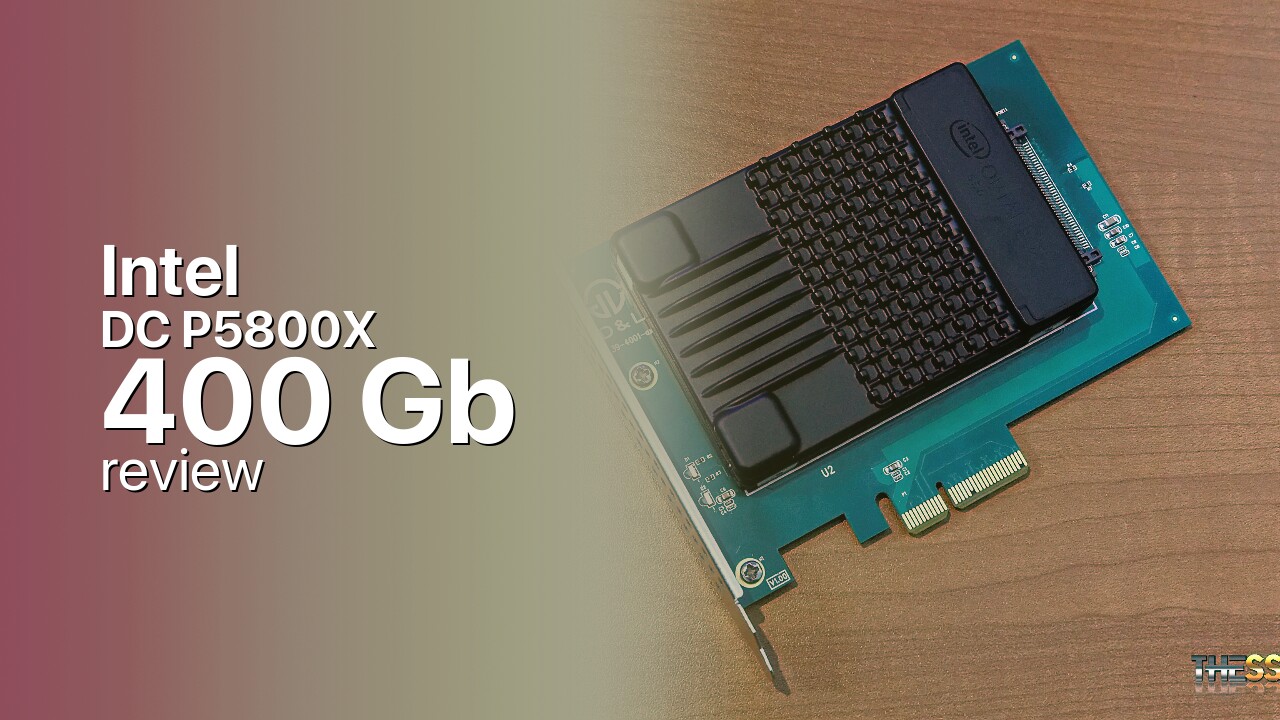
The Intel Optane DC P5800X is not an SSD in the conventional sense. It does not use NAND flash. Instead, it uses Intel's second-generation 3D XPoint (Optane) persistent memory — a fundamentally different storage medium that sits between DRAM and NAND in the memory hierarchy. Optane media is bit-addressable at the hardware level, can be written in-place without the erase-before-write cycle that NAND requires, and offers latency measured in microseconds rather than the tens or hundreds of microseconds typical of NAND SSDs. The P5800X packages this media behind a PCIe 4.0 x4 interface driven by a single-core 1.1 GHz ARM Cortex-R7 controller, delivering 7,400 MB/s sequential read and 7,400 MB/s sequential write — fully symmetric, unlike any NAND-based drive — and random performance of up to 1.55 million IOPS read and 1.6 million IOPS write at low queue depths where NAND drives struggle to reach six figures.
The 400 GB capacity point is the entry-level SKU in the P5800X family (which also includes 800 GB, 1.6 TB, and 3.2 TB variants). The drive ships in a 2.5-inch U.2 form factor with a 15 mm z-height, connecting via a standard U.2 (SFF-8639) to PCIe adapter cable or backplane — it is not an M.2 device and requires a U.2-compatible motherboard or add-in card. Power consumption under load is approximately 18–21 W, which is high for an SSD but commensurate with the performance. The endurance rating is 100 drive writes per day (DWPD) for 5 years on a random workload, which means the 400 GB model can sustain 40 TB of writes every single day — approximately 73,000 TB of total writes over the warranty period. To put that in perspective, a Samsung 990 PRO 2 TB is rated for 1,200 TBW total; the P5800X 400 GB can write that entire amount every 30 days, for five years straight, without exceeding its endurance rating.
Intel developed the P5800X for workloads where NAND SSDs are either too slow or wear out too quickly: high-frequency trading platforms where single-digit microsecond latency matters, write-caching layers in front of large all-flash arrays, database logging volumes that see continuous small-block writes 24/7, and AI/ML data pipelines where mixed random read/write performance at low queue depths is the bottleneck. The drive is priced accordingly — at launch the 400 GB model cost roughly $1,200–$1,500, or about $3–$4 per gigabyte, which is an order of magnitude more expensive than even premium consumer NVMe drives. Intel sold its Optane business to SK Hynix (now Solidigm) in 2021, and Optane media production was discontinued in 2022, making the P5800X the last and fastest Optane drive ever manufactured.
Storage Comparisons:
DC P5800X Performance & Benchmarks
The P5800X 400 GB delivers a performance profile that no NAND-based SSD can approach, particularly at the low queue depths that characterise real-world workloads. Sequential throughput saturates the PCIe 4.0 x4 interface in both directions at 7,400 MB/s, and unlike NAND drives where writes are only fast inside the pSLC cache, the P5800X maintains full write speed indefinitely — there is no cache, no folding, and no write cliff. A full-drive sequential write of the entire 400 GB completes at 7,400 MB/s from start to finish, a feat that no NAND SSD of any generation can match.
Intel DC P5800X 400 GB vs U.2 2.5" or E1.S peers
Switch between sequential throughput and random IOPS to see how this drive stacks up against other U.2 2.5" or E1.S SSDs in our database. The highlighted bar is the drive on this page — click any other bar to open that drive.
- Intel DC P5800X 400 GB (this drive): 7,400 MB/s read, 7,400 MB/s write
- Intel DC P5800X 800 GB: 7,400 MB/s read, 7,400 MB/s write
- Intel DC P5800X 1.6 TB: 7,200 MB/s read, 6,200 MB/s write
The defining characteristic, however, is random performance at low queue depths. The P5800X delivers approximately 450,000–500,000 random 4K read IOPS at QD1 — nearly an order of magnitude more than the ~15,000–20,000 IOPS that the best NAND SSDs manage at the same queue depth. Random 4K write at QD1 is similarly dominant at 350,000–400,000 IOPS versus ~50,000–60,000 IOPS for a top-tier NAND drive. This low-QD dominance is what makes Optane transformative for real-world server and workstation workloads: databases, virtualisation, and software compilation are all dominated by small, scattered I/O at low queue depths where NAND controllers cannot hide their media latency behind parallelism. The P5800X's 4K random read latency is approximately 5–7 microseconds, compared to 50–80 microseconds for a fast NAND SSD and roughly 0.1 microseconds for DRAM. It occupies a unique position roughly 50–100x slower than DRAM but 10–20x faster than NAND, with persistence that DRAM lacks.
Thermally, the P5800X is a 15 mm U.2 device designed for server chassis with forced airflow. The 18–21 W power draw under full load requires active cooling in most environments; the drive incorporates thermal throttling that engages at 85 °C, but a well-ventilated server chassis or a U.2-to-PCIe adapter card with a heatsink keeps the drive in the 50–65 °C range under sustained load.
Endurance, TBW & Warranty
Intel warrants the DC P5800X 400 GB for 5 years, with an endurance rating of 100 drive writes per day (DWPD) under a random 4K write workload. This translates to 40 TB of writes per day, or approximately 73,000 TBW over the 5-year warranty period. For context, the highest-endurance consumer NVMe drive on the market — a 2 TB Phison E16 TLC drive like the Sabrent Rocket 4.0 — carries 3,600 TBW total. The P5800X 400 GB, despite having one-fifth the capacity, offers roughly 20 times the total write endurance. This endurance is made possible by Optane's fundamentally different physics: 3D XPoint media does not require the erase-before-write cycle that wears out NAND cells, and writes are performed in-place by changing the resistance state of the storage material, which causes negligible wear compared to the charge-trap or floating-gate programming of NAND. Intel's warranty and support for the P5800X are enterprise-grade, with advance replacement options and technical support channels that differ from Intel's consumer SSD programme. The Solidigm transition following SK Hynix's acquisition of the Optane business may affect long-term warranty service, and enterprise buyers should confirm current support channels with their distributor.
Intel DC P5800X 400 GB Specifications
| Category | Value |
|---|---|
| Capacity [?] | 400 GB |
| Interface [?] | U.2 2.5" or E1.S |
| Controller [?] | Intel |
| Memory type [?] | Intel Optane 2nd Gen |
| DRAM [?] | No |
| Read speed (MB/s) [?] | 7400 |
| Write speed (MB/s) [?] | 7400 |
| Read IOPS [?] | 1550000 |
| Write IOPS [?] | 1600000 |
| Endurance (TBW) [?] | 73000 |
| MTBF (million hours) [?] | 2 |
| Warranty (years) [?] | 5 |
Verdict: Is the DC P5800X Worth It in 2026?
The Intel Optane DC P5800X 400 GB is a category-defying product that has no direct successor and no true peer. It combines PCIe 4.0 interface speeds with Optane's unmatched low-queue-depth random performance and an endurance rating that makes even the most durable NAND drives look disposable. It is also a dead-end product: Intel discontinued Optane media production in 2022, and while Solidigm (SK Hynix) continues to sell remaining inventory and provide support, no future Optane SSDs will be manufactured. For the workloads that justify its cost — latency-sensitive financial trading, write-intensive database logging, high-endurance caching tiers — the P5800X remains the best SSD ever made and is likely to hold that title for years after it disappears from the market. For everyone else, a high-end NAND NVMe drive like the Samsung 990 PRO or Solidigm P44 Pro delivers far more capacity per dollar and performance that is already overkill for consumer and prosumer workloads. The P5800X is not a product you buy; it is a product you deploy to solve a specific, expensive performance or endurance problem that NAND cannot address.
+ Pros
- Fastest SSD ever made — no NAND drive comes close
- 7,400 MB/s symmetric read/write, sustained indefinitely
- 100 DWPD endurance — 73,000 TBW over 5 years
- ~5–7 μs random 4K latency vs. 50–80 μs for NAND
- 450K+ random read IOPS at QD1 — 10x NAND SSDs
- No write cliff, no cache, no folding — Optane is different
- Cons
- Extremely expensive — ~$3–4/GB at launch
- U.2 form factor requires compatible hardware (not M.2)
- 400 GB capacity is small for consumer use
- 18–21 W power draw requires active cooling
- Optane discontinued — no future products or long-term supply
- Enterprise support channels required for warranty service
Buy this or similar SSD Storage:



Video Review
The fastest SSD for gaming, and one big problem..