Corsair Neutron NX500 400GB PCIe SSD Review (2026)
Quick answer
Desktop builders who need sustained NVMe performance without thermal throttling will find the Corsair Neutron NX500 400 GB delivers exactly that.
Read: 2800 MB/s Write: 1600 MB/s Endurance: 698 TBW Warranty: 5 years Interface: PCIe 3.0 x 4
The Corsair Neutron NX500 400 GB is a PCIe add-in card NVMe SSD that pairs Phison E7 MLC technology with a custom heatsink for thermally unconstrained sustained performance in desktop systems.
Controller & Memory
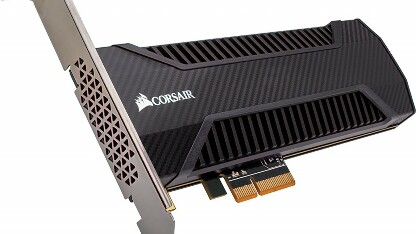
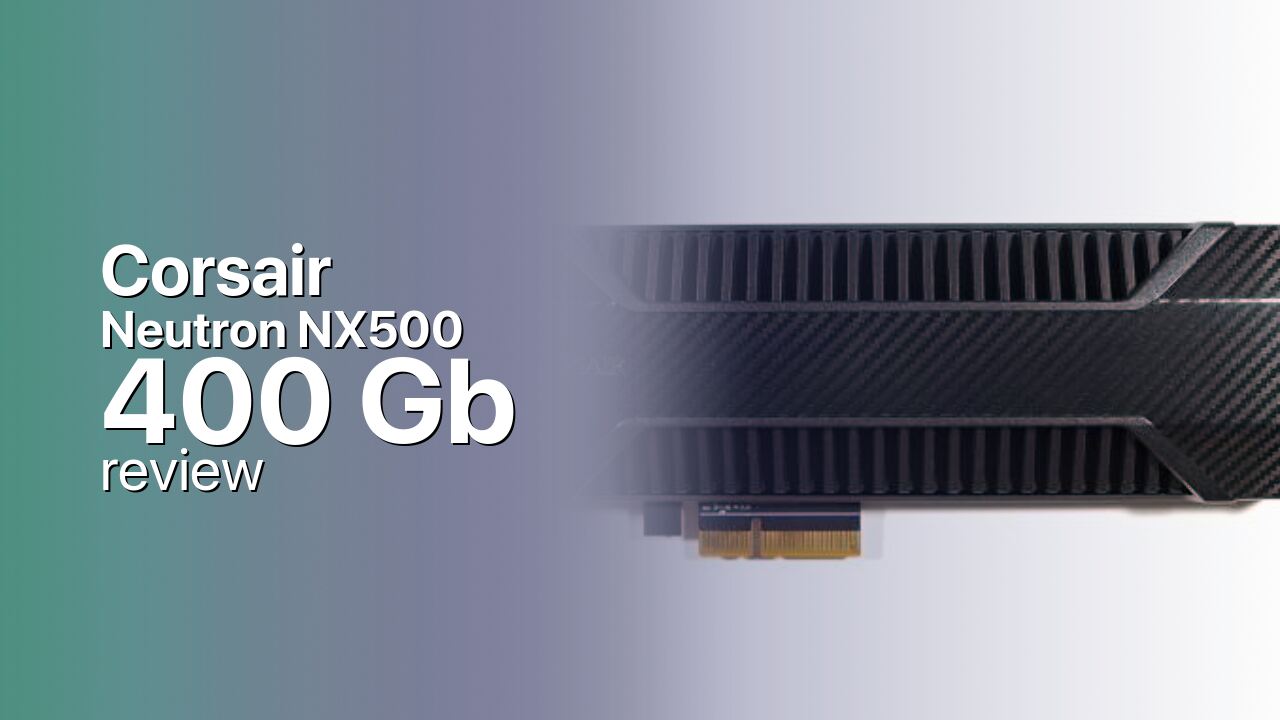
The NX500 400GB is built on Phison's PS5007-E7 NVMe controller, a PCIe 3.0 x4 design paired with Toshiba's 15nm planar MLC NAND flash. Unlike the M.2-based Force MP500, the NX500 mounts its components directly on a half-height half-length (HHHL) PCIe add-in card PCB rather than an M.2 module. A 1 GB Nanya DDR3 DRAM chip services the flash translation layer, which is double the typical DRAM allocation for a 400 GB drive and reflects the heavy overprovisioning Corsair applied to this model.
The NX500 reserves a large spare area, leaving 400 GB usable from a raw capacity that would normally yield 480 GB. This level of overprovisioning is typically seen on enterprise SSDs and gives the NX500 its high endurance rating and consistent sustained write performance. The card ships with a substantial aluminum heatsink that covers the Phison controller, connected via a thermal pad. The drive also includes a perforated PCIe bracket with Corsair styling cues.
The NX500 only comes in 400 GB and 800 GB capacities. There is no M.2 variant. The drive competes with other Phison E7 add-in cards like the Zotac Sonix and Patriot Scorch, as well as M.2 drives in add-in card adapters like the Plextor M8PeY and Toshiba OCZ RD400A. Against Samsung's 960 Pro, the NX500 offers MLC endurance at a similar price point with the advantage of thermally unconstrained sustained writes.
Storage Comparisons:
Neutron NX500 Performance & Benchmarks
Corsair rates the Neutron NX500 400 GB at 2,800 MB/s sequential read and 1,600 MB/s sequential write, with up to 300,000 random read IOPS and 270,000 random write IOPS. These figures match the Force MP500 M.2 variant, as both use the same Phison E7 controller and Toshiba MLC NAND. The NX500 adds roughly 20 to 30 percent more random IOPS than the MP500 thanks to firmware optimizations and the larger DRAM cache on the NX500 platform.
Corsair Neutron NX500 400 GB vs PCIe 3.0 x 4 peers
Switch between sequential throughput and random IOPS to see how this drive stacks up against other PCIe 3.0 x 4 SSDs in our database. The highlighted bar is the drive on this page — click any other bar to open that drive.
- Asura Genesis Xtreme 256 GB: 3,400 MB/s read, 3,000 MB/s write
- Asura Genesis Xtreme 512 GB: 3,400 MB/s read, 3,000 MB/s write
- Asura Genesis Xtreme 1 TB: 3,400 MB/s read, 3,000 MB/s write
- Asura Genesis Xtreme 2 TB: 3,400 MB/s read, 3,000 MB/s write
- Corsair Neutron NX500 400 GB (this drive): 2,800 MB/s read, 1,600 MB/s write
The real advantage of the NX500 over its M.2 sibling is sustained performance under thermal load. TechSpot testing showed the NX500 never exceeded 49 degrees Celsius during a 100 GB sustained transfer test, while the Samsung 960 Evo peaked at 90 degrees and throttled heavily. The NX500 large heatsink and direct-mount PCB design eliminate thermal throttling entirely, making it more than twice as fast as the Samsung 960 Evo for sustained writes over 20 GB. For short burst transfers under 3 GB, performance is similar to M.2 alternatives.
Corsair Neutron NX500 vs Competitors
See how the Neutron NX500 stacks up against other PCIe 3.0 x 4 drives in our database:
Compare with rival drives:
Endurance, TBW & Warranty
Corsair backs the Neutron NX500 400 GB with a five-year limited warranty, ending at 698 TBW of writes or the warranty period, whichever comes first. The 698 TBW rating equates to approximately 1 DWPD (drive write per day) over the five-year term, which is an enterprise-level endurance metric for a consumer drive. At a typical 20 GB per day consumer workload, the endurance translates to roughly 95 years of use. The heavy overprovisioning and MLC NAND contribute to this endurance rating, which matches the Corsair Force MP500 480 GB despite the NX500 having less usable capacity. The NX500 warranty is a significant upgrade over the previous-generation MP500 three-year warranty.
Corsair Neutron NX500 400 GB Specifications
| Category | Value |
|---|---|
| Capacity [?] | 400 GB |
| Interface [?] | PCIe 3.0 x 4 |
| Controller [?] | Phison PS5007-E7 |
| Memory type [?] | Toshiba 15nm MLC |
| DRAM [?] | Nanya DDR3 |
| Read speed (MB/s) [?] | 2800 |
| Write speed (MB/s) [?] | 1600 |
| Read IOPS [?] | 300000 |
| Write IOPS [?] | 270000 |
| Endurance (TBW) [?] | 698 |
| MTBF (million hours) [?] | 2000000 |
| Warranty (years) [?] | 5 |
Verdict: Is the Neutron NX500 Worth It in 2026?
Desktop builders who need sustained NVMe performance without thermal throttling will find the Corsair Neutron NX500 400 GB delivers exactly that. The add-in card form factor with its large heatsink keeps the drive cool under heavy sustained writes where M.2 drives throttle to a fraction of their rated speed. Anyone building in a system without a spare PCIe slot, or who needs M.2 for space-constrained builds, should look at the Samsung 960 Pro or the Corsair Force MP500 instead. The NX500 400 GB is a niche product for enthusiasts who prioritize thermally unconstrained MLC performance over M.2 convenience, and it fills that niche well.
+ Pros
- Large heatsink prevents thermal throttling
- Toshiba 15nm MLC NAND for endurance
- 698 TBW with heavy overprovisioning
- Sustained writes stay fast past 100 GB
- Double DRAM cache (1 GB) vs M.2 variant
- 5-year warranty coverage
- Cons
- PCIe add-in card requires spare slot
- Only 400 GB usable from ~480 GB raw
- 2,800 MB/s reads below Samsung 960 Pro
- Not M.2, no laptop compatibility
- Premium pricing for the capacity
Buy this or similar SSD Storage:
Video Review
Corsair NX500 400GB Review, HHHL PCIe NVMe SSD.