Kioxia Exceria 1TB NVMe SSD Review (2026)
Quick answer
The Kioxia Exceria 1TB is a value-focused mainstream NVMe SSD that delivers the right features at a budget price: confirmed TLC NAND, DRAM cache, 400 TBW endurance, and enough capacity for a full system build.
Read: 1700 MB/s Write: 1600 MB/s Endurance: 400 TBW Warranty: 5 years Interface: M.2 3.0 x 4
The Kioxia Exceria 1TB is the range-topping capacity of Kioxia's mainstream NVMe line, offering 1,700 MB/s reads, 400 TBW endurance, and confirmed TLC NAND with DRAM cache at a budget-friendly price.
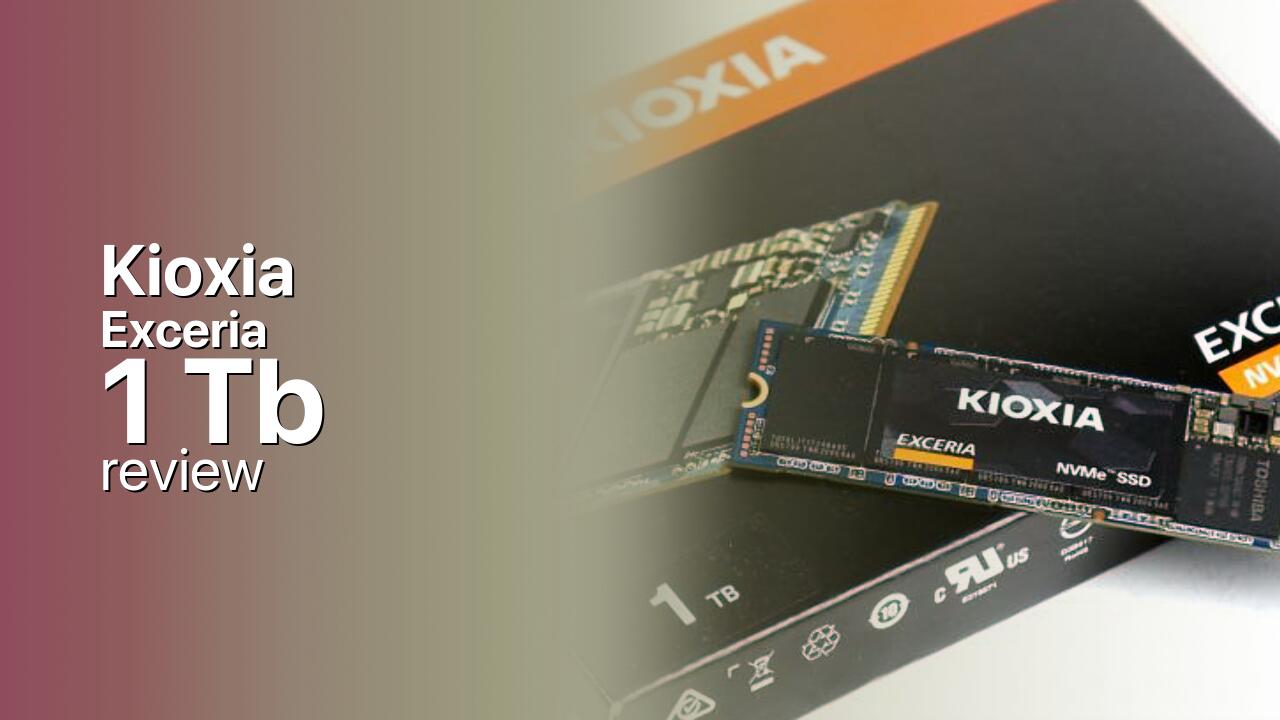
Controller & Memory
The Exceria uses Kioxia's TC58NC1202GST in-house controller with Toshiba BiCS5 96-layer 3D TLC NAND and a DDR4 DRAM cache. This is Kioxia's mainstream NVMe tier — below the Exceria Plus (3,400/3,200 MB/s) but above SATA SSDs in every metric. The 1TB model is the largest capacity in the Exceria NVMe range, offering 400 TBW endurance and enough space for a combined OS, application, and game drive.
The 1TB model has more NAND die for parallel writes than the smaller capacities, giving it a larger SLC cache and better sustained write performance after cache exhaustion. The DRAM cache and TLC NAND ensure consistent performance that QLC-based competitors cannot match. The drive uses an M.2 2280 form factor compatible with most desktops and laptops.
The Exceria 1TB competes with the Kingston A2000 1TB, Crucial P2 1TB, and Team MP33 1TB. The Exceria's confirmed TLC NAND with DRAM gives it an edge over QLC alternatives at similar prices, ensuring consistent write performance regardless of workload.
Storage Comparisons:
Exceria Performance & Benchmarks
The Exceria 1TB is rated for 1,700 MB/s sequential reads and 1,600 MB/s sequential writes, with 350K random read IOPS and 400K random write IOPS. These are entry-level PCIe 3.0 speeds — three times faster than SATA in sequential reads. The 1TB model's larger SLC cache absorbs roughly 30–60 GB of burst writes before folding to native TLC rates around 1,000–1,200 MB/s, which is better than the smaller capacities.
Kioxia Exceria 1 TB vs M.2 3.0 x 4 peers
Switch between sequential throughput and random IOPS to see how this drive stacks up against other M.2 3.0 x 4 SSDs in our database. The highlighted bar is the drive on this page — click any other bar to open that drive.
- ADATA SX 8800 Pro 512 GB: 3,500 MB/s read, 2,700 MB/s write
- ADATA SX 8800 Pro 1 TB: 3,500 MB/s read, 2,700 MB/s write
- ADATA XPG Spectrix S40G RGB 256 GB: 3,500 MB/s read, 3,000 MB/s write
- ADATA XPG Spectrix S40G RGB 512 GB: 3,500 MB/s read, 3,000 MB/s write
- Kioxia Exceria 1 TB (this drive): 1,700 MB/s read, 1,600 MB/s write
The DRAM cache ensures consistent random IO performance under multitasking workloads. Gaming load times are noticeably faster than SATA SSDs, though not as quick as 3,400 MB/s NVMe drives. The 1TB capacity holds 15–25 AAA titles alongside the OS and applications, making it a practical single-drive solution for budget builds. Content creators will find the sustained write performance adequate for basic video editing, though the 1,600 MB/s ceiling is lower than enthusiast-grade NVMe drives.
Kioxia Exceria vs Competitors
See how the Exceria stacks up against other M.2 3.0 x 4 drives in our database:
Compare with rival drives:
Endurance, TBW & Warranty
Kioxia rates the Exceria 1TB at 400 TBW with a five-year limited warranty. At 30–40 GB of writes per day, the endurance budget covers 27 to 36 years. The 1.5 million hour MTBF is a population-level statistic. Warranty service is handled through Kioxia's RMA process or the retailer.
Kioxia Exceria 1 TB Specifications
| Category | Value |
|---|---|
| Capacity [?] | 1 TB |
| Interface [?] | M.2 3.0 x 4 |
| Controller [?] | Toshiba TC58NC1202GST |
| Memory type [?] | Toshiba 96L 3D TLC |
| DRAM [?] | 1GB DDR4 SLC-Cache |
| Read speed (MB/s) [?] | 1700 |
| Write speed (MB/s) [?] | 1600 |
| Read IOPS [?] | 350000 |
| Write IOPS [?] | 400000 |
| Endurance (TBW) [?] | 400 |
| MTBF (million hours) [?] | 1.5 |
| Warranty (years) [?] | 5 |
Verdict: Is the Exceria Worth It in 2026?
The Kioxia Exceria 1TB is a value-focused mainstream NVMe SSD that delivers the right features at a budget price: confirmed TLC NAND, DRAM cache, 400 TBW endurance, and enough capacity for a full system build. The 1,700/1,600 MB/s speeds are entry-level for NVMe but represent a genuine upgrade from SATA. The Exceria Plus offers double the throughput for more money. For budget builders who prioritize capacity, reliability, and consistent write performance over peak speed, the Exceria 1TB is one of the better TLC NVMe options at its price point.
+ Pros
- 1,700 MB/s reads — three times faster than SATA
- 1TB capacity for OS, games, and applications
- TLC NAND with DRAM cache at a budget price
- 400 TBW endurance with 5-year warranty
- In-house Kioxia controller with native BiCS5 NAND
- Cons
- 1,700 MB/s reads — entry-level NVMe speed
- Exceria Plus delivers double the speed for moderate price increase
- PCIe 3.0 — surpassed by Gen4 drives
- 1,600 MB/s writes lag behind premium NVMe drives
- Limited management software compared to Samsung or WD
Buy this or similar SSD Storage:



Video Review
KIOXIA EXCERIA NVME SSD - Best Value NVME SSD?