ADATA XPG SX8800 Pro 512GB SSD — In-Depth Review & Specs (2026)
Quick answer
The ADATA XPG SX8800 Pro 512GB is a competent mid-range NVMe drive that carves out a defensible position with its 8-channel Realtek RTS5762 controller and dedicated DRAM.
Read: 3500 MB/s Write: 2700 MB/s Endurance: 320 TBW Warranty: 5 years Interface: M.2 3.0 x 4
The ADATA XPG SX8800 Pro 512GB occupies a unique niche: it pairs Realtek's 8-channel RTS5762 controller with dedicated Nanya DRAM cache, positioning it above the DRAM-less budget tier while undercutting premium Silicon Motion and Phison flagships. At 512GB the drive delivers the platform's full rated throughput of 3,500 MB/s read and 2,700 MB/s write, with 290K/240K random IOPS and a single-sided M.2 2280 form factor. This review examines how the RTS5762 platform performs in real-world use and whether the SX8800 Pro earns its place between budget DRAM-less drives and premium Gen3 flagships.
Controller & Memory
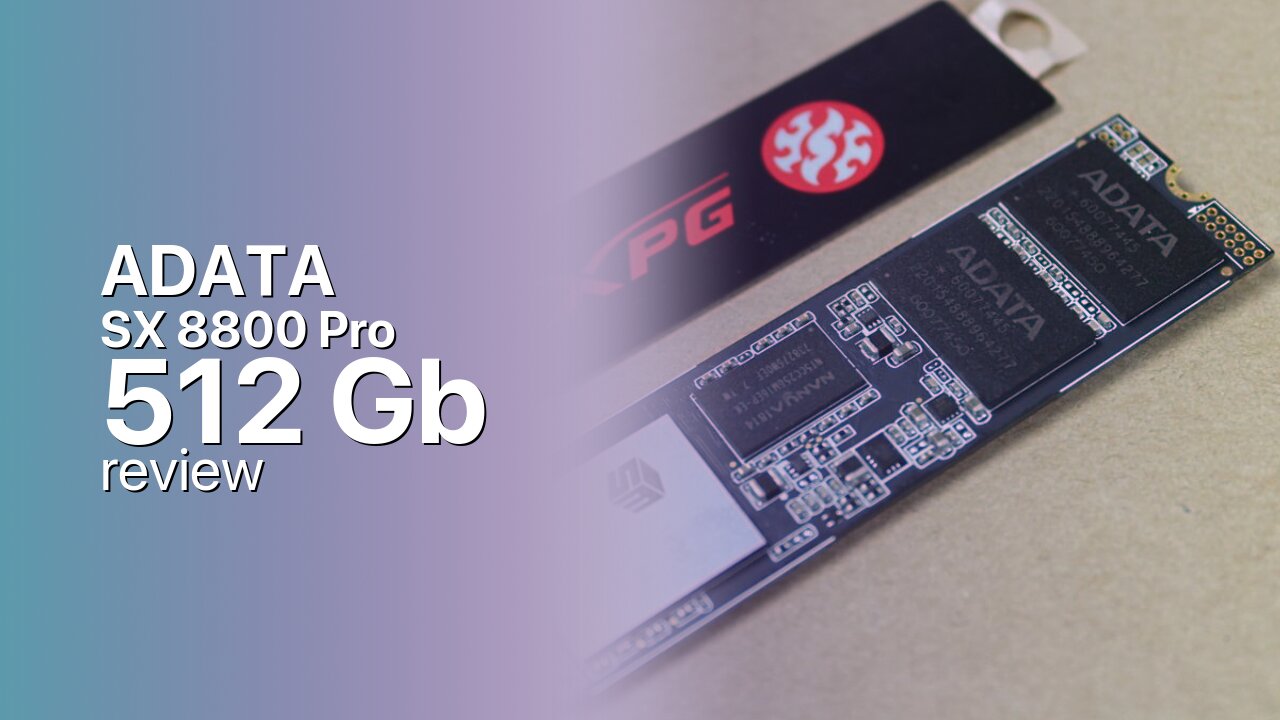
The Realtek RTS5762 is an 8-channel PCIe 3.0 x4 NVMe controller with a dedicated DRAM interface — a departure from the DRAM-less HMB designs that dominate the budget segment. Realtek designed the RTS5762 to compete with the Silicon Motion SM2262EN and Phison E12, offering similar channel count and DRAM support at a lower licensing cost. The RTS5763DL (the DRAM-less variant often confused with the RTS5762) uses HMB; the SX8800 Pro specifically uses the full RTS5762 with on-controller DRAM — Nanya DDR3, roughly 512 MB for the 512GB capacity point.
ADATA pairs the controller with next-generation 3D TLC NAND behind an SLC write cache. Sequential throughput reaches 3,500 MB/s read and 2,700 MB/s write — numbers that sit just below the 3,500 MB/s PCIe 3.0 x4 practical ceiling and match or exceed many DRAM-equipped competitors in the same price band. Random performance peaks at 290,000 IOPS read and 240,000 IOPS write.
The drive includes AES 256-bit hardware encryption, LDPC error correction, and SLC caching with intelligent cache management. Endurance is rated at 320 TBW — adequate for a 512GB consumer drive though lower than some Phison E12-based alternatives. The single-sided M.2 2280 layout and lack of a pre-installed heatsink make it compatible with any M.2 slot, including thin laptops, though sustained write-heavy workloads will benefit from motherboard M.2 heatsink coverage or at least modest case airflow. ADATA backs the drive with a 5-year warranty and provides SSD Toolbox software for firmware updates, health monitoring, and secure erase.
Storage Comparisons:
SX 8800 Pro Performance & Benchmarks
Rated sequential throughput of 3,500 MB/s read and 2,700 MB/s write pushes near the PCIe 3.0 x4 bandwidth ceiling. Reads saturate the link under ideal conditions, and writes reach roughly 77% of the theoretical maximum — a strong result for the Realtek platform. For comparison, the Silicon Motion SM2262EN in ADATA's own SX8200 Pro achieves similar numbers, so the RTS5762 is genuinely competitive in sequential throughput.
ADATA SX 8800 Pro 512 GB vs M.2 3.0 x 4 peers
Switch between sequential throughput and random IOPS to see how this drive stacks up against other M.2 3.0 x 4 SSDs in our database. The highlighted bar is the drive on this page — click any other bar to open that drive.
- ADATA SX 8800 Pro 512 GB (this drive): 3,500 MB/s read, 2,700 MB/s write
- ADATA SX 8800 Pro 1 TB: 3,500 MB/s read, 2,700 MB/s write
- ADATA XPG Spectrix S40G RGB 256 GB: 3,500 MB/s read, 3,000 MB/s write
- ADATA XPG Spectrix S40G RGB 512 GB: 3,500 MB/s read, 3,000 MB/s write
- ADATA XPG Spectrix S40G RGB 1 TB: 3,500 MB/s read, 3,000 MB/s write
Random 4K performance at 290K/240K IOPS is mid-pack for PCIe 3.0 DRAM drives. Windows boots, application launches, and game level loads complete in times indistinguishable from any other high-end Gen3 NVMe drive — the DRAM cache keeps the flash translation layer responsive, and the SLC write buffer absorbs burst writes without slowdown. The 512GB capacity provides enough SLC cache headroom that typical desktop workloads (OS operation, application installs, file copies under 50 GB) rarely if ever exhaust the cache and hit native TLC write speeds.
The RTS5762 runs slightly warmer than equivalent Silicon Motion controllers under sustained sequential writes — a known characteristic of the Realtek platform. Motherboard M.2 heatsinks or directed case airflow are recommended for any write workload exceeding 5-10 minutes of continuous full-speed transfer. Laptop users should ensure the M.2 slot has at least passive thermal dissipation; the single-sided PCB helps here since heat concentrates on the component side where a thermal pad can reach it. For bursty desktop and gaming workloads, thermal throttling is unlikely to occur in practice.
ADATA SX 8800 Pro vs Competitors
See how the SX 8800 Pro stacks up against other M.2 3.0 x 4 drives in our database:
Compare with rival drives:
Endurance, TBW & Warranty
ADATA provides a 5-year limited warranty for the XPG SX8800 Pro, with endurance rated at 320 TBW for the 512GB capacity. The warranty is tied to the original purchaser and coverage ends at whichever comes first: the 5-year term or the TBW limit. ADATA's SSD Toolbox software provides health monitoring and secure erase functionality.
ADATA SX 8800 Pro 512 GB Specifications
| Category | Value |
|---|---|
| Capacity [?] | 512 GB |
| Interface [?] | M.2 3.0 x 4 |
| Controller [?] | Realtek RTS5762 |
| Memory type [?] | 3D TLC |
| DRAM [?] | Nanya |
| Read speed (MB/s) [?] | 3500 |
| Write speed (MB/s) [?] | 2700 |
| Read IOPS [?] | 290000 |
| Write IOPS [?] | 240000 |
| Endurance (TBW) [?] | 320 |
| MTBF (million hours) [?] | 2 |
| Warranty (years) [?] | 5 |
Verdict: Is the SX 8800 Pro Worth It in 2026?
The ADATA XPG SX8800 Pro 512GB is a competent mid-range NVMe drive that carves out a defensible position with its 8-channel Realtek RTS5762 controller and dedicated DRAM. At 3,500/2,700 MB/s it delivers PCIe 3.0 performance within striking distance of the segment leaders, and the Nanya DRAM cache means it avoids the mixed-workload latency penalties of DRAM-less alternatives. The 512GB capacity is the sweet spot for a balanced system drive — enough room for an OS, major applications, and a reasonable game library without paying the premium for 1TB. The main caveats are the RTS5762's slightly higher thermal output versus Silicon Motion equivalents and a 320 TBW endurance rating that trails some Phison E12 competitors. For builders who want DRAM-equipped NVMe performance at a price closer to DRAM-less drives, the SX8800 Pro 512GB is a sensible middle-ground pick.
+ Pros
- 3,500/2,700 MB/s — near the PCIe 3.0 x4 ceiling with DRAM-equipped controller
- Dedicated Nanya DRAM — consistent mixed-workload latency, no HMB compromises
- Realtek RTS5762 — 8-channel design competitive with SM2262EN and Phison E12
- AES 256-bit hardware encryption — full-disk security support
- Single-sided M.2 2280 — universal compatibility including thin laptops
- 5-year warranty — matching premium-drive coverage terms
- Cons
- 320 TBW endurance — lower than some Phison E12 competitors at this capacity
- RTS5762 runs warmer than equivalent Silicon Motion controllers
- No pre-installed heatsink — sustained writes benefit from motherboard cooling
- Realtek platform has fewer firmware updates vs. Silicon Motion or Phison
- Brand confusion with ADATA's SX8200 Pro (different controller)
- Limited independent review coverage vs. more popular models
Buy this or similar SSD Storage:



Video Review
NVME Tested in Real World Performance featuring XPG SX8200 Pro 512GB