Crucial P1 512GB QLC NVMe SSD Review (2026)
Quick answer
The Crucial P1 512 GB was a notable product as Micron's first consumer NVMe SSD and one of the first QLC drives, but it has been superseded by better options in every segment.
Read: 1900 MB/s Write: 950 MB/s Endurance: 100 TBW Warranty: 5 years Interface: M.2 3.0 x 4
The Crucial P1 512 GB was Micron's first consumer NVMe SSD -- and one of the first QLC NAND drives on the market, with a large variable SLC cache that masks the slow native QLC write speed.
Controller & Memory
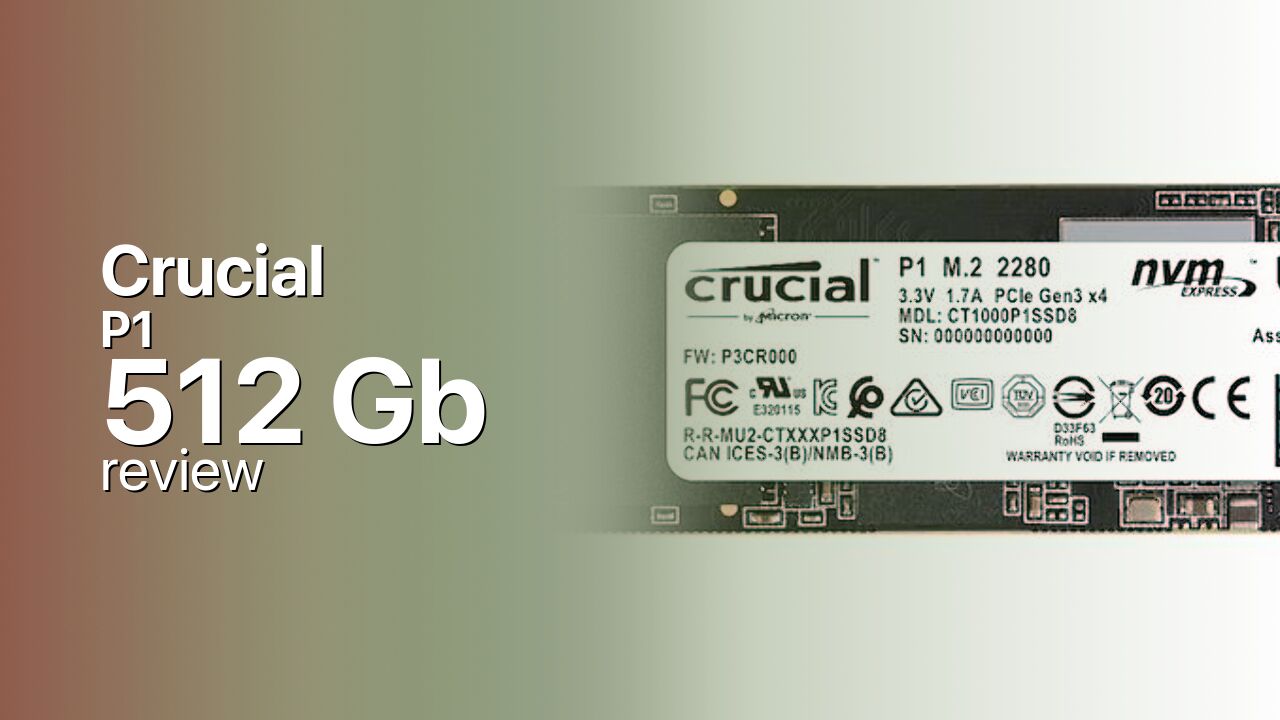
The P1 uses a Silicon Motion SM2263 four-channel NVMe controller paired with Micron 64-layer 3D QLC NAND. The 512 GB (500 GB usable) capacity includes 512 MB of DDR3 DRAM for the flash translation layer. The SM2263 is the smaller controller from Silicon Motion's lineup, sitting above the DRAM-less SM2263XT but below the eight-channel designs used in TLC drives.
QLC (quad-level cell) NAND stores four bits per cell, making it denser and cheaper than TLC but significantly slower for native writes and less durable. The P1 compensates with a large variable SLC write cache that can span up to 50 GB on a fresh 500 GB drive, which absorbs writes at full speed before folding them into QLC blocks. Once the cache fills, write speeds drop dramatically.
The P1 was one of only two consumer QLC NVMe SSDs at launch (alongside the Intel 660p). Also available in 1 TB and 2 TB capacities. The 2 TB is double-sided. The drive's SLC caching strategy prioritizes avoiding the QLC write performance cliff rather than mitigating it, which works well for light consumer workloads but fails under sustained writes.
Storage Comparisons:
P1 Performance & Benchmarks
Crucial rates the 512 GB P1 for up to 1,900 MB/s sequential reads and 950 MB/s sequential writes over PCIe 3.0 x4, with 90,000 random read IOPS and 220,000 random write IOPS. These numbers are only achievable within the SLC write cache.
Crucial P1 512 GB vs M.2 3.0 x 4 peers
Switch between sequential throughput and random IOPS to see how this drive stacks up against other M.2 3.0 x 4 SSDs in our database. The highlighted bar is the drive on this page — click any other bar to open that drive.
- ADATA SX 8800 Pro 512 GB: 3,500 MB/s read, 2,700 MB/s write
- ADATA SX 8800 Pro 1 TB: 3,500 MB/s read, 2,700 MB/s write
- ADATA XPG Spectrix S40G RGB 256 GB: 3,500 MB/s read, 3,000 MB/s write
- ADATA XPG Spectrix S40G RGB 512 GB: 3,500 MB/s read, 3,000 MB/s write
- Crucial P1 512 GB (this drive): 1,900 MB/s read, 950 MB/s write
The P1's variable SLC cache on the 512 GB model ranges from approximately 5 GB minimum to 50 GB maximum on a fresh drive. When the cache is full, writes must go through the SLC layer first before being folded into QLC blocks -- the P1 does not bypass the cache. This means all writes are fast initially but slow to a crawl once the cache fills, as QLC programming is inherently slow.
AnandTech found the P1's caching strategy effective for lightweight consumer workloads but completely inadequate for sustained writes of many gigabytes. The drive is not suitable for workstations that regularly transfer large datasets. In read-heavy everyday use -- web browsing, app launching, media consumption -- the P1 behaves similarly to a TLC drive. In write-heavy scenarios, the QLC weakness is impossible to miss.
Crucial P1 vs Competitors
See how the P1 stacks up against other M.2 3.0 x 4 drives in our database:
Compare with rival drives:
Endurance, TBW & Warranty
Crucial rates the 512 GB P1 for 100 TBW of write endurance under a five-year limited warranty. This equates to approximately 0.1 drive writes per day (DWPD), which is low -- most TLC SSDs are rated at 0.3 to 1.0 DWPD. At 5 GB of writes per day, 100 TBW lasts roughly 55 years on paper, but heavy write workloads will exhaust it much sooner. The drive includes partial power loss protection through its write-through SLC caching.
Crucial P1 512 GB Specifications
| Category | Value |
|---|---|
| Capacity [?] | 512 GB |
| Interface [?] | M.2 3.0 x 4 |
| Controller [?] | Silicon Motion SM2263 |
| Memory type [?] | Micron 3D QLC |
| DRAM [?] | DDR3 / DDR4 |
| Read speed (MB/s) [?] | 1900 |
| Write speed (MB/s) [?] | 950 |
| Read IOPS [?] | 90000 |
| Write IOPS [?] | 220000 |
| Endurance (TBW) [?] | 100 |
| MTBF (million hours) [?] | 1.5 |
| Warranty (years) [?] | 5 |
Verdict: Is the P1 Worth It in 2026?
The Crucial P1 512 GB was a notable product as Micron's first consumer NVMe SSD and one of the first QLC drives, but it has been superseded by better options in every segment. Its 100 TBW endurance, 950 MB/s writes, and QLC NAND's poor sustained write performance make it a poor choice for anything beyond basic read-heavy desktop use. The Crucial P2 (despite its own issues) and WD Blue SN550 offer better performance at similar prices. Users who need reliable NVMe storage should look at TLC-based drives like the Samsung 970 EVO Plus.
+ Pros
- Large variable SLC cache (up to 50 GB)
- 512 MB DDR3 DRAM for FTL
- Single-sided M.2 2280
- Five-year warranty
- Read performance adequate for desktop use
- Cons
- QLC NAND with poor sustained write speed
- Only 100 TBW endurance (0.1 DWPD)
- 950 MB/s writes well below TLC alternatives
- 90K random read IOPS is very low
- Not suitable for write-heavy workloads
- Superseded by newer drives at similar prices
Buy this or similar SSD Storage:



Video Review
NVMe Samsung 970 Evo Plus vs Crucial P1 Gaming Load Times Comparison in 5 Games