Addlink S90 1TB Review — Phison E16 PCIe 4.0 NVMe SSD (2026)
Quick answer
The Addlink S90 1 TB is a Phison E16 drive without the paperwork.
Read: 5000 MB/s Write: 4400 MB/s Endurance: 700 TBW Warranty: 5 years Interface: M.2 4.0 x 4
The Addlink S90 1 TB is an early PCIe 4.0 drive built on the Phison E16 platform with DDR4 DRAM, and while its 5,000 MB/s reads are now mid-pack, the core silicon is the same as drives that cost more from bigger brands.
Controller & Memory
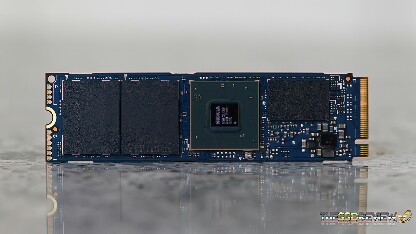
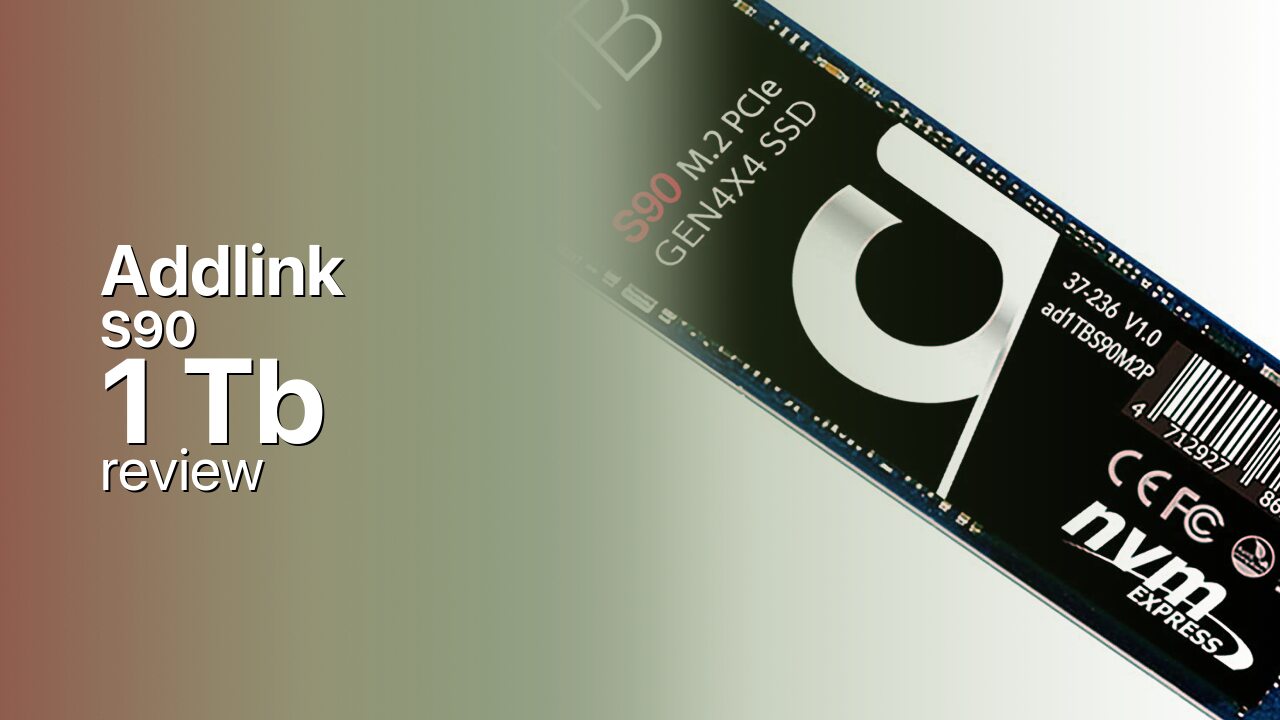
The Addlink S90 is built on the Phison PS5016-E16, the first-generation PCIe 4.0 controller that powered the initial wave of Gen 4 SSDs. It is an 8-channel design with a DDR4 DRAM cache and 3D TLC NAND, delivering rated speeds of 5,000 MB/s sequential read and 4,400 MB/s sequential write. The drive uses the M.2 2280 form factor and the PCIe 4.0 x4 interface. The S90 predates Addlink's more refined S95 (which moved to the second-gen Phison E18) and represents the company's entry into the PCIe 4.0 market.
Addlink does not publish comprehensive specifications for the S90 — endurance (TBW) and random IOPS figures are absent from official materials, which is common for entry-level drives from smaller brands that prioritise cost over documentation. The S90 is also available in a 2 TB capacity. The 1 TB variant reviewed here competes in the budget PCIe 4.0 segment against other first-gen E16 drives like the Corsair MP600, the Sabrent Rocket 4.0, and ADATA's own XPG Gammix S50 — all of which use identical controller silicon with similar speed ratings.
The S90 occupies an odd position: it has the hardware of a flagship (8-channel E16, DDR4 DRAM) but the documentation of a budget drive. Buyers comfortable with the Phison E16 platform know what they are getting — a proven controller with good sustained performance and a DRAM cache. Buyers who want published endurance numbers and detailed spec sheets should look to the S95 or to brand-name competitors that document their products fully.
Storage Comparisons:
S90 Performance & Benchmarks
The S90 is rated at up to 5,000 MB/s sequential reads and 4,400 MB/s sequential writes — standard figures for the Phison E16 platform across all implementations. Random IOPS are not published by Addlink, but the E16 platform typically delivers 700,000—750,000 IOPS for both reads and writes when paired with TLC NAND. In practice, game load times, OS boot speeds, and application launches are indistinguishable from any PCIe 4.0 NVMe drive — the E16's 5,000 MB/s ceiling is more than adequate for consumer workloads.
Addlink S90 1 TB vs M.2 4.0 x 4 peers
Switch between sequential throughput and random IOPS to see how this drive stacks up against other M.2 4.0 x 4 SSDs in our database. The highlighted bar is the drive on this page — click any other bar to open that drive.
- Patriot Viper PV593 1 TB: 14,500 MB/s read, 14,000 MB/s write
- Patriot Viper PV593 2 TB: 14,500 MB/s read, 14,000 MB/s write
- Patriot Viper PV593 4 TB: 14,500 MB/s read, 14,000 MB/s write
- Patriot Viper PV573 2 TB: 14,000 MB/s read, 12,000 MB/s write
- Addlink S90 1 TB (this drive): 5,000 MB/s read, 4,400 MB/s write
Like all E16 drives, the S90 uses a large SLC write cache — likely 150—200 GB on the 1 TB model based on platform behaviour — and direct-to-TLC writes settle in the 1,200—1,500 MB/s range after the cache fills. The E16 controller runs hot: sustained sequential writes will push the controller past 75 °C without a heatsink, triggering thermal throttling. A motherboard M.2 heatsink with case airflow is strongly recommended. The drive is not suited for laptops or fanless enclosures — the thermals are a desktop-only proposition.
Addlink S90 vs Competitors
See how the S90 stacks up against other M.2 4.0 x 4 drives in our database:
Compare with rival drives:
Endurance, TBW & Warranty
Addlink does not publish a TBW endurance rating for the S90 — the official specification sheet omits this figure entirely. The drive carries a 5-year warranty, backed by an 1.8 million hour MTBF. The absence of a published TBW figure is unusual for a PCIe 4.0 drive and makes it difficult to assess how the warranty interacts with write endurance. For context, other Phison E16 drives in the same class were rated at 1,800 TBW for the 1 TB capacity (ADATA XPG Gammix S50) or 700—800 TBW depending on NAND tier. Addlink handles warranty claims through its distribution network. Buyers concerned about endurance should consider the S95 or a brand-name alternative with published TBW figures.
Addlink S90 1 TB Specifications
| Category | Value |
|---|---|
| Capacity [?] | 1 TB |
| Interface [?] | M.2 4.0 x 4 |
| Controller [?] | Phison PS5016-E16 |
| Memory type [?] | 3D TLC |
| DRAM [?] | DDR4 Cache |
| Read speed (MB/s) [?] | 5000 |
| Write speed (MB/s) [?] | 4400 |
| Read IOPS [?] | 750000 |
| Write IOPS [?] | 700000 |
| Endurance (TBW) [?] | 700 |
| MTBF (million hours) [?] | 1.8 |
| Warranty (years) [?] | 5 |
Verdict: Is the S90 Worth It in 2026?
The Addlink S90 1 TB is a Phison E16 drive without the paperwork. It has the same controller, DRAM, and PCIe 4.0 throughput as better-documented competitors, but Addlink's decision not to publish endurance or IOPS figures limits its appeal to buyers who research before purchasing. Buy it if you find it at a clearance price and understand the E16 platform well enough to know what you are getting — a capable first-gen PCIe 4.0 drive with DRAM that needs a heatsink. Skip it if you want published endurance numbers, detailed spec sheets, or the reassurance of a fully documented product — the Addlink S95 or the Corsair MP600 are E16 alternatives with transparent specifications. The S90 is fine silicon in a foggy box, and whether that is acceptable depends entirely on your tolerance for ambiguity.
+ Pros
- 5,000 MB/s reads on the proven Phison E16 PCIe 4.0 controller
- DDR4 DRAM cache for consistent mixed-workload latency
- 8-channel controller handles sustained workloads well
- 5-year warranty
- Same core platform as the Corsair MP600 and Sabrent Rocket 4.0
- Cons
- No published TBW endurance rating — unusual for an NVMe SSD
- No published random IOPS figures
- Phison E16 runs hot and requires a heatsink
- Limited documentation compared to brand-name E16 competitors
- Poor fit for laptops due to thermals and power draw
Buy this or similar SSD Storage:



Video Review
Can an Amazon 1TB SSD compete with a Samsung EVO? Actually... yes | Hardware