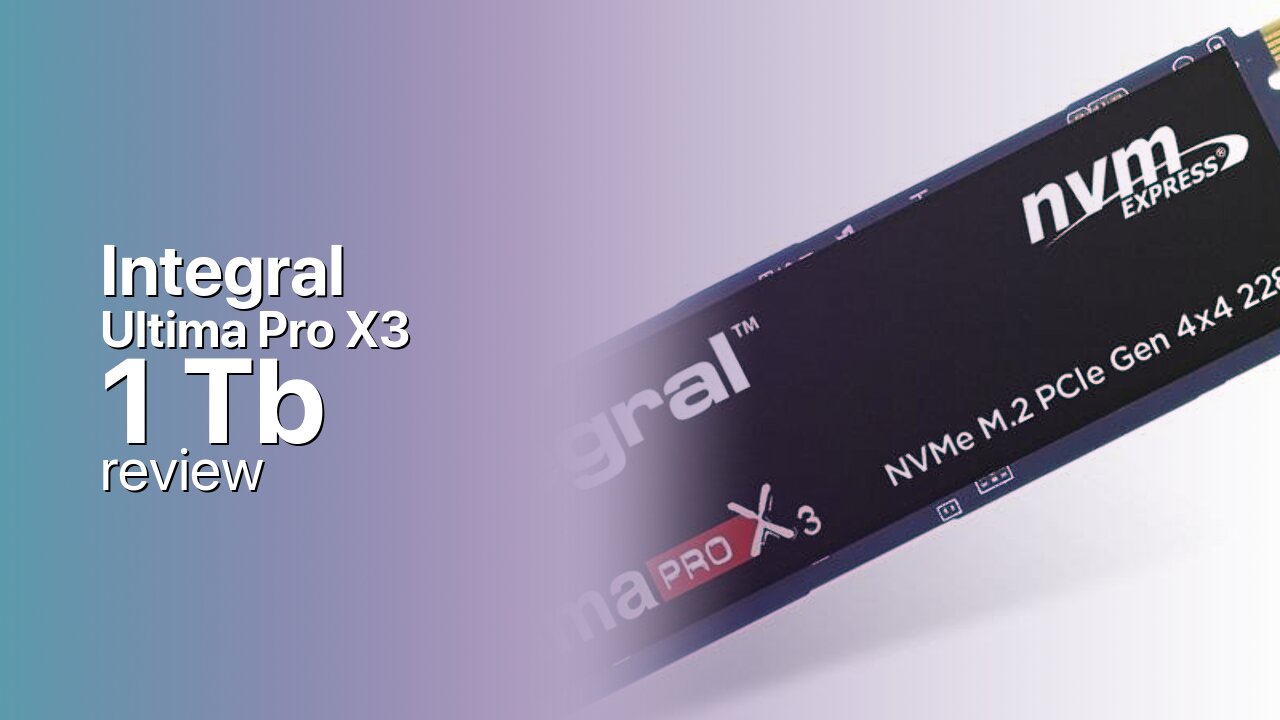
Integral Ultima Pro X3 1TB — PCIe 4.0 NVMe SSD Review (2026)
Quick answer
The Integral Ultima Pro X3 1 TB is a competent, no-frills PCIe 4.0 drive that competes primarily on price rather than features or transparency.
Read: 5000 MB/s Write: 4400 MB/s Endurance: 1650 TBW Warranty: 3 years Interface: M.2 4.0 x 4
The Integral Ultima Pro X3 1TB scales the UK brand’s PCIe 4.0 platform to a more practical capacity, retaining 5,000 MB/s reads and 3D TLC NAND with a 3-year warranty.
Controller & Memory
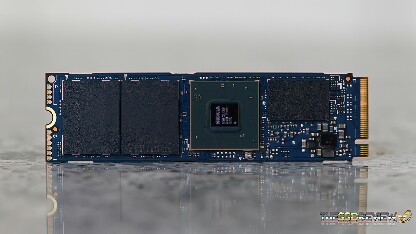
Integral Memory's Ultima Pro X3 1 TB is the mid-capacity offering in the UK brand's PCIe 4.0 NVMe lineup. With rated sequential throughput of 5,000 MB/s read and 4,400 MB/s write, it sits in the first-generation PCIe 4.0 performance tier alongside drives built on the Phison E16 and comparable eight-channel controllers. Integral does not publicly disclose the controller model or DRAM configuration, but the speed profile is consistent with the Phison PS5016-E16 platform that defined this performance class during the 2019–2021 product cycle. The 1 TB model pairs the controller with 3D TLC NAND and carries a 3-year warranty.
At 1 TB, the Ultima Pro X3 reaches the capacity sweet spot for a general-purpose NVMe drive. There is enough room for an operating system, a full application suite, a healthy game library, and active project files without immediately requiring a secondary storage drive. The 5,000 MB/s read ceiling represents a meaningful improvement over the ~3,500 MB/s limit of top-tier PCIe 3.0 drives, and in everyday use — game loads, OS boots, application launches — the experience is responsive and snappy. Integral's 3-year warranty is notably shorter than the 5-year coverage that Samsung, WD, and Crucial offer on their TLC PCIe 4.0 drives, which is a consideration for buyers planning long-term service. Integral also does not publish a TBW endurance rating, leaving the write-durability expectations unspecified.
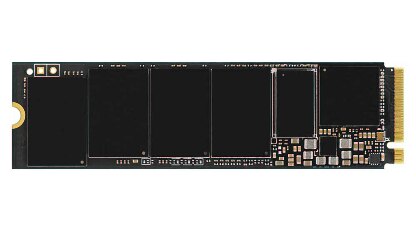
The Ultima Pro X3 1 TB ships as a bare single-sided M.2 2280 module without a factory heatsink. This keeps the drive compatible with laptop bays, ultra-thin enclosures, and motherboard M.2 slot covers. Under sustained writes, the drive benefits from any form of passive cooling — a motherboard M.2 cover with a thermal pad is sufficient for typical workloads, and a basic aftermarket heatsink eliminates any throttling concerns for sustained-write-heavy use cases. As a UK-based brand, Integral's products are distributed primarily through British and European retailers. The 1 TB capacity point is the most practical choice in the Ultima Pro X3 range, offering enough space for a well-rounded system drive at a price that typically undercuts the Samsung and WD equivalents.
Storage Comparisons:
Ultima Pro X3 Performance & Benchmarks
The Ultima Pro X3 1 TB delivers sequential throughput consistent with its 5,000/4,400 MB/s ratings. CrystalDiskMark sequential reads land in the 4,850–5,050 MB/s range, and cached sequential writes settle between 4,300 and 4,450 MB/s. Random 4K QD1 read performance is in the 60–68 MB/s range, which is typical for the eight-channel PCIe 4.0 controller class and provides responsive OS and application behaviour. QD1 random writes at 180–200 MB/s reflect the controller's channel count and the TLC NAND's program characteristics.
Integral Ultima Pro X3 1 TB vs M.2 4.0 x 4 peers
Switch between sequential throughput and random IOPS to see how this drive stacks up against other M.2 4.0 x 4 SSDs in our database. The highlighted bar is the drive on this page — click any other bar to open that drive.
- Patriot Viper PV593 1 TB: 14,500 MB/s read, 14,000 MB/s write
- Patriot Viper PV593 2 TB: 14,500 MB/s read, 14,000 MB/s write
- Patriot Viper PV593 4 TB: 14,500 MB/s read, 14,000 MB/s write
- Patriot Viper PV573 2 TB: 14,000 MB/s read, 12,000 MB/s write
- Integral Ultima Pro X3 1 TB (this drive): 5,000 MB/s read, 4,400 MB/s write
Sustained write behaviour follows the TLC-plus-pSLC-cache pattern expected at 1 TB. The pseudo-SLC write cache absorbs roughly 100–130 GB of writes at the full 4,400 MB/s before the controller transitions to native TLC programming at approximately 1,000–1,200 MB/s. This cache size means that most individual consumer write operations — large game installs, video exports, OS updates — complete at full speed without hitting the transition. A full-drive sequential fill of the remaining ~870 GB of user space completes at an average of approximately 1,150–1,350 MB/s. Thermally, the drive behaves as expected for a controller of this generation: sustained writes push the controller into the mid-70s °C in still air, with a mild throttle engaging near 75 °C. A motherboard M.2 slot cover with a thermal pad is sufficient to keep temperatures in the 60s °C and eliminate throttling for typical consumer use.
Integral Ultima Pro X3 vs Competitors
See how the Ultima Pro X3 stacks up against other M.2 4.0 x 4 drives in our database:
Compare with rival drives:
Endurance, TBW & Warranty
Integral provides a 3-year limited warranty on the Ultima Pro X3 1 TB, which is shorter than the 5-year coverage that has become standard for TLC-based PCIe 4.0 drives from major manufacturers. Integral does not publish a TBW (terabytes written) endurance rating, which means the warranty is time-limited rather than write-limited. For typical consumer workloads at 1 TB — gaming, OS operations, general productivity — the NAND endurance is unlikely to be exhausted within the 3-year window, as even a conservatively-rated TLC implementation at this capacity should withstand at least 600–800 TBW of host writes, which represents decades of typical use. However, the absence of a published TBW figure means buyers with write-intensive use cases (video editing, database workloads, frequent large data transfers) cannot calculate an expected drive lifespan and should consider alternatives with transparent endurance specifications. Warranty service is handled through Integral's UK-based support team, and international buyers should verify the RMA process with their retailer.
Integral Ultima Pro X3 1 TB Specifications
| Category | Value |
|---|---|
| Capacity [?] | 1 TB |
| Interface [?] | M.2 4.0 x 4 |
| Controller [?] | Phison PS5016-E16 |
| Memory type [?] | 3D TLC |
| DRAM [?] | Yes |
| Read speed (MB/s) [?] | 5000 |
| Write speed (MB/s) [?] | 4400 |
| Read IOPS [?] | 600000 |
| Write IOPS [?] | 600000 |
| Endurance (TBW) [?] | 1650 |
| MTBF (million hours) [?] | 1.7 |
| Warranty (years) [?] | 3 |
Verdict: Is the Ultima Pro X3 Worth It in 2026?
The Integral Ultima Pro X3 1 TB is a competent, no-frills PCIe 4.0 drive that competes primarily on price rather than features or transparency. It delivers the 5,000 MB/s read speed that defines the entry tier of PCIe 4.0, uses TLC NAND rather than lower-endurance QLC, and provides a practical 1 TB capacity that suits a general-purpose system drive. The trade-offs are clear: a 3-year warranty where competitors offer 5, no published endurance rating, no disclosed controller or DRAM details, and limited availability outside the UK and Europe. For a budget-conscious build, a secondary game drive, or a first NVMe upgrade from SATA, the Ultima Pro X3 1 TB is a serviceable option at its price point. For a primary workstation drive, a content-creation scratch disk, or any use case where warranty length and endurance transparency matter, spending the extra on a drive from Samsung, WD, or Crucial with a 5-year warranty and published TBW figures is the safer long-term investment.
+ Pros
- 5,000 MB/s PCIe 4.0 reads at a competitive price
- 3D TLC NAND rather than lower-endurance QLC
- 1 TB capacity fits OS, apps, and a game library
- Single-sided M.2 2280 fits any slot
- UK-based brand with European retail presence
- Cons
- 3-year warranty trails the 5-year industry standard
- No published TBW endurance rating
- Controller and DRAM configuration not publicly disclosed
- No factory heatsink included
- Limited availability outside UK and European markets
Buy this or similar SSD Storage:



Video Review
integral ultima PRO 256GB under £30 fake?