Addlink S92 2TB Review — QLC PCIe 4.0 NVMe SSD (2026)
Quick answer
The Addlink S92 2 TB is a purpose-built drive with a narrow but valid use case: bulk PCIe 4.0 storage at the lowest possible cost per gigabyte.
Read: 4900 MB/s Write: 3600 MB/s Endurance: 400 TBW Warranty: 5 years Interface: M.2 4.0 x 4
The Addlink S92 2 TB is the QLC drive you buy when capacity is the only spec that matters — 2 TB of PCIe 4.0 storage with a DRAM cache for less than most TLC 1 TB drives, provided you can live with the endurance and write speed penalties that QLC brings.
Controller & Memory
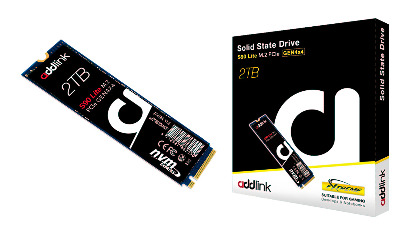
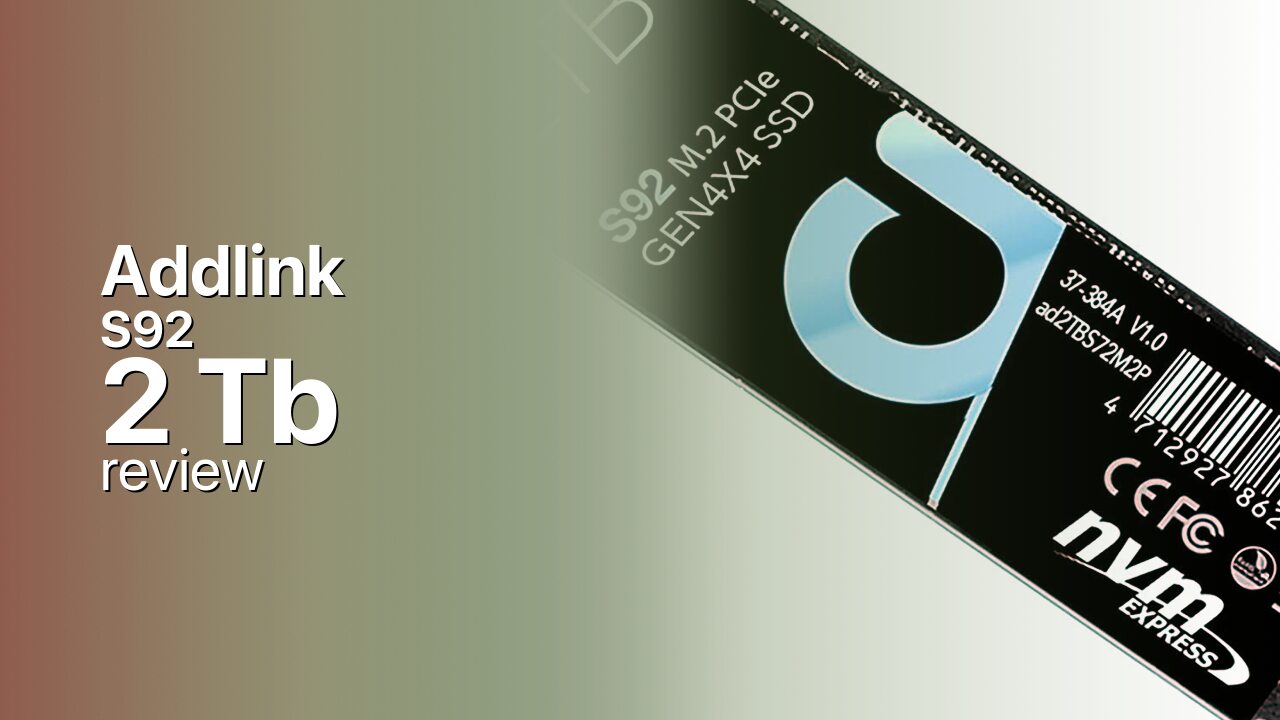
The 2 TB Addlink S92 is the mid-capacity option in Addlink's QLC lineup, built on the Phison PS5016-E16 controller with DDR3 DRAM and Micron 3D QLC NAND. The 2 TB capacity doubles the endurance to 400 TBW and provides a larger SLC write cache than the 1 TB variant — important because QLC's post-cache write speeds are low enough that a bigger cache is the only thing standing between the user and a hard-drive-tier write experience. The drive uses the M.2 2280 form factor with the PCIe 4.0 x4 interface.
Addlink also sells the S92 in 1 TB and 4 TB capacities, with endurance scaling linearly: 200 TBW at 1 TB and 800 TBW at 4 TB. The 2 TB reviewed here is the practical sweet spot — enough space for a substantial game library or media collection, with enough endurance that a typical read-heavy workload will never approach the limit within the warranty period. The S92 competes against other QLC drives like the Corsair MP400 2 TB, Sabrent Rocket Q 2 TB, and Intel 670p 2 TB — all of which share the same QLC-for-capacity trade-off.
Use the S92 2 TB as a game library, a media archive, or a bulk storage drive where reads far outnumber writes. The DRAM cache makes it responsive for launching games and browsing large file collections. Do not use it as a scratch disk for video editing or a write-heavy workstation drive — the QLC NAND will both slow down and wear out faster than a TLC alternative. At 2 TB, the S92 is large enough that most users will fill it once and then read from it for years, which is exactly the workload QLC was designed for.
Storage Comparisons:
S92 Performance & Benchmarks
Addlink rates the S92 2 TB at up to 4,900 MB/s sequential reads and 3,600 MB/s sequential writes — identical to the 1 TB variant. Random performance is rated at up to 350,000 read IOPS and 700,000 write IOPS. The 2 TB capacity benefits from a larger SLC write cache than the 1 TB — typically 120—200 GB when the drive is empty, roughly double the smaller capacity — which means larger game installs and file transfers complete at full speed before the QLC bottleneck appears.
Addlink S92 2 TB vs M.2 4.0 x 4 peers
Switch between sequential throughput and random IOPS to see how this drive stacks up against other M.2 4.0 x 4 SSDs in our database. The highlighted bar is the drive on this page — click any other bar to open that drive.
- Patriot Viper PV593 1 TB: 14,500 MB/s read, 14,000 MB/s write
- Patriot Viper PV593 2 TB: 14,500 MB/s read, 14,000 MB/s write
- Patriot Viper PV593 4 TB: 14,500 MB/s read, 14,000 MB/s write
- Patriot Viper PV573 2 TB: 14,000 MB/s read, 12,000 MB/s write
- Addlink S92 2 TB (this drive): 4,900 MB/s read, 3,600 MB/s write
Once the pSLC cache fills, direct-to-QLC write speeds settle to roughly 200—400 MB/s — comparable to a mechanical hard drive in sequential transfers. For a drive used primarily for game launches and media playback, this is an infrequent event: the initial fill is slow, but subsequent use is almost entirely reads. The Phison E16 controller runs warm, though the QLC NAND's lower sustained write throughput means it generates less heat than TLC E16 implementations. A heatsink is beneficial but not essential for read-heavy use. The drive is not suitable for a laptop without adequate M.2 cooling if sustained writes are expected.
Addlink S92 vs Competitors
See how the S92 stacks up against other M.2 4.0 x 4 drives in our database:
Compare with rival drives:
Endurance, TBW & Warranty
The 2 TB Addlink S92 carries a 400 TBW endurance rating and a 5-year limited warranty. At a typical 20 GB/day write rate — reasonable for a secondary game library drive — this translates to roughly 55 years of service, well beyond the warranty period. At 50 GB/day, the endurance is exhausted in roughly 22 years, still longer than the 5-year warranty. The MTBF is rated at 1.8 million hours. For context, the Intel 670p 2 TB (QLC) is rated at 740 TBW and the Crucial P3 2 TB (QLC) at 440 TBW — the S92's 400 TBW is on the low side for a 2 TB QLC drive but still adequate for read-heavy consumer use. The 4 TB variant doubles endurance to 800 TBW. Addlink handles warranty through its distribution partners.
Addlink S92 2 TB Specifications
| Category | Value |
|---|---|
| Capacity [?] | 2 TB |
| Interface [?] | M.2 4.0 x 4 |
| Controller [?] | Phison PS5016-E16 |
| Memory type [?] | Micron 3D QLC |
| DRAM [?] | DDR3 |
| Read speed (MB/s) [?] | 4900 |
| Write speed (MB/s) [?] | 3600 |
| Read IOPS [?] | 350000 |
| Write IOPS [?] | 700000 |
| Endurance (TBW) [?] | 400 |
| MTBF (million hours) [?] | 1.8 |
| Warranty (years) [?] | 5 |
Verdict: Is the S92 Worth It in 2026?
The Addlink S92 2 TB is a purpose-built drive with a narrow but valid use case: bulk PCIe 4.0 storage at the lowest possible cost per gigabyte. It reads fast, has a DRAM cache, and fits 2 TB into a budget that would only buy 1 TB of TLC from a brand-name competitor. Buy it as a game library or media drive where you fill it once and read from it for years. Skip it as a boot drive, a scratch disk, or a write-heavy workstation drive — QLC endurance and post-cache write speeds are real limitations that a TLC alternative avoids entirely. For a general-purpose 2 TB TLC drive at a competitive price, the WD Blue SN580 or Addlink S93 are stronger all-rounders. The S92 is a specialist, and in the right role it delivers exactly what it promises.
+ Pros
- 4,900 MB/s reads on PCIe 4.0 — fast enough for game loads and media
- 2 TB capacity with DDR3 DRAM at a budget price point
- 400 TBW endurance — adequate for read-heavy secondary storage
- 5-year warranty despite QLC endurance limits
- Larger SLC cache than the 1 TB variant for longer burst writes
- One of the lowest-cost 2 TB DRAM-equipped NVMe drives
- Cons
- Direct-to-QLC write speed drops to 200—400 MB/s after cache fills
- 400 TBW endurance — below most QLC competitors at 2 TB
- DDR3 DRAM is slower than the DDR4 used in TLC E16 designs
- Unsuitable for write-intensive workloads or boot-drive duty
- SLC cache shrinks as the drive fills, accelerating the write cliff
Buy this or similar SSD Storage:



Video Review
Can an Amazon 1TB SSD compete with a Samsung EVO? Actually... yes | Hardware