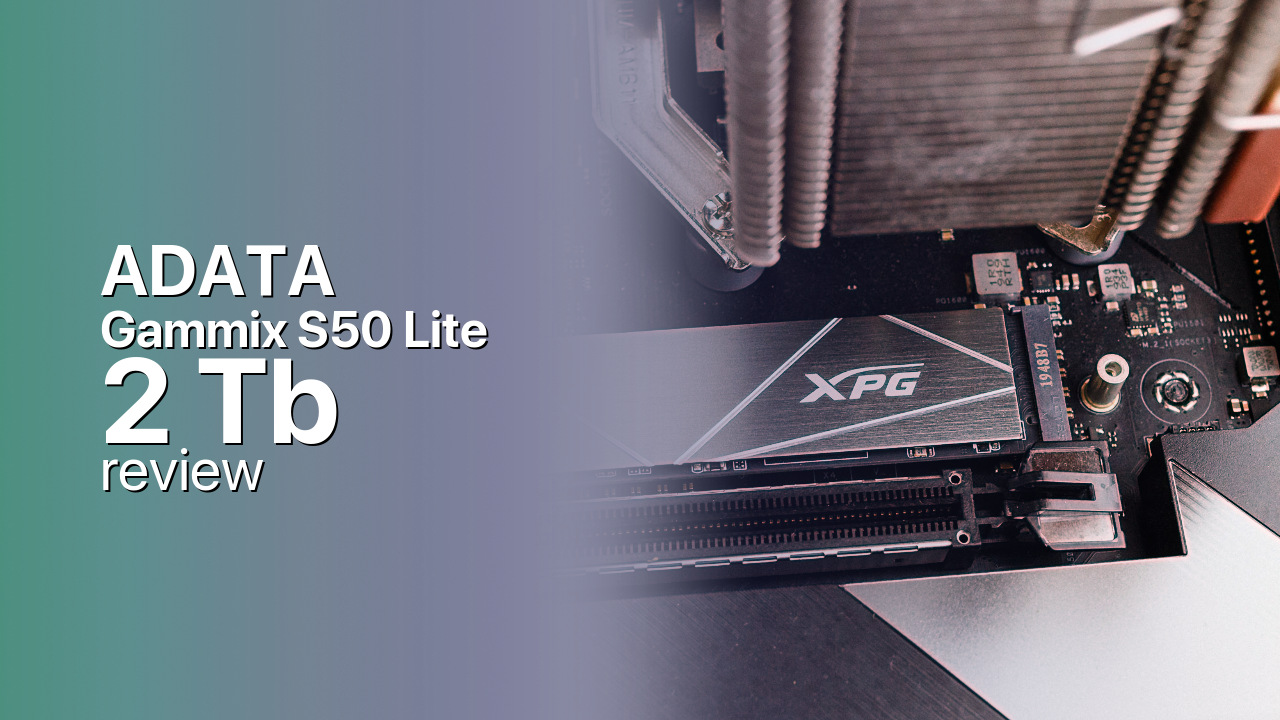
ADATA Gammix S50 Lite 2TB — PCIe 4.0 NVMe SSD Review (2026)
Quick answer
The ADATA Gammix S50 Lite 2 TB is a transitional-generation product that has aged into a specific niche: a DRAM-equipped PCIe 4.0 drive with TLC NAND and generous endurance, sold at a capacity and price where modern alternatives are increasingly DRAM-less.
Read: 3900 MB/s Write: 3200 MB/s Endurance: 1480 TBW Warranty: 5 years Interface: M.2 4.0 x 4
The ADATA Gammix S50 Lite 2 TB is a first-generation PCIe 4.0 drive built on the Silicon Motion SM2267 platform, trading peak Gen4 throughput for mature firmware and cost-effective TLC capacity.
Controller & Memory
The S50 Lite was ADATA's entry into the PCIe 4.0 market, launching during the transition period when Gen4 controllers were scarce and expensive. It uses the Silicon Motion SM2267, a four-channel PCIe 4.0 x4 controller that is DRAM-equipped — unlike the DRAM-less E21T designs that later came to dominate the budget Gen4 segment. ADATA pairs it with Micron 96-layer 3D TLC NAND and DDR4 DRAM, creating a drive that sits between first-generation Gen4 flagships (Phison E16) and modern DRAM-less budget designs in both performance and price positioning. The Lite designation distinguishes it from the full-fat Gammix S50, which used a faster but hotter Phison E16 controller.
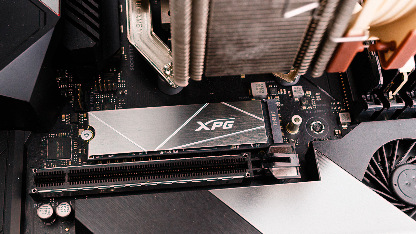
The 2 TB is the largest capacity in the S50 Lite lineup, sitting above the 1 TB variant. Rated speeds are 3,900 MB/s sequential reads and 3,200 MB/s sequential writes — figures that fall between the PCIe 3.0 ceiling (~3,500 MB/s) and the PCIe 4.0 ceiling (~7,000 MB/s), making the S50 Lite a Gen4-lite product that delivers a real but modest throughput uplift over Gen3 drives. Endurance is 1,480 TBW at 2 TB, a 740-TBW-per-terabyte ratio that is competitive with premium TLC drives. The drive uses a double-sided M.2 2280 PCB with a compact aluminium heatsink, part of ADATA's Gammix gaming aesthetic with red accents.
In the value PCIe 4.0 segment, the S50 Lite competes against modern DRAM-less Gen4 drives like the Silicon Power UD90 and Crucial P3 Plus. Its DRAM-equipped SM2267 controller gives it an advantage in sustained mixed-I/O consistency, but its 3,900 MB/s read ceiling trails the 4,800–5,000 MB/s of newer DRAM-less Gen4 controllers. For a PCIe 4.0 system where the buyer values DRAM and endurance over peak sequential numbers, the S50 Lite represents a thoughtful compromise. For a PCIe 3.0 system, the drive is functionally a Gen3-plus product that will never reach its rated speeds.
Storage Comparisons:
XPG Gammix S50 Lite Performance & Benchmarks
ADATA rates the 2 TB S50 Lite at 3,900 MB/s sequential reads and 3,200 MB/s sequential writes with 490,000/540,000 random IOPS. The read figure represents roughly a 10% uplift over the PCIe 3.0 ceiling — measurable but not transformative — while the write figure sits squarely in Gen3 flagship territory. The four-channel SM2267 simply cannot saturate the PCIe 4.0 bus the way eight-channel controllers can.
ADATA XPG Gammix S50 Lite 2 TB vs M.2 4.0 x 4 peers
Switch between sequential throughput and random IOPS to see how this drive stacks up against other M.2 4.0 x 4 SSDs in our database. The highlighted bar is the drive on this page — click any other bar to open that drive.
- Patriot Viper PV593 1 TB: 14,500 MB/s read, 14,000 MB/s write
- Patriot Viper PV593 2 TB: 14,500 MB/s read, 14,000 MB/s write
- Patriot Viper PV593 4 TB: 14,500 MB/s read, 14,000 MB/s write
- Patriot Viper PV573 2 TB: 14,000 MB/s read, 12,000 MB/s write
- ADATA XPG Gammix S50 Lite 2 TB (this drive): 3,900 MB/s read, 3,200 MB/s write
The drive's DRAM cache and Silicon Motion firmware provide the consistency that HMB-based designs sometimes lack. The pseudo-SLC cache on the 2 TB model is large, absorbing roughly 100–150 GB of burst writes before transitioning to native TLC speeds around 600–800 MB/s. Sustained TLC writes at these speeds are SATA-SSD-class, not hard-drive-class — a meaningful advantage over QLC alternatives. The aluminium heatsink provides adequate passive cooling for the SM2267 controller, which runs cooler than the Phison E16 of the full-fat S50. For gaming, the S50 Lite delivers load times that are indistinguishable from any PCIe 3.0 or 4.0 NVMe drive — the gap between 3,900 and 7,000 MB/s reads has no practical impact on game load times. For content creation involving large file transfers, the 2 TB capacity is a bigger asset than the modest Gen4 throughput.
ADATA XPG Gammix S50 Lite vs Competitors
See how the XPG Gammix S50 Lite stacks up against other M.2 4.0 x 4 drives in our database:
Compare with rival drives:
Endurance, TBW & Warranty
ADATA backs the S50 Lite 2 TB with a five-year warranty, bounded by a 1,480 TBW endurance rating. At 30 GB/day, this endurance budget spans roughly 135 years. The 740-TBW-per-terabyte ratio is competitive with premium TLC drives and reflects the maturity of the SM2267 platform and Micron TLC NAND. ADATA's warranty service is handled through regional RMA centres; turnaround times vary by location but are generally competitive with other Taiwanese SSD vendors. The 1 TB S50 Lite carries 740 TBW, maintaining the same per-terabyte ratio.
ADATA XPG Gammix S50 Lite 2 TB Specifications
| Category | Value |
|---|---|
| Capacity [?] | 2 TB |
| Interface [?] | M.2 4.0 x 4 |
| Controller [?] | Silicon Motion SM2267 |
| Memory type [?] | Micron 3D TLC |
| DRAM [?] | HMB SLC |
| Read speed (MB/s) [?] | 3900 |
| Write speed (MB/s) [?] | 3200 |
| Read IOPS [?] | 490000 |
| Write IOPS [?] | 540000 |
| Endurance (TBW) [?] | 1480 |
| MTBF (million hours) [?] | 1500000 |
| Warranty (years) [?] | 5 |
Verdict: Is the XPG Gammix S50 Lite Worth It in 2026?
The ADATA Gammix S50 Lite 2 TB is a transitional-generation product that has aged into a specific niche: a DRAM-equipped PCIe 4.0 drive with TLC NAND and generous endurance, sold at a capacity and price where modern alternatives are increasingly DRAM-less. Its 3,900 MB/s reads will never impress on a benchmark chart next to a 7,000 MB/s E18 drive, but for a game library, media archive, or general-purpose large-capacity SSD, the S50 Lite's combination of DRAM, TLC, and 1,480 TBW endurance makes it a more resilient choice than newer DRAM-less and QLC-based competitors at the same capacity. Buy it if you value DRAM-equipped consistency and endurance at 2 TB over chasing peak sequential numbers that your workload will never reach.
+ Pros
- DRAM-equipped Silicon Motion SM2267 — no HMB compromises
- Micron 96L TLC NAND — consistent sustained writes, no QLC penalty
- 1,480 TBW endurance — 740 TBW/TB, competitive with premium drives
- 2 TB capacity with factory aluminium heatsink included
- 5-year warranty from an established Taiwanese storage vendor
- Cons
- 3,900 MB/s reads — only modestly above the PCIe 3.0 ceiling
- Four-channel controller limits peak Gen4 throughput
- Double-sided PCB — may not fit thin laptops
- Outpaced on peak reads by newer DRAM-less budget Gen4 drives
Buy this or similar SSD Storage:



Video Review
Are Budget PCIe 4 SSDs Worth It?? - ADATA XPG GAMMIX S50 Lite