Addlink X70 512GB SSD — In-Depth Review & Specs (2026)
Quick answer
The Addlink X70 512GB is a well-rounded mid-capacity NVMe drive that combines the proven Phison E12 DRAM-equipped platform with practical storage and an attention-grabbing RGB heatsink.
Read: 3500 MB/s Write: 3000 MB/s Endurance: 763 TBW Warranty: 5 years Interface: M.2 3.0 x 4
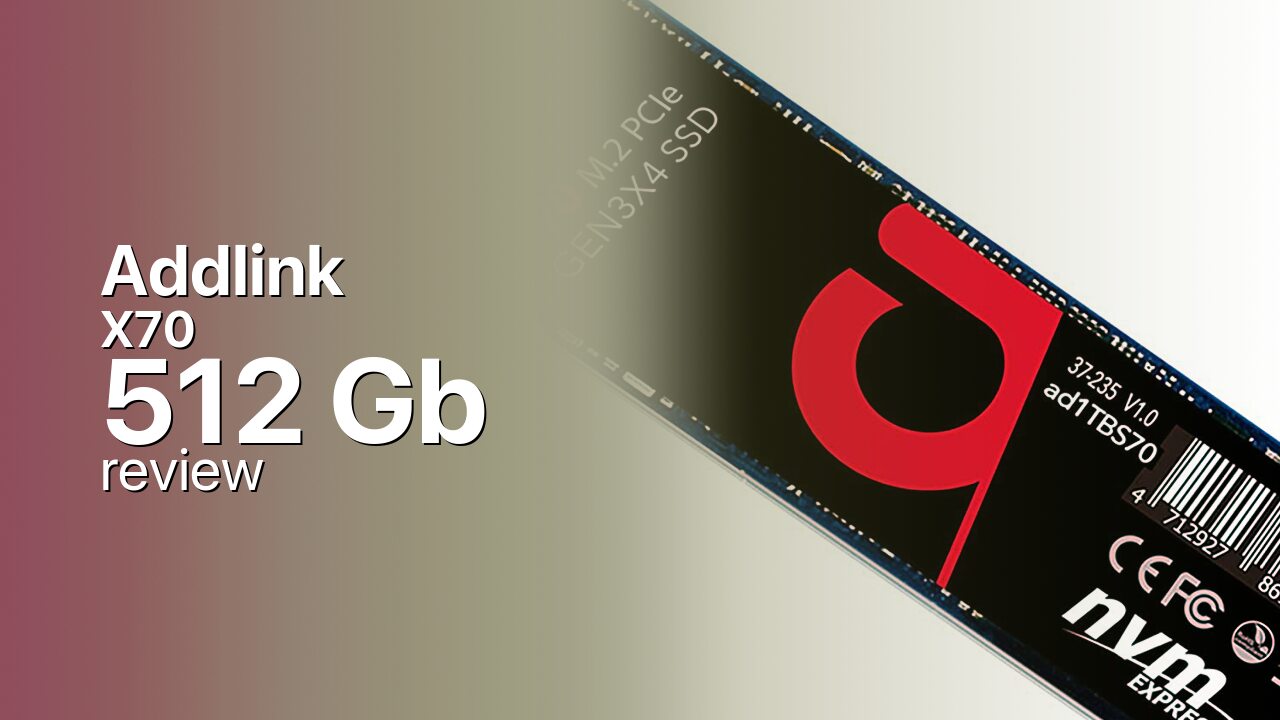
The Addlink X70 512GB is the practical mid-capacity option in Addlink's gaming-focused X70 NVMe line. Built on the proven Phison PS5012-E12 8-channel DRAM-equipped platform with an integrated RGB heatsink, the 512GB model provides enough capacity for an OS, full application suite, and a moderate game library — all on one drive — while delivering the full-fat E12 read performance and consistent mixed-workload latency that DRAM-equipped controllers provide. This review examines how the X70 512GB balances gaming aesthetics, DRAM-equipped performance, and practical capacity.
Controller & Memory
The Phison PS5012-E12 is an 8-channel PCIe 3.0 x4 NVMe controller with a dedicated DRAM interface — the same platform that powers flagship drives across multiple brands. Addlink pairs the E12 with SK Hynix DDR4-2400 DRAM for the flash translation layer and Toshiba 3D TLC NAND behind an SLC write cache. At 512GB, the additional NAND dies per channel compared to the 256GB model improve write parallelism and increase the SLC cache size — typically 60-120 GB dynamically — meaning everyday consumer writes complete at full cache speed without touching native TLC rates.
The X70's standout feature is the integrated aluminum RGB heatsink with addressable lighting. Compatible with ASUS Aura Sync, MSI Mystic Light, Gigabyte RGB Fusion, and ASRock Polychrome, the heatsink eliminates the need for a separate M.2 cooler and adds a distinctive visual element to any windowed build. The aluminum construction provides genuine thermal dissipation, keeping the Phison E12 controller well below throttle temperature under sustained writes — particularly relevant at 512GB where the additional NAND packages generate more heat than the 256GB model.
Endurance is rated at 763 TBW — roughly 0.82 drive-writes-per-day over the 5-year warranty, and more than double the 256GB model's 350 TBW. The drive supports LDPC error correction, end-to-end data path protection, and Phison's thermal throttling firmware. The M.2 2280 form factor with attached heatsink may require checking clearance against motherboard M.2 shrouds.
Storage Comparisons:
X70 Performance & Benchmarks
The Phison E12 platform at 512GB delivers strong sequential read throughput near the PCIe 3.0 x4 ceiling — Windows boots in under 15 seconds, large games load levels in single-digit seconds, and application launches feel instantaneous. Sequential write throughput benefits from the increased NAND parallelism at 512GB compared to the 256GB model, and the large SLC cache absorbs real-world writes transparently.
Addlink X70 512 GB vs M.2 3.0 x 4 peers
Switch between sequential throughput and random IOPS to see how this drive stacks up against other M.2 3.0 x 4 SSDs in our database. The highlighted bar is the drive on this page — click any other bar to open that drive.
- Addlink X70 512 GB (this drive): 3,500 MB/s read, 3,000 MB/s write
- ADATA SX 8800 Pro 512 GB: 3,500 MB/s read, 2,700 MB/s write
- ADATA SX 8800 Pro 1 TB: 3,500 MB/s read, 2,700 MB/s write
- ADATA XPG Spectrix S40G RGB 256 GB: 3,500 MB/s read, 3,000 MB/s write
- ADATA XPG Spectrix S40G RGB 512 GB: 3,500 MB/s read, 3,000 MB/s write
The dedicated SK Hynix DDR4 DRAM cache is the X70's key performance advantage over DRAM-less budget alternatives. Mixed-workload latency stays low and consistent regardless of host system memory pressure — installing Windows updates while working in multiple applications, or running a virus scan alongside your usual workflow, won't cause the latency spikes that DRAM-less HMB designs exhibit under concurrent I/O. For a system drive where unpredictable background tasks create erratic mixed read/write patterns, dedicated DRAM provides a real-world responsiveness benefit.
The integrated RGB heatsink keeps the E12 controller thermally comfortable. At 512GB the additional NAND packages push total power draw higher than the 256GB model, so the heatsink earns its keep — sustained sequential writes that would push a bare E12 past 75C stay in the 60-65C range, well below throttle territory. The RGB lighting adds zero performance overhead, drawing negligible power from the 5V ARGB header. Note that the heatsink adds roughly 3-4mm of height above the M.2 slot — check clearance against CPU air coolers and GPU backplates in compact builds.
Addlink X70 vs Competitors
See how the X70 stacks up against other M.2 3.0 x 4 drives in our database:
Compare with rival drives:
Endurance, TBW & Warranty
Addlink provides a 5-year limited warranty for the X70 512GB, with endurance rated at 763 TBW — roughly 0.82 drive-writes-per-day. The warranty is tied to the original purchaser. The integrated heatsink should not be removed; doing so may void the warranty.
Addlink X70 512 GB Specifications
| Category | Value |
|---|---|
| Capacity [?] | 512 GB |
| Interface [?] | M.2 3.0 x 4 |
| Controller [?] | Phison PS5012-E12-27 |
| Memory type [?] | Toshiba 3D TLC |
| DRAM [?] | SK Hynix DDR4-2400 |
| Read speed (MB/s) [?] | 3500 |
| Write speed (MB/s) [?] | 3000 |
| Read IOPS [?] | 510000 |
| Write IOPS [?] | 500000 |
| Endurance (TBW) [?] | 763 |
| MTBF (million hours) [?] | 1.8 |
| Warranty (years) [?] | 5 |
Verdict: Is the X70 Worth It in 2026?
The Addlink X70 512GB is a well-rounded mid-capacity NVMe drive that combines the proven Phison E12 DRAM-equipped platform with practical storage and an attention-grabbing RGB heatsink. The 512GB capacity is the sweet spot for a single-drive gaming build — OS, applications, and a decent game library all fit without storage anxiety — and the dedicated DRAM cache means it handles the mixed-workload reality of a system drive more gracefully than any DRAM-less alternative. The RGB heatsink is the wildcard: it's either a fun aesthetic bonus or unnecessary bulk depending on your build priorities. Either way, it provides real thermal headroom and eliminates the need for a motherboard M.2 cover. For a mid-range gaming PC where every component is visible and performance matters, the X70 512GB is a solid pick.
+ Pros
- Phison PS5012-E12 — proven 8-channel DRAM-equipped flagship platform
- SK Hynix DDR4-2400 DRAM — consistent mixed-workload latency
- 512GB — practical single-drive capacity for OS, apps, and game library
- 763 TBW endurance — 0.82 DWPD, generous for a 512GB drive
- Integrated RGB heatsink — addressable lighting + genuine thermal dissipation
- 5-year warranty and broad RGB ecosystem support
- Cons
- Integrated heatsink adds height — check clearance in compact builds
- Heatsink cannot be removed without voiding warranty
- Limited brand recognition vs. Samsung, WD, Crucial
- Addlink software ecosystem less developed than major competitors
- No hardware encryption (TCG Opal / Pyrite)
- Phison E12 draws more power than newer Gen4 controllers at this capacity
Buy this or similar SSD Storage:



Video Review
Can an Amazon 1TB SSD compete with a Samsung EVO? Actually... yes | Hardware