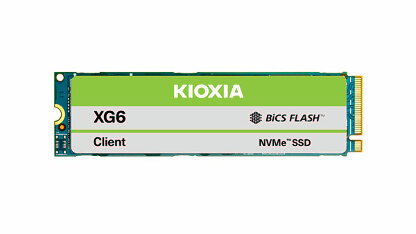
Intel 670P 512GB — Third-Gen QLC NVMe SSD (2026)
Quick answer
The Intel 670P 512GB is a significant improvement over the 660P and one of the better QLC NVMe drives available.
Read: 3500 MB/s Write: 2700 MB/s Endurance: 185 TBW Warranty: 5 years Interface: M.2 3.0 x 4
The Intel 670P 512GB is Intel's third-generation QLC NVMe drive, offering dramatically better performance than the 660P thanks to 144-layer QLC NAND and the Silicon Motion SM2265G controller.
Controller & Memory
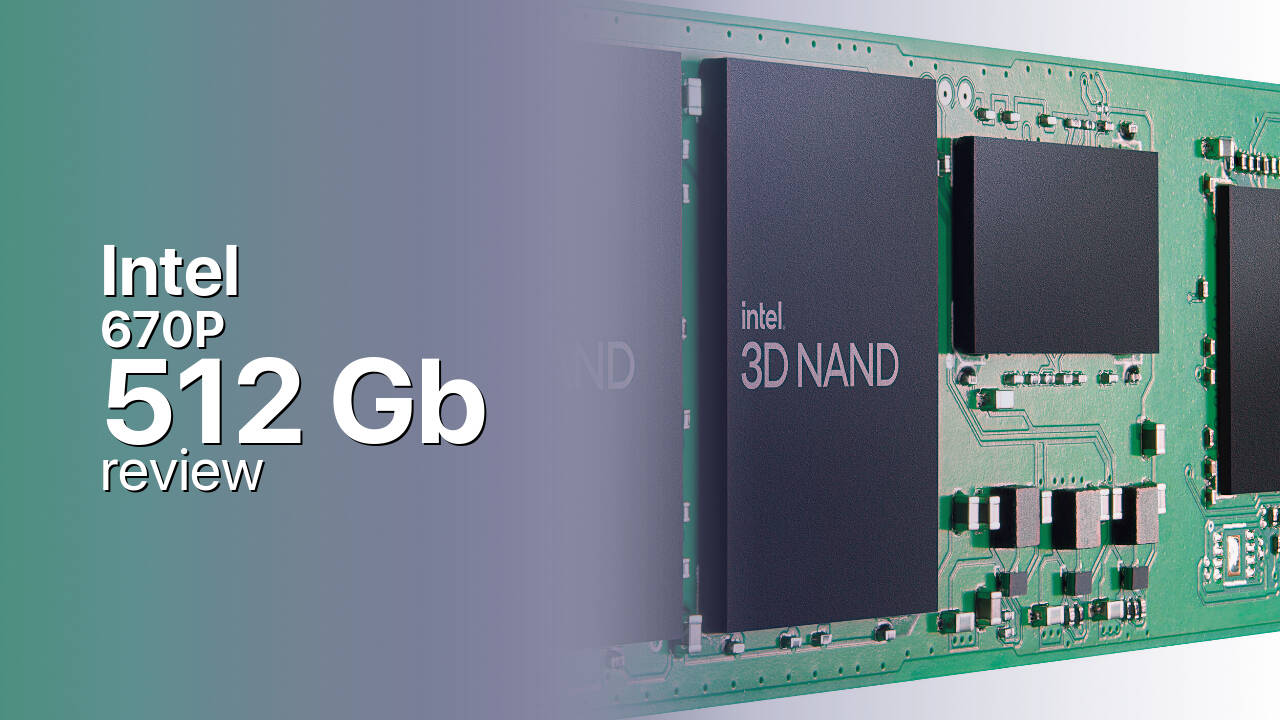
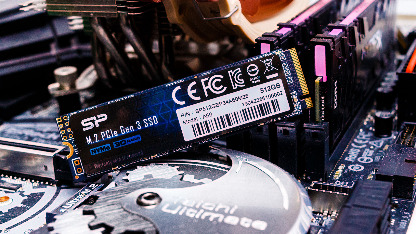
The Intel 670P 512GB uses the Silicon Motion SM2265G controller with Intel 144-layer 3D QLC NAND and 256MB of Nanya DDR3L DRAM. It is a PCIe 3.0 x4 NVMe 1.4 drive in the single-sided M.2 2280 form factor. The 144-layer QLC NAND is a major upgrade over the 660P's 64-layer and the 665P's 96-layer, offering better performance, higher density, and improved endurance.
Sequential performance is rated at up to 3,500 MB/s reads and 2,700 MB/s writes — a massive improvement over the 660P's 1,800/1,800 MB/s and the 665P's 2,000/2,000 MB/s. Random performance reaches 310K read IOPS and 340K write IOPS. These numbers competitive with many TLC Gen3 drives, making the 670P one of the fastest QLC drives available.
The 670P line is available in 512GB, 1TB, and 2TB capacities. The 512GB model has 185 TBW endurance. The 1TB is rated at 370 TBW and the 2TB at 740 TBW. Intel backs the 670P with a 5-year warranty. All capacities are single-sided, making them ideal for laptop upgrades.
The SM2265G controller supports a dynamic SLC cache that scales from 6GB (minimum) to 70GB (maximum) on the 512GB model, depending on free space. This is a significant improvement over previous generations. However, QLC NAND's sustained write limitations still apply — once the SLC cache exhausts, direct-to-QLC write speeds drop to approximately 320 MB/s according to PCMag's testing.
Key rivals include the Samsung 970 EVO Plus 500GB (TLC, 300 TBW, faster sustained writes), the WD Blue SN580 500GB (TLC, similar performance), and the Crucial P3 500GB (QLC, similar tier).
Storage Comparisons:
670P Performance & Benchmarks
The Intel 670P 512GB is rated at up to 3,500 MB/s sequential reads and 2,700 MB/s sequential writes, with random performance up to 310K read IOPS and 340K write IOPS. These represent a generational leap over the 660P (1,800/1,800 MB/s) and 665P (2,000/2,000 MB/s), bringing QLC performance into TLC territory for typical consumer workloads.
Intel 670P 512 GB vs M.2 3.0 x 4 peers
Switch between sequential throughput and random IOPS to see how this drive stacks up against other M.2 3.0 x 4 SSDs in our database. The highlighted bar is the drive on this page — click any other bar to open that drive.
- Intel 670P 512 GB (this drive): 3,500 MB/s read, 2,700 MB/s write
- ADATA SX 8800 Pro 512 GB: 3,500 MB/s read, 2,700 MB/s write
- ADATA SX 8800 Pro 1 TB: 3,500 MB/s read, 2,700 MB/s write
- ADATA XPG Spectrix S40G RGB 256 GB: 3,500 MB/s read, 3,000 MB/s write
- ADATA XPG Spectrix S40G RGB 512 GB: 3,500 MB/s read, 3,000 MB/s write
Independent reviews at AnandTech, Tom's Hardware, PCMag, and StorageReview confirmed the 670P's competitive sequential performance. In real-world use, the 670P feels much faster than the 660P and approaches TLC Gen3 performance for typical consumer workloads including OS boot, application launches, and game loading.
The dynamic SLC cache handles burst writes well, scaling from 6GB to 70GB depending on free space. Once the cache exhausts during sustained large-file writes, throughput drops to approximately 320 MB/s — better than the 660P's ~100-150 MB/s but still noticeably slower than TLC drives. For typical consumer workloads, the cache rarely exhausts. The limitation shows up during large file transfers exceeding the cache size.
The 670P's single-sided design is a practical advantage for laptop compatibility. All capacities fit on one side of the PCB, making the drive compatible with thin-and-light laptops that only accept single-sided M.2 modules.
Intel 670P vs Competitors
See how the 670P stacks up against other M.2 3.0 x 4 drives in our database:
Compare with rival drives:
Endurance, TBW & Warranty
Intel backs the 670P 512GB with a 5-year limited warranty and a 185 TBW endurance rating. At 30 GB of writes per day, that is roughly 16 years of theoretical endurance. The 185 TBW is lower than TLC competitors like the Samsung 970 EVO Plus 500GB (300 TBW) but typical for a QLC drive. Intel's warranty is handled through their support portal.
Intel 670P 512 GB Specifications
| Category | Value |
|---|---|
| Capacity [?] | 512 GB |
| Interface [?] | M.2 3.0 x 4 |
| Controller [?] | Silicon Motion SM2265G |
| Memory type [?] | Intel 144L 3D QLC |
| DRAM [?] | Nanya 256MB DDR3L |
| Read speed (MB/s) [?] | 3500 |
| Write speed (MB/s) [?] | 2700 |
| Read IOPS [?] | 310000 |
| Write IOPS [?] | 340000 |
| Endurance (TBW) [?] | 185 |
| MTBF (million hours) [?] | 1200000 |
| Warranty (years) [?] | 5 |
Verdict: Is the 670P Worth It in 2026?
The Intel 670P 512GB is a significant improvement over the 660P and one of the better QLC NVMe drives available. Its 3,500 MB/s read speed is competitive with TLC Gen3 drives, and the 5-year warranty provides peace of mind. The single-sided design is ideal for laptop upgrades. If you need better sustained write performance or higher endurance, the Samsung 970 EVO Plus 500GB (TLC, 300 TBW) is a better choice. For a budget NVMe drive with good read performance and laptop-friendly form factor, the 670P is a solid option.
+ Pros
- 3,500 MB/s reads — near the PCIe 3.0 x4 ceiling
- 144-layer QLC NAND — major upgrade over 660P/665P
- 5-year warranty
- Single-sided PCB fits thin laptops
- Competitive price for QLC NVMe
- Cons
- 185 TBW endurance — lower than TLC competitors
- Sustained write speed drops to ~320 MB/s after cache
- QLC NAND limits write-heavy workloads
- 512GB capacity may be limiting for some users
Buy this or similar SSD Storage:
Video Review
The Intel 670p NVMe is here! Yes, this is a budget NVMe SSD that you should be excited about.