Corsair MP600 Core 2TB — PCIe 4.0 QLC NVMe SSD Review (2026)
Quick answer
The Corsair MP600 Core 2 TB is the capacity where this QLC lineup starts to make sense.
Read: 4950 MB/s Write: 3700 MB/s Endurance: 450 TBW Warranty: 5 years Interface: M.2 4.0 x 4
The Corsair MP600 Core 2 TB is the sweet spot in Corsair's QLC PCIe 4.0 lineup — fast enough to nearly match TLC drives on reads while offering double the endurance and write speed of the 1 TB model.
Controller & Memory
The 2 TB MP600 Core uses the same Phison PS5016-E16 8-channel controller found across the entire Core series, paired with Micron 96-layer QLC NAND and 2 GB of SK Hynix LPDDR4 DRAM. The additional DRAM and doubled NAND die count compared to the 1 TB model give the controller more parallelism to work with, which is why the 2 TB variant achieves substantially higher write speeds and random IOPS.
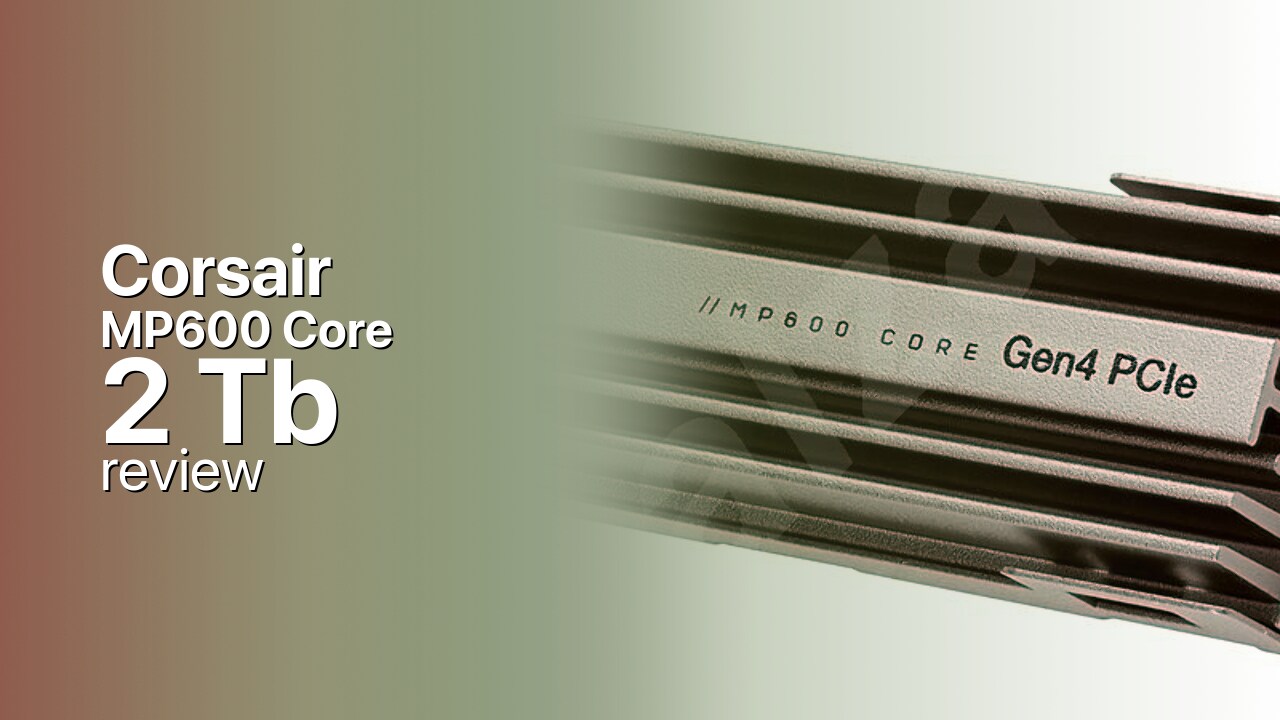
The drive comes with a factory-installed gunmetal aluminum heatsink that uses a tool-free clip design — no tiny screws to lose during installation. It is an M.2 2280 form factor with an NVMe 1.3 protocol over PCIe 4.0 x4, and it works in PCIe 3.0 slots at reduced speeds around 3,400/3,000 MB/s. Also available in 1 TB and 4 TB, with the 4 TB variant offering slightly higher sequential writes at 3,950 MB/s.
Direct competitors include the Sabrent Rocket Q4 2 TB (same Phison E16 platform, similar QLC NAND) and TLC alternatives like the Kingston KC3000 and WD Black SN770. The Corsair\'s advantage is the included heatsink and competitive endurance; its disadvantage is that QLC still writes slower than TLC once the pseudo-SLC cache is exhausted, and the write cliff is steeper than on TLC drives.
The 2 TB model also benefits from a larger pseudo-SLC write cache allocation compared to the 1 TB, which means the buffer absorbs longer sustained write bursts before the QLC native write performance kicks in. For users who frequently move large files but cannot justify the price premium of TLC PCIe 4.0 drives, the 2 TB MP600 Core represents a reasonable middle ground between cost and capability.
Storage Comparisons:
MP600 Core Performance & Benchmarks
Rated at 4,950 MB/s sequential reads and 3,700 MB/s sequential writes, the MP600 Core 2 TB comes close to the PCIe 4.0 interface ceiling on reads. The 380K random read IOPS and 580K random write IOPS represent a significant step up from the 1 TB model. Independent reviewers at Guru3D and AnandTech found that the 2 TB model's pseudo-SLC cache absorbs approximately 40–80 GB of sustained writes before performance degrades to native QLC levels, which can dip below 200 MB/s during long transfers.
Corsair MP600 Core 2 TB vs M.2 4.0 x 4 peers
Switch between sequential throughput and random IOPS to see how this drive stacks up against other M.2 4.0 x 4 SSDs in our database. The highlighted bar is the drive on this page — click any other bar to open that drive.
- Patriot Viper PV593 1 TB: 14,500 MB/s read, 14,000 MB/s write
- Patriot Viper PV593 2 TB: 14,500 MB/s read, 14,000 MB/s write
- Patriot Viper PV593 4 TB: 14,500 MB/s read, 14,000 MB/s write
- Patriot Viper PV573 2 TB: 14,000 MB/s read, 12,000 MB/s write
- Corsair MP600 Core 2 TB (this drive): 4,950 MB/s read, 3,700 MB/s write
For gaming, the MP600 Core 2 TB is effectively indistinguishable from TLC PCIe 4.0 drives in load-time benchmarks. The random-read performance is strong, and PCIe 4.0 bandwidth ensures DirectStorage-capable titles can stream textures without bottlenecking. Where the QLC penalty matters is sustained writes: copying a 200 GB video project or cloning a full drive will expose the cache exhaustion. For most desktop users whose write patterns are bursty rather than sustained, the cache handles the workload without issue.
Corsair MP600 Core vs Competitors
See how the MP600 Core stacks up against other M.2 4.0 x 4 drives in our database:
Compare with rival drives:
Endurance, TBW & Warranty
The Corsair MP600 Core 2 TB is rated for 450 TBW endurance, covered by Corsair's five-year limited warranty. At a typical desktop workload of 30 GB/day, the drive would take over 40 years to exhaust its rated endurance — well beyond the warranty period. The 1.7 million hour MTBF rating is consistent with other Phison E16-based drives. Corsair provides their SSD Toolbox utility for health monitoring, SMART data, and firmware updates. Warranty claims are processed through Corsair's online RMA system, and the drive must be registered to receive the full five-year coverage. Corsair provides their SSD Toolbox utility for health monitoring, S.M.A.R.T. data access, and firmware updates throughout the warranty period.
Corsair MP600 Core 2 TB Specifications
| Category | Value |
|---|---|
| Capacity [?] | 2 TB |
| Interface [?] | M.2 4.0 x 4 |
| Controller [?] | Phison PS5016-E16 |
| Memory type [?] | 3D QLC |
| DRAM [?] | SK Hynix DRAM Cache |
| Read speed (MB/s) [?] | 4950 |
| Write speed (MB/s) [?] | 3700 |
| Read IOPS [?] | 380000 |
| Write IOPS [?] | 580000 |
| Endurance (TBW) [?] | 450 |
| MTBF (million hours) [?] | 1.7 |
| Warranty (years) [?] | 5 |
Verdict: Is the MP600 Core Worth It in 2026?
The Corsair MP600 Core 2 TB is the capacity where this QLC lineup starts to make sense. The 3,700 MB/s writes and 380K random read IOPS are competitive with early TLC PCIe 4.0 drives, and 450 TBW provides generous endurance headroom for a desktop. The included heatsink saves the cost and hassle of a separate purchase. Where it falls short is against current-gen TLC PCIe 4.0 drives like the Kingston KC3000, which offer higher sustained writes and better performance consistency for a similar price. Choose the MP600 Core 2 TB if the included heatsink and generous capacity matter more than peak write consistency, and skip it if you regularly move files larger than 50 GB in a single session.
+ Pros
- 4,950 MB/s sequential reads near PCIe 4.0 ceiling
- 3,700 MB/s writes, nearly double the 1 TB model
- 450 TBW endurance with 5-year warranty
- 2 GB LPDDR4 DRAM cache
- Factory-installed tool-free aluminum heatsink
- Backward-compatible with PCIe 3.0 slots
- Cons
- QLC write speeds drop sharply after SLC cache fills
- No hardware AES 256-bit encryption
- NVMe 1.3, not the newer 1.4 protocol
- Slower sustained writes than TLC alternatives at similar price
Buy this or similar SSD Storage:



Video Review
How Much Faster Is PCIe 4.0 vs 3.0 - Corsair MP600 Review