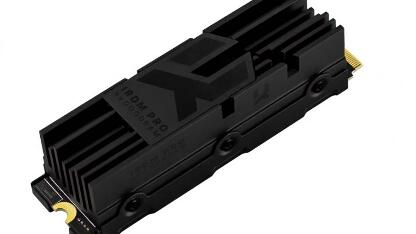
Corsair MP600 Pro LPX 2TB — PS5-Optimized PCIe 4.0 NVMe SSD Review (2026)
Quick answer
The Corsair MP600 Pro LPX 2 TB earns its position as a PS5-first drive by solving the one problem that disqualifies most high-end NVMe SSDs from console use: heatsink clearance.
Read: 7100 MB/s Write: 6800 MB/s Endurance: 3000 TBW Warranty: 5 years Interface: M.2 4.0 x 4
The Corsair MP600 Pro LPX 2 TB is a Phison E18-powered PCIe 4.0 drive whose low-profile aluminium heatsink is specifically engineered to fit the PlayStation 5 expansion bay without clearance issues.
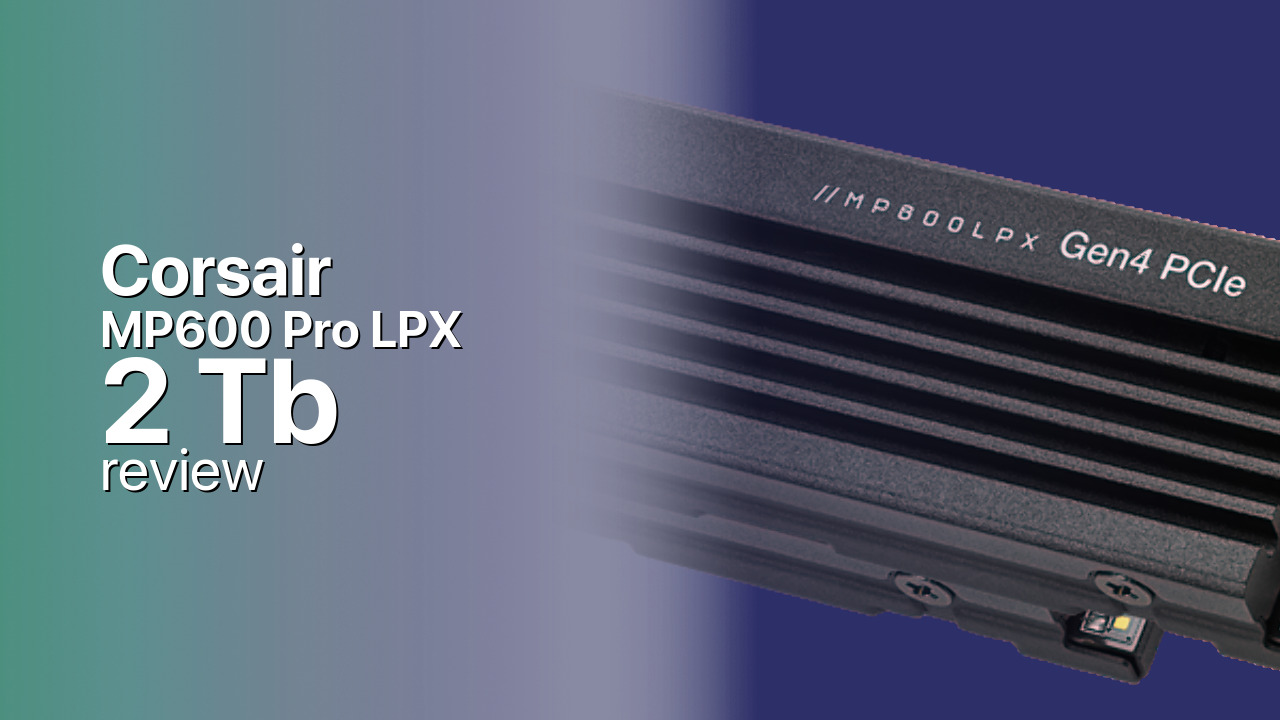
Controller & Memory
The MP600 Pro LPX is built on the Phison PS5018-E18, an eight-channel PCIe 4.0 x4 controller manufactured on a 12 nm process. Corsair pairs it with Micron 96-layer 3D TLC NAND and 1 GB of DDR4 DRAM, a configuration shared with most E18 reference drives including the standard MP600 Pro and the Sabrent Rocket 4 Plus. The LPX differentiator is mechanical: an aluminium heatsink milled to a low-profile shape that stays within Sony's 11.25 mm height limit for the PS5 expansion slot, a constraint that disqualifies many taller third-party M.2 coolers. The heatsink uses a finned design with a dark grey anodised finish, and Corsair ships the drive pre-installed in it — no user assembly required.
The 2 TB variant is the largest capacity in the LPX lineup, sitting above the 500 GB, 1 TB, and 4 TB SKUs. Capacity scaling on the E18 platform is relatively flat: all capacities share the same 7,100 MB/s read and 6,800 MB/s write ratings, though the 500 GB model's write throughput drops slightly due to fewer populated NAND channels. Endurance scales from 700 TBW on 500 GB to 3,000 TBW on 4 TB, with the 2 TB carrying 3,000 TBW at a 1,500-TBW-per-terabyte ratio that is generous even by Phison E18 standards. The drive is double-sided for the 2 TB and 4 TB capacities — a consideration for thin laptop installations where double-sided PCBs may not fit.
In the PS5-targeted PCIe 4.0 segment, the MP600 Pro LPX competes against the WD Black SN850P, Samsung 990 Pro with Heatsink, and the Sabrent Rocket 4 Plus with PS5 heatsink. Corsair's pricing has historically undercut Samsung and WD at equivalent capacities, and the LPX heatsink's clean design with no RGB or aggressive branding fits console-adjacent aesthetics better than some gaming-focused alternatives. For desktop use, the heatsink is functional but not exceptional — a motherboard M.2 cover or a larger third-party finned cooler will outperform it in sustained write scenarios with good case airflow.
Storage Comparisons:
MP600 Pro LPX Performance & Benchmarks
Corsair rates the 2 TB MP600 Pro LPX at 7,100 MB/s sequential reads and 6,800 MB/s sequential writes, within striking distance of the PCIe 4.0 x4 interface ceiling. Random performance is specified at 1,000,000 IOPS read and 1,200,000 IOPS write, figures that place it in the upper tier of E18 implementations alongside the Sabrent Rocket 4 Plus and Kingston KC3000.
Corsair MP600 Pro LPX 2 TB vs M.2 4.0 x 4 peers
Switch between sequential throughput and random IOPS to see how this drive stacks up against other M.2 4.0 x 4 SSDs in our database. The highlighted bar is the drive on this page — click any other bar to open that drive.
- Patriot Viper PV593 1 TB: 14,500 MB/s read, 14,000 MB/s write
- Patriot Viper PV593 2 TB: 14,500 MB/s read, 14,000 MB/s write
- Patriot Viper PV593 4 TB: 14,500 MB/s read, 14,000 MB/s write
- Patriot Viper PV573 2 TB: 14,000 MB/s read, 12,000 MB/s write
- Corsair MP600 Pro LPX 2 TB (this drive): 7,100 MB/s read, 6,800 MB/s write
The Phison E18's pseudo-SLC cache on a 2 TB drive is substantial, absorbing dozens of gigabytes of burst writes at full speed before transitioning to native TLC write speeds around 1,200–1,500 MB/s. Independent reviewers find that the LPX heatsink keeps the drive 5–8 °C cooler than a bare E18 under sustained sequential writes, enough to delay throttling in the PS5's minimally ventilated expansion bay but not enough to eliminate it during large game installs or transfers that run for more than a few minutes. For PC use in a well-ventilated case with a motherboard M.2 cover, thermal throttling is a non-issue. The LPX's real-world gaming performance is indistinguishable from any other PCIe 4.0 flagship — DirectStorage-capable titles and PS5-native games load in seconds regardless of which high-end Gen4 drive sits in the slot.
Corsair MP600 Pro LPX vs Competitors
See how the MP600 Pro LPX stacks up against other M.2 4.0 x 4 drives in our database:
Compare with rival drives:
Endurance, TBW & Warranty
Corsair backs the MP600 Pro LPX 2 TB with a five-year warranty, tied to a 3,000 TBW endurance rating. At 30 GB/day, that budget spans over 270 years — effectively unlimited for any consumer workload. The 500 GB model carries 700 TBW, the 1 TB carries 1,400 TBW, and the 4 TB reaches 3,000 TBW as well. The high TBW-per-terabyte ratio (1,500 TBW/TB) reflects Corsair's confidence in the Micron B27B TLC NAND used on this platform, and it places the LPX above many competing E18 drives that rate the same NAND more conservatively. Corsair's warranty process is handled through their support portal with RMA shipping labels provided in most regions. The drive carries a 1.6-million-hour MTBF rating, standard for E18-based designs.
Corsair MP600 Pro LPX 2 TB Specifications
| Category | Value |
|---|---|
| Capacity [?] | 2 TB |
| Interface [?] | M.2 4.0 x 4 |
| Controller [?] | Phison PS5018-E18 |
| Memory type [?] | Micron 3D TLC |
| DRAM [?] | 1GB DRAM |
| Read speed (MB/s) [?] | 7100 |
| Write speed (MB/s) [?] | 6800 |
| Read IOPS [?] | 1000000 |
| Write IOPS [?] | 1200000 |
| Endurance (TBW) [?] | 3000 |
| MTBF (million hours) [?] | 2000000 |
| Warranty (years) [?] | 5 |
Verdict: Is the MP600 Pro LPX Worth It in 2026?
The Corsair MP600 Pro LPX 2 TB earns its position as a PS5-first drive by solving the one problem that disqualifies most high-end NVMe SSDs from console use: heatsink clearance. Its performance envelope is standard-issue Phison E18 — excellent, but shared with a dozen competitors — so the buying decision hinges on whether the LPX's factory heatsink matters for your use case. PS5 owners who want a guaranteed fit without researching third-party cooler dimensions should buy it. Desktop PC builders who already have motherboard M.2 heatsinks will find the non-LPX MP600 Pro or a competitor like the Kingston KC3000 delivers identical performance at a potentially lower price. For laptop use, verify that your chassis accepts a drive with a pre-installed heatsink, as the LPX's extra height may interfere in thin notebooks.
+ Pros
- 7,100 MB/s sequential reads — effectively saturating PCIe 4.0 x4
- Low-profile aluminium heatsink pre-installed and PS5-compatible
- 3,000 TBW endurance — 1,500 TBW per terabyte, above-class average
- Phison E18 controller with Micron 96L TLC — proven, mature platform
- 5-year warranty with Corsair's established RMA process
- Cons
- Double-sided PCB on 2 TB and 4 TB — may not fit all laptops
- Heatsink adds height that can conflict with motherboard M.2 covers
- Performance identical to non-LPX E18 drives — heatsink is the only differentiator
- No hardware encryption support on Phison E18 consumer firmware
Buy this or similar SSD Storage:



Video Review
Corsair MP600 PRO LPX SSD PS5 Expansion Tests