ADATA XPG Gammix S50 2TB Review — First-Gen PCIe 4.0 NVMe SSD (2026)
Quick answer
Buy the ADATA XPG Gammix S50 2 TB if you need a high-capacity PCIe 4.0 boot and game drive on a budget and you’re comfortable with first-gen performance limits.
Read: 5000 MB/s Write: 4400 MB/s Endurance: 3600 TBW Warranty: 5 years Interface: M.2 4.0 x 4
The ADATA XPG Gammix S50 2 TB was one of the first consumer PCIe 4.0 NVMe drives to market, built on Phison’s E16 controller and still holding its own as a capacious gaming drive in 2026.
Controller & Memory
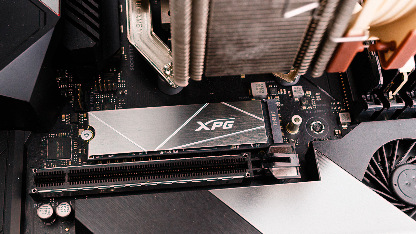
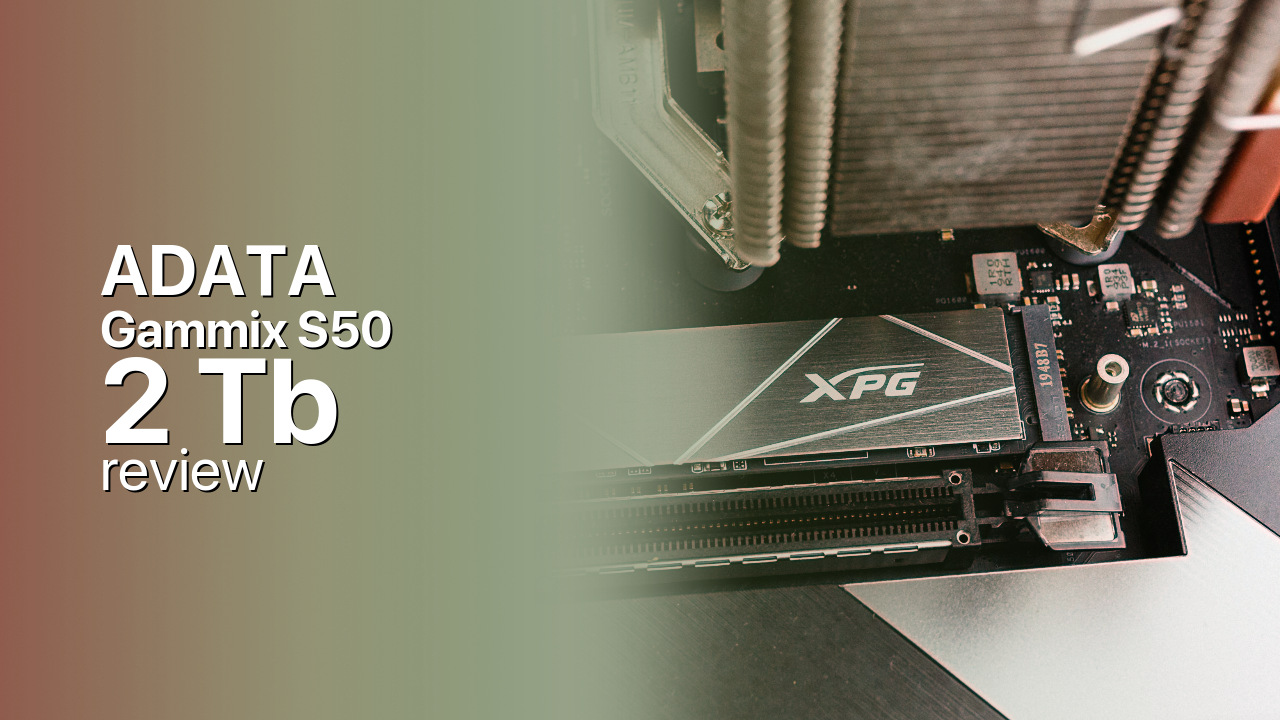
Inside the Gammix S50 2 TB sits the Phison PS5016-E16 controller — the first PCIe 4.0 SSD controller that reached consumers, launched alongside AMD’s X570 platform. It’s paired with Toshiba 96-layer 3D TLC NAND and a DRAM cache buffer, with an SLC caching algorithm to accelerate burst writes. The drive ships with a gunmetal-grey aluminum heatspreader pre-installed, which was essential on early E16 drives that ran warm under sustained load.
This is the 2 TB variant, also available in 1 TB. Both capacities share the same 5,000 MB/s sequential read and 4,400 MB/s write ratings, but endurance scales: the 2 TB offers 3,600 TBW versus 1,800 TBW on the 1 TB model. That’s double the write headroom for content creators who hammer their drives daily. The drive uses a standard M.2 2280 form factor and fits any PCIe 4.0 x4 slot, but the included heatsink adds height — check clearance if you’re installing under a laptop keyboard or in a cramped ITX build.
Compared to its launch-day rivals, the Gammix S50 2 TB trades blows with the Corsair MP600 and Gigabyte Aorus — all E16-based drives with nearly identical performance profiles. Where newer PCIe 4.0 drives like the Samsung 980 Pro or WD SN850X have pushed past 7,000 MB/s, the S50 sits in that first-gen 5 GB/s tier. For most gaming and general use, that gap barely matters in real-world load times. What does matter is that this drive matured: firmware updates improved thermals and sustained write performance since launch, and the 2 TB capacity gives you room for a massive Steam library plus scratch disks for video editing.
PS5 buyers should note that the S50 meets Sony’s 5,500 MB/s+ recommendation and fits within the 110 mm length limit, but the thick factory heatsink may interfere with the PS5’s internal slot cover. You might need to swap it for a low-profile PlayStation-optimized heatsink.
Storage Comparisons:
XPG Gammix S50 Performance & Benchmarks
Rated at 5,000 MB/s sequential reads and 4,400 MB/s writes, the Gammix S50 2 TB hits about double the throughput of the best PCIe 3.0 drives like the Samsung 970 Evo Plus. Random 4K performance comes in at up to 750,000 IOPS for both reads and writes — plenty for OS responsiveness and game asset loading. In practice, you’re looking at sub-second game level loads and near-instant app launches.
ADATA XPG Gammix S50 2 TB vs M.2 4.0 x 4 peers
Switch between sequential throughput and random IOPS to see how this drive stacks up against other M.2 4.0 x 4 SSDs in our database. The highlighted bar is the drive on this page — click any other bar to open that drive.
- Patriot Viper PV593 1 TB: 14,500 MB/s read, 14,000 MB/s write
- Patriot Viper PV593 2 TB: 14,500 MB/s read, 14,000 MB/s write
- Patriot Viper PV593 4 TB: 14,500 MB/s read, 14,000 MB/s write
- Patriot Viper PV573 2 TB: 14,000 MB/s read, 12,000 MB/s write
- ADATA XPG Gammix S50 2 TB (this drive): 5,000 MB/s read, 4,400 MB/s write
The SLC cache on the 2 TB model is substantial but finite. Independent benchmarks consistently show the drive maintaining its full 4,400 MB/s write speed for roughly 150–200 GB of sustained writes, after which it drops to NAND-native speeds of roughly 1,800–2,000 MB/s. For most users, that cache exhaustion point never arrives — you’d need to copy massive video files or disk images daily to hit it consistently. Thermals are the bigger performance limiter: under sustained write workloads, the E16 controller can throttle without adequate airflow. The included heatspreader helps, but a motherboard M.2 shield or a case fan pointed at the slot is recommended if you’re pushing large file transfers regularly.
Versus SATA SSDs, the jump is massive — expect 6–7x faster transfers for large files. Versus PCIe 3.0 NVMe, gains are more modest in real-world use: boot times shave off maybe a second, and game load improvements are often within the margin of error. Where this drive shines is in workflows that move lots of data sequentially: video editing, 3D rendering pipelines, and loading games with massive asset streams.
ADATA XPG Gammix S50 vs Competitors
See how the XPG Gammix S50 stacks up against other M.2 4.0 x 4 drives in our database:
Compare with rival drives:
Endurance, TBW & Warranty
ADATA backs the Gammix S50 2 TB with a 5-year warranty rated at 3,600 TBW endurance. That terabytes-written figure means you can write 3.6 petabytes to the drive before the warranty expires — roughly 2 TB of writes per day for five years straight. At a more typical enthusiast workload of 50 GB/day, that’s nearly 200 years of theoretical endurance. The warranty itself is standard for consumer SSDs: covers defects and failure under normal use, but not physical damage or unauthorized modifications.
Note that the 5-year term is tied to either elapsed time OR hitting the TBW limit, whichever comes first. If you somehow write 3,600 TB within three years, the warranty ends early. For comparison, the 1 TB model offers 1,800 TBW — exactly half, confirming that endurance scales linearly with capacity. MTBF isn’t prominently specified in ADATA’s consumer materials, but Phison E16-based drives typically target 2 million hours, which is industry-standard for this tier. RMA processing goes through ADATA’s regional distributors; check your local retailer’s policy for exchange convenience.
ADATA XPG Gammix S50 2 TB Specifications
| Category | Value |
|---|---|
| Capacity [?] | 2 TB |
| Interface [?] | M.2 4.0 x 4 |
| Controller [?] | Phison PS5016-E16 |
| Memory type [?] | Toshiba 3D TLC |
| DRAM [?] | DRAM SLC |
| Read speed (MB/s) [?] | 5000 |
| Write speed (MB/s) [?] | 4400 |
| Read IOPS [?] | 750000 |
| Write IOPS [?] | 750000 |
| Endurance (TBW) [?] | 3600 |
| MTBF (million hours) [?] | 2000000 |
| Warranty (years) [?] | 5 |
Verdict: Is the XPG Gammix S50 Worth It in 2026?
Buy the ADATA XPG Gammix S50 2 TB if you need a high-capacity PCIe 4.0 boot and game drive on a budget and you’re comfortable with first-gen performance limits. It’s ideal for AMD X570/B550 or Intel Z590/Z690 upgraders who want double the storage space without paying the premium for flagship 7 GB/s drives. The 3,600 TBW rating and DRAM cache make it a solid scratch disk for 1080p or light 4K video editing.
Skip it if you’re building a new rig from scratch and can afford the jump to a PCIe 4.0 drive with a newer Phison E18 or Samsung Pascal controller — those push past 7,000 MB/s and run cooler for a small price premium. Also skip if you’re specifically targeting PS5 expansion, where the factory heatsink may require modification. Consider the Corsair MP600 or WD Black SN850X as alternatives: the MP600 is essentially the same drive with a different heatsink design, while the SN850X offers significantly better sustained write performance if you can spare the extra cost.
The S50 2 TB is a competent, if aging, PCIe 4.0 drive that does nothing badly. It’s not the fastest SSD on the shelf in 2026, but at 2 TB it’s a practical workhorse that has benefited from years of firmware refinement. Gamers and general users will find it indistinguishable from newer drives in day-to-day use, and the price per gigabyte is often attractive.
+ Pros
- 5,000 MB/s sequential reads, 4,400 MB/s writes
- 3,600 TBW endurance on the 2 TB model
- DRAM cache buffer plus SLC caching
- Includes aluminum heatspreader
- 5-year warranty coverage
- Competitive price-per-GB at 2 TB capacity
- Cons
- Slower than newer PCIe 4.0 drives (7,000+ MB/s)
- Thermal throttling under sustained writes without airflow
- Thick factory heatsink may conflict with some PS5 setups
- First-gen E16 controller, not the fastest for random workloads
Buy this or similar SSD Storage:



Video Review
Are Budget PCIe 4 SSDs Worth It?? - ADATA XPG GAMMIX S50 Lite