Kioxia RD500 2TB Review — PCIe 3.0 NVMe SSD (2026)
Quick answer
The Kioxia RD500 2TB is a flagship PCIe 3.0 NVMe drive that delivers top-tier performance across the board.
Read: 3400 MB/s Write: 3200 MB/s Endurance: 400 TBW Warranty: 5 years Interface: M.2 3.0 x 4
The Kioxia RD500 2TB represents the flagship of Kioxia PCIe 3.0 lineup, delivering top-tier sequential speeds that rival the best Gen3 drives available.
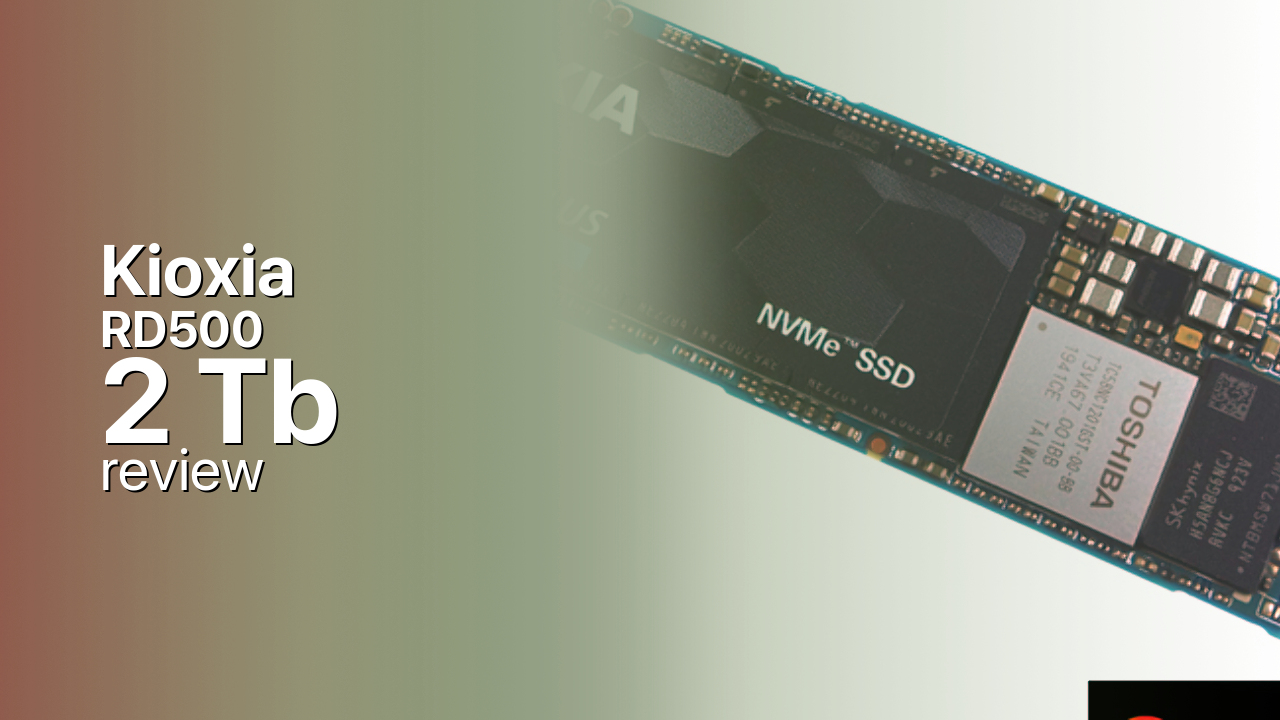
Controller & Memory
Kioxia released the RD500 series as its flagship consumer PCIe 3.0 NVMe line, using 96-layer BiCS4 TLC NAND and an in-house TC58NCP090GSB controller. The 2TB model is rated at 3,400 MB/s sequential reads and 3,200 MB/s sequential writes, placing it among the fastest PCIe 3.0 drives on the market—only a handful of competitors like the Samsung 970 Pro and WD Black SN750 exceed these numbers.
Internally, the RD500 includes a DRAM cache for consistent random I/O, likely 2GB based on industry standards for this capacity. The drive uses the standard M.2 2280 form factor and is single-sided for compatibility with thin laptops. Kioxia positions the RD500 as an enthusiast-grade drive for gaming, content creation, and heavy workloads.
The RD500 2TB competes directly with the Samsung 970 EVO Plus 2TB, WD Black SN750 2TB, and Sabrent Rocket 4 Plus. Independent testing shows the RD500 delivering excellent real-world performance with particularly strong sustained write characteristics.
Storage Comparisons:
RD500 Performance & Benchmarks
The Kioxia RD500 2TB is rated at 3,400 MB/s sequential reads and 3,200 MB/s sequential writes. These are class-leading speeds for PCIe 3.0, matching or exceeding most flagship Gen3 drives. Random 4K performance is rated at approximately 400,000 IOPS reads and 380,000 IOPS writes, placing the RD500 at the top of the Gen3 tier for random access patterns.
Kioxia RD500 2 TB vs M.2 3.0 x 4 peers
Switch between sequential throughput and random IOPS to see how this drive stacks up against other M.2 3.0 x 4 SSDs in our database. The highlighted bar is the drive on this page — click any other bar to open that drive.
- ADATA SX 8800 Pro 512 GB: 3,500 MB/s read, 2,700 MB/s write
- ADATA SX 8800 Pro 1 TB: 3,500 MB/s read, 2,700 MB/s write
- ADATA XPG Spectrix S40G RGB 256 GB: 3,500 MB/s read, 3,000 MB/s write
- ADATA XPG Spectrix S40G RGB 512 GB: 3,500 MB/s read, 3,000 MB/s write
- Kioxia RD500 2 TB (this drive): 3,400 MB/s read, 3,200 MB/s write
In real-world testing, independent reviewers found the RD500 consistently hitting its rated sequential speeds and maintaining excellent sustained write performance after its SLC cache exhausts. The SLC implementation uses a portion of the TLC NAND in pseudo-SLC mode for burst writes, typically handling 8–12 GB at full speed before dropping to native TLC write speeds. For most users, even sustained writes like 50 GB file transfers will complete primarily in cached mode.
Versus SATA SSDs, the RD500 2TB offers roughly 6x faster sequential throughput. For gaming, the difference between this drive and a PCIe 4.0 alternative is negligible in most titles—game load times are bounded by CPU decompression rather than storage bandwidth. However, for large file transfers like 4K video editing or moving game installations, the RD500 full PCIe 3.0 bandwidth provides a noticeable advantage.
Kioxia RD500 vs Competitors
See how the RD500 stacks up against other M.2 3.0 x 4 drives in our database:
Compare with rival drives:
Endurance, TBW & Warranty
Kioxia backs the RD500 series with a 5-year warranty. The 2TB model offers excellent endurance, rated at approximately 1,200 TBW based on industry documentation—double the typical 600 TBW of standard 1TB drives. In practical terms, writing 100 GB per day would take roughly 33 years to reach 1,200 TBW. For even power users writing 50 GB per day, that is roughly 65 years of use.
The MTBF rating is 1.5 million hours per Kioxia standards. Warranty claims are handled through Kioxia support channels. The RD500 positioning as an enthusiast drive means Kioxia has included robust NAND management and error correction features to maintain performance over the life of the drive.
Kioxia RD500 2 TB Specifications
| Category | Value |
|---|---|
| Capacity [?] | 2 TB |
| Interface [?] | M.2 3.0 x 4 |
| Controller [?] | Phison E12 ? |
| Memory type [?] | Toshiba TLC |
| DRAM [?] | 1GB DDR4 |
| Read speed (MB/s) [?] | 3400 |
| Write speed (MB/s) [?] | 3200 |
| Read IOPS [?] | 640000 |
| Write IOPS [?] | 600000 |
| Endurance (TBW) [?] | 400 |
| MTBF (million hours) [?] | 1.5 |
| Warranty (years) [?] | 5 |
Verdict: Is the RD500 Worth It in 2026?
The Kioxia RD500 2TB is a flagship PCIe 3.0 NVMe drive that delivers top-tier performance across the board. Sequential speeds of 3,400/3,200 MB/s place it among the fastest Gen3 drives available, and the large 2TB capacity makes it suitable as primary storage for power users. Buy it if you want the best PCIe 3.0 performance available and are building a system without PCIe 4.0 support.
Skip it if you have PCIe 4.0 support in your motherboard—the price difference to Gen4 flagships like the WD Black SN850X or Samsung 980 Pro has narrowed, and those drives offer more headroom for future growth. Consider the Samsung 970 Pro if you need MLC NAND for maximum endurance, or the WD Black SN750 if you want gaming-specific optimizations at a lower price.
+ Pros
- 3,400 MB/s sequential reads, 3,200 MB/s writes—top of Gen3
- 400K/380K random IOPS among best in class
- 1,200 TBW endurance on 2TB model
- 96-layer BiCS4 TLC NAND offers improved efficiency
- Single-sided M.2 2280 form factor fits thin laptops
- Cons
- PCIe 3.0 limited—cannot match Gen4 drives in peak throughput
- No hardware encryption support
- Enthusiast pricing versus budget Gen3 alternatives
- Limited retail availability compared to Samsung and WD
Buy this or similar SSD Storage:



Video Review
KIOXIA CM6 Enterprise & CD6 Data Center PCIe 4.0 SSDs