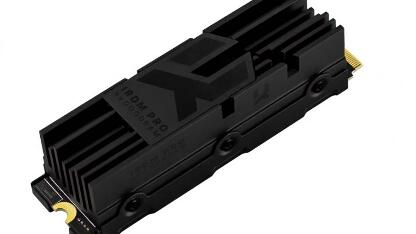
Addlink H90 2TB Review — Phison E16 PCIe 4.0 NVMe SSD (2026)
Quick answer
The Addlink H90 2 TB is the endurance champion of Addlink's E16 lineup — a fully documented, DRAM-equipped PCIe 4.0 drive whose 3,600 TBW rating makes the most demanding write workloads irrelevant.
Read: 5000 MB/s Write: 4400 MB/s Endurance: 3600 TBW Warranty: 5 years Interface: M.2 4.0 x 4
The Addlink H90 2 TB doubles the already-exceptional endurance of the 1 TB variant to 3,600 TBW, making it one of the few 2 TB drives ever sold where the warranty is genuinely more likely to expire than the NAND — by a margin measured in centuries.
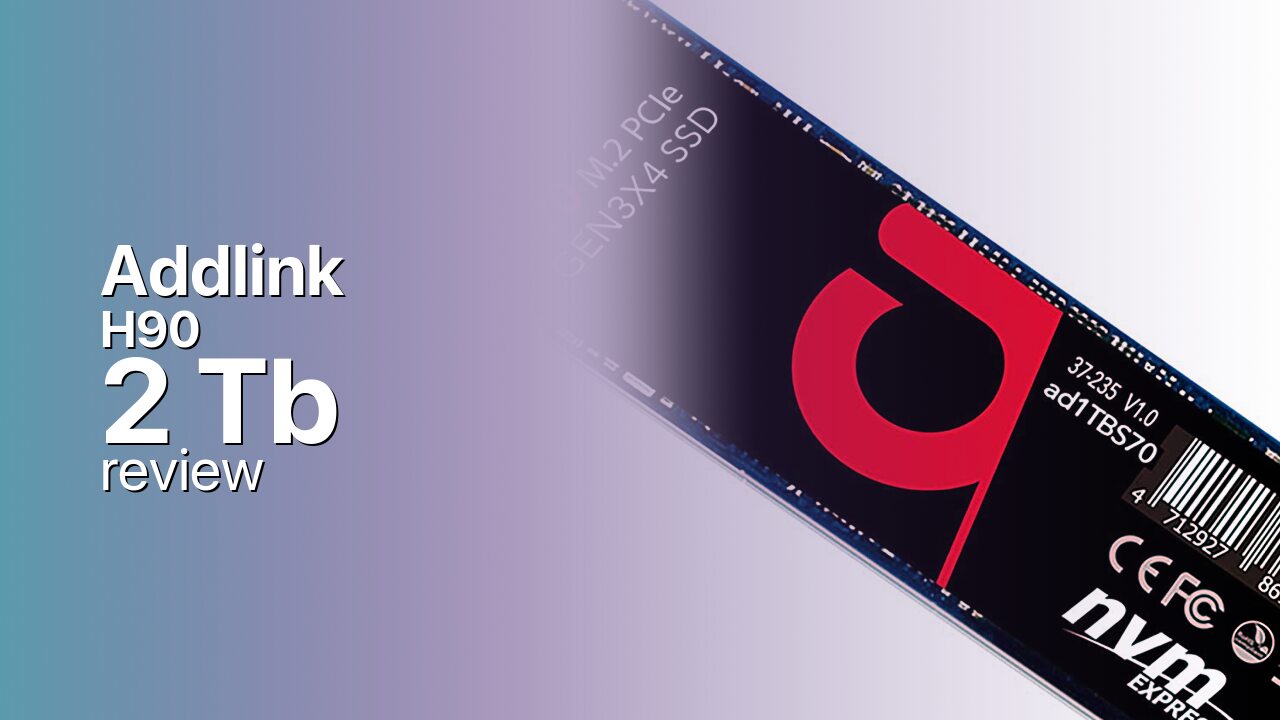
Controller & Memory
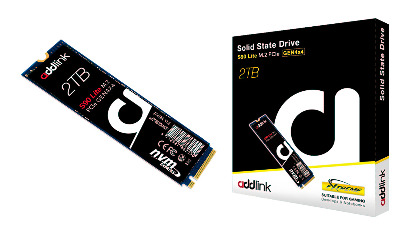
The 2 TB Addlink H90 is built on the same Phison PS5016-E16 platform as the 1 TB variant — an 8-channel PCIe 4.0 controller with DDR4 DRAM and 3D TLC NAND. The 2 TB capacity doubles the endurance to 3,600 TBW and provides a larger SLC write cache by virtue of the additional NAND. Sequential speeds remain 5,000 MB/s read and 4,400 MB/s write — the E16 controller ceiling is the same regardless of capacity. The drive uses a double-sided M.2 2280 PCB with the PCIe 4.0 x4 interface.
The H90 family includes 1 TB and 2 TB capacities, with endurance scaling linearly: 1,800 TBW at 1 TB and 3,600 TBW at 2 TB. The 2 TB reviewed here is the fully documented E16 pick for buyers who want maximum endurance in a single-drive desktop solution. It competes against other E16 2 TB drives — the Corsair MP600 2 TB, the Sabrent Rocket 4.0 2 TB, and ADATA's XPG Gammix S50 2 TB — all of which share the same controller DNA with minor variations in NAND vendor and firmware.
The H90 2 TB is a desktop drive through and through. The E16 requires a heatsink and airflow, and the double-sided PCB may not clear thin M.2 slots in ITX boards or laptops. For a standard ATX desktop build with an M.2 heatsink, it is a capable and fully documented 2 TB PCIe 4.0 drive with endurance numbers that make modern flagships look disposable by comparison.
Storage Comparisons:
H90 Performance & Benchmarks
The H90 2 TB is rated at up to 5,000 MB/s sequential reads and 4,400 MB/s sequential writes — identical to the 1 TB. Random performance is rated at up to 750,000 read IOPS and 700,000 write IOPS. In practice, game loads and desktop use are indistinguishable from any PCIe 4.0 NVMe drive. The 2 TB capacity benefits from a larger SLC write cache (roughly 300—400 GB) and greater NAND parallelism, which helps sustain higher post-cache write speeds compared to the 1 TB.
Addlink H90 2 TB vs M.2 4.0 x 4 peers
Switch between sequential throughput and random IOPS to see how this drive stacks up against other M.2 4.0 x 4 SSDs in our database. The highlighted bar is the drive on this page — click any other bar to open that drive.
- Patriot Viper PV593 1 TB: 14,500 MB/s read, 14,000 MB/s write
- Patriot Viper PV593 2 TB: 14,500 MB/s read, 14,000 MB/s write
- Patriot Viper PV593 4 TB: 14,500 MB/s read, 14,000 MB/s write
- Patriot Viper PV573 2 TB: 14,000 MB/s read, 12,000 MB/s write
- Addlink H90 2 TB (this drive): 5,000 MB/s read, 4,400 MB/s write
Like all E16 drives, the H90 uses a pSLC cache to absorb burst writes, with direct-to-TLC writes settling to roughly 1,200—1,500 MB/s after the cache fills. Sustained sequential writes demand a heatsink — the E16 will hit 75 °C and thermal-throttle within minutes on a bare drive. A motherboard M.2 heatsink with case airflow is the minimum requirement. The drive is not suited for laptops or passive-cooled enclosures.
Addlink H90 vs Competitors
See how the H90 stacks up against other M.2 4.0 x 4 drives in our database:
Compare with rival drives:
Endurance, TBW & Warranty
The 2 TB Addlink H90 carries a 3,600 TBW endurance rating and a 5-year limited warranty. At a typical 50 GB/day write rate, this translates to roughly 200 years of continuous use — the warranty will expire long before the NAND cells approach their endurance ceiling. The MTBF is rated at 1.8 million hours. For comparison, the Samsung 990 Pro 2 TB is rated at 1,200 TBW and the WD Black SN850X 2 TB at 1,200 TBW — the H90 offers triple. The Phison E16 platform's endurance figures are a consequence of conservative NAND management and heavy over-provisioning from an era before manufacturers aggressively trimmed endurance to reduce cost. Addlink handles warranty through its distribution network.
Addlink H90 2 TB Specifications
| Category | Value |
|---|---|
| Capacity [?] | 2 TB |
| Interface [?] | M.2 4.0 x 4 |
| Controller [?] | Phison PS5016-E16 |
| Memory type [?] | 3D TLC |
| DRAM [?] | DDR4 Cache |
| Read speed (MB/s) [?] | 5000 |
| Write speed (MB/s) [?] | 4400 |
| Read IOPS [?] | 750000 |
| Write IOPS [?] | 700000 |
| Endurance (TBW) [?] | 3600 |
| MTBF (million hours) [?] | 1.8 |
| Warranty (years) [?] | 5 |
Verdict: Is the H90 Worth It in 2026?
The Addlink H90 2 TB is the endurance champion of Addlink's E16 lineup — a fully documented, DRAM-equipped PCIe 4.0 drive whose 3,600 TBW rating makes the most demanding write workloads irrelevant. Buy it if endurance is your primary concern, you have a desktop with M.2 cooling, and you value a complete spec sheet from a smaller brand. Skip it if you need modern PCIe 4.0 speeds — the second-gen E18 drives offer 40% more throughput — or if you need a laptop-compatible drive. The H90 2 TB is a specialist: a write-heavy workhorse whose endurance headroom borders on absurd, and for the right desktop workload, that is exactly the point.
+ Pros
- 3,600 TBW endurance — triple most modern 2 TB SSDs
- 5,000 MB/s reads on the proven Phison E16 controller
- DDR4 DRAM cache for consistent mixed-workload latency
- 750,000 read IOPS and 700,000 write IOPS
- 5-year warranty with fully published specifications
- Larger SLC cache than the 1 TB variant for sustained bursts
- Cons
- Phison E16 runs hot — heatsink and airflow required
- 4,400 MB/s writes trail second-gen PCIe 4.0 drives
- Double-sided PCB may not fit all M.2 slots
- Desktop-only — unsuitable for laptops
- First-gen PCIe 4.0 speeds surpassed by modern DRAM-less drives
Buy this or similar SSD Storage:



Video Review
Android Box H96 Max Test