Intel Optane SSD 900P 480GB Review (2026)
Quick answer
The Intel Optane 900P 480GB is the more practical of the two 900P capacities, offering enough space for a working set of databases, virtual machines, or development projects while retaining the class-leading random I/O consistency of 3D XPoint memory.
Read: 2500 MB/s Write: 2000 MB/s Endurance: 8760 TBW Warranty: 5 years Interface: PCIe 3.0 x 4 or U.2 2.5"
The Intel Optane 900P 480GB doubles the capacity of the 280 GB model while retaining the same 3D XPoint low-latency random I/O performance and delivering 8,760 TBW of write endurance.
Controller & Memory
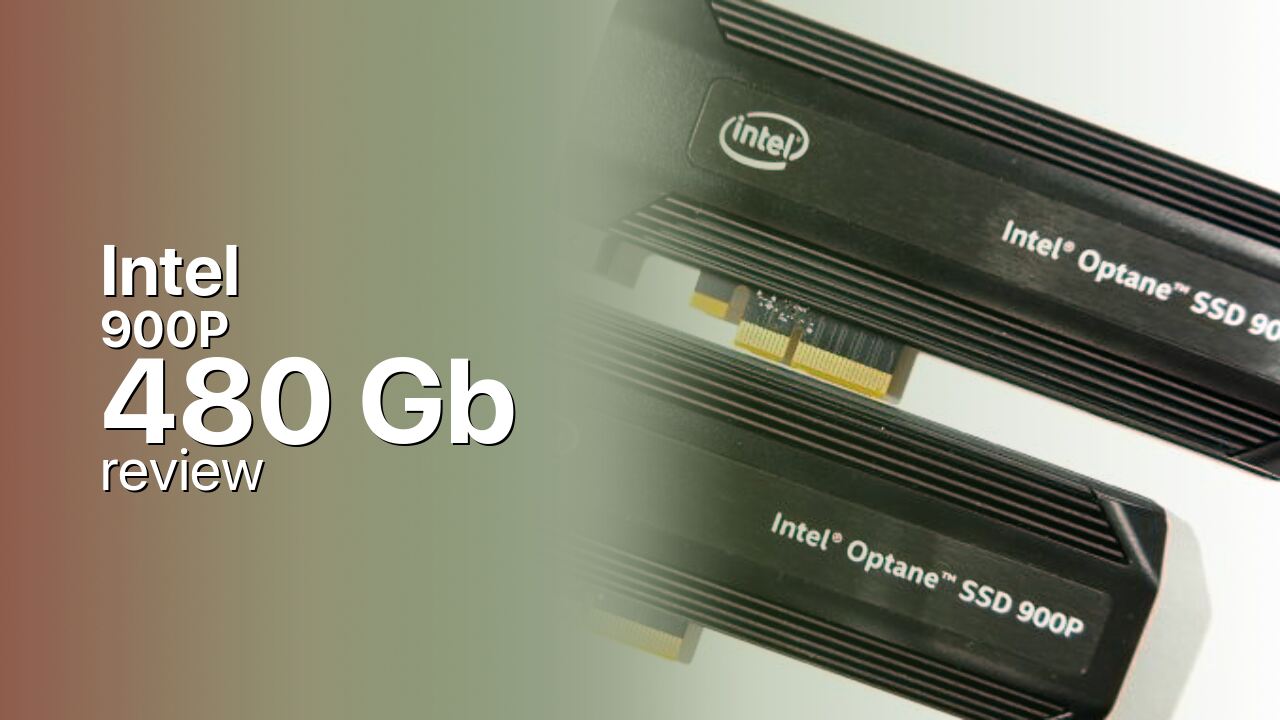
The 900P 480 GB uses Intel's first-generation 3D XPoint memory with the custom Intel EAU01D76 controller. 3D XPoint is a phase-change memory technology that is bit-addressable and does not suffer from the asymmetric read/write latency or SLC cache requirements of NAND flash. The drive ships in either an add-in card (AIC) or U.2 2.5-inch form factor, connecting over PCIe 3.0 x4.
Sequential speeds match the 280 GB model at 2,500 MB/s reads and 2,000 MB/s writes. Random IOPS are also identical at 550,000 reads and 500,000 writes. The 480 GB model's advantage is capacity: it provides more usable space for workloads like database indices, virtual machines, and development environments where the 280 GB model is tight. Endurance jumps to 8,760 TBW.
The 900P 480 GB competes with high-end consumer NVMe drives on price but not on use case. It targets the same niche as the 280 GB model: users who need consistently low random I/O latency rather than maximum sequential bandwidth.
Storage Comparisons:
900P Performance & Benchmarks
Sequential throughput of 2,500 MB/s reads and 2,000 MB/s writes is lower than mainstream TLC NVMe drives can achieve. The 900P's strength is random I/O: 550,000 read IOPS and 500,000 write IOPS, delivered with consistent latency that does not vary with drive fill level or queue depth. AnandTech's comprehensive review of the 900P 280 GB showed it dominating NAND-based drives on their random-I/O-heavy Storage Bench traces.
Intel 900P 480 GB vs PCIe 3.0 x 4 or U.2 2.5" peers
Switch between sequential throughput and random IOPS to see how this drive stacks up against other PCIe 3.0 x 4 or U.2 2.5" SSDs in our database. The highlighted bar is the drive on this page — click any other bar to open that drive.
- Intel 905P 380 GB: 2,600 MB/s read, 2,200 MB/s write
- Intel 905P 480 GB: 2,600 MB/s read, 2,200 MB/s write
- Intel 905P 960 GB: 2,600 MB/s read, 2,200 MB/s write
- Intel 900P 480 GB (this drive): 2,500 MB/s read, 2,000 MB/s write
- Intel 900P 280 GB: 2,500 MB/s read, 2,000 MB/s write
The 480 GB model delivers the same per-thread random I/O performance as the 280 GB. In practice, the extra capacity means more data can live on the fast 3D XPoint media rather than being offloaded to a slower secondary drive. For workloads like database queries, software compilation, and virtual machine image access, this translates to a real improvement in workflow speed.
Unlike NAND SSDs, there is no SLC cache to fill and no performance cliff to fall off. The 900P delivers consistent throughput in every condition.
Endurance, TBW & Warranty
Intel rates the 900P 480 GB at 8,760 TBW over its 5-year warranty -- over 4,700 GB of writes per day. This is roughly 10 full drive writes per day for five consecutive years, a figure made possible by 3D XPoint's inherently higher write endurance. For any consumer or prosumer workload, this endurance rating is effectively unlimited. The 1.6 million hour MTBF is a population-level reliability metric. Intel handles warranty claims through its standard RMA process.
Intel 900P 480 GB Specifications
| Category | Value |
|---|---|
| Capacity [?] | 480 GB |
| Interface [?] | PCIe 3.0 x 4 or U.2 2.5" |
| Controller [?] | Intel EAU01D76 |
| Memory type [?] | Intel 3D XPoint |
| DRAM [?] | No |
| Read speed (MB/s) [?] | 2500 |
| Write speed (MB/s) [?] | 2000 |
| Read IOPS [?] | 550000 |
| Write IOPS [?] | 500000 |
| Endurance (TBW) [?] | 8760 |
| MTBF (million hours) [?] | 1.6 |
| Warranty (years) [?] | 5 |
Verdict: Is the 900P Worth It in 2026?
The Intel Optane 900P 480GB is the more practical of the two 900P capacities, offering enough space for a working set of databases, virtual machines, or development projects while retaining the class-leading random I/O consistency of 3D XPoint memory. Against high-end NAND SSDs, it wins on latency and endurance but loses on sequential bandwidth and cost per GB. For general consumer use, a Samsung 990 Pro or WD Black SN850X at 2 TB is a better buy. For the specific niche of low-latency random I/O, the 900P has few peers.
+ Pros
- 550,000 random read IOPS with consistent latency
- 8,760 TBW endurance, far exceeds any NAND SSD
- 480 GB usable capacity on 3D XPoint
- No SLC cache, uniform performance when full or empty
- 3D XPoint memory with no write amplification
- Available as AIC or U.2 2.5-inch
- Cons
- 2,500 MB/s reads, below mainstream TLC NVMe
- Very expensive per GB
- AIC or U.2 form factor, not M.2
- Not compatible with PS5 or laptops
- Discontinued by Intel
- Limited capacity compared to NAND SSDs
Buy this or similar SSD Storage:



Video Review
The fastest SSD for gaming, and one big problem..