Team Group T-Force Cardea Zero 480GB Review (2026)
Quick answer
The Team Group T-Force Cardea Zero 480GB is an older NVMe drive that still offers unique value through its MLC NAND.
Read: 2600 MB/s Write: 1400 MB/s Endurance: 670 TBW Warranty: 3 years Interface: PCIe 3.0 x 4
The Team Group T-Force Cardea Zero 480GB is a no-heatsink variant of the Cardea NVMe drive, using MLC NAND for consistent write performance without cache tricks.
Controller & Memory
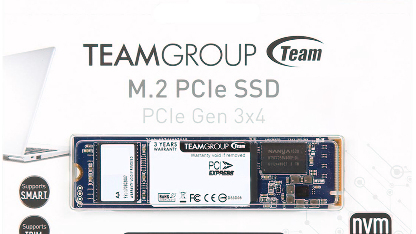
Team Group released the T-Force Cardea Zero as a companion to the original Cardea, dropping the factory heatsink to create a bare-drive option for users who already have motherboard M.2 shields or who prefer a slimmer profile. The Zero uses the same Phison PS5007-11 controller and Toshiba MLC NAND as the standard Cardea, so performance characteristics are nearly identical.
The 480GB capacity uses Toshiba MLC (multi-level cell) NAND with a Nanya DDR3-1600 DRAM cache. MLC stores two bits per cell versus three bits on TLC, which means higher endurance and more consistent write speeds without relying on a pseudo-SLC cache. The drive is rated at 2,600 MB/s sequential reads and 1,400 MB/s writes with 180,000/150,000 IOPS random performance.
The M.2 2280 form factor fits any NVMe slot. Without the heatsink, the Zero is even thinner than the standard Cardea, making it suitable for laptops and tight-clearance desktop builds. Team Group covers the drive with a 3-year warranty and rates endurance at 670 TBW.
Storage Comparisons:
T-Force Cardea Zero Performance & Benchmarks
The Team Group T-Force Cardea Zero 480GB is rated at 2,600 MB/s sequential reads and 1,400 MB/s sequential writes. These speeds were competitive in the 2017 PCIe 3.0 landscape but sit below the 3,400-3,500 MB/s ceiling that later Phison E12 and Samsung Phoenix controllers achieved. The PS5007-11 controller uses a 28nm process that caps peak throughput around 2.6 GB/s regardless of NAND speed.
Team Group T-Force Cardea Zero 480 GB vs PCIe 3.0 x 4 peers
Switch between sequential throughput and random IOPS to see how this drive stacks up against other PCIe 3.0 x 4 SSDs in our database. The highlighted bar is the drive on this page — click any other bar to open that drive.
- Asura Genesis Xtreme 256 GB: 3,400 MB/s read, 3,000 MB/s write
- Asura Genesis Xtreme 512 GB: 3,400 MB/s read, 3,000 MB/s write
- Asura Genesis Xtreme 1 TB: 3,400 MB/s read, 3,000 MB/s write
- Asura Genesis Xtreme 2 TB: 3,400 MB/s read, 3,000 MB/s write
- Team Group T-Force Cardea Zero 480 GB (this drive): 2,600 MB/s read, 1,400 MB/s write
The key advantage of the Cardea Zero is its MLC NAND. Unlike modern TLC drives that use pseudo-SLC caching to boost write speeds in bursts, MLC writes at full native speed continuously. There is no burst-to-sustained performance cliff. When a TLC drive exhausts its pSLC cache, writes can drop to 800-1,500 MB/s. The Cardea Zero delivers its rated 1,400 MB/s from the first byte to the last, making it surprisingly capable for sustained write workloads.
Random performance is rated at 180,000 IOPS reads and 150,000 IOPS writes, aided by the Nanya DDR3 DRAM cache. The DRAM cache ensures consistent mapping table lookups, which translates to stable random 4K performance under mixed workloads. For gaming, the Cardea Zero loads titles at speeds comparable to other PCIe 3.0 NVMe drives. The lack of a heatsink means the controller can run warmer under sustained load, so users doing heavy writes should consider adding an M.2 heatsink or using a motherboard shield.
Team Group T-Force Cardea Zero vs Competitors
See how the T-Force Cardea Zero stacks up against other PCIe 3.0 x 4 drives in our database:
Compare with rival drives:
Endurance, TBW & Warranty
Team Group backs the T-Force Cardea Zero with a 3-year warranty. The 480GB model is rated at 670 TBW endurance, which reflects the inherent durability of MLC NAND. In practical terms, writing 50 GB per day would take over 36 years to reach 670 TBW. Even power users writing 100 GB daily would need roughly 18 years.
The 3-year warranty is shorter than the 5-year coverage offered by some competitors, but the MLC NAND provides a durability advantage that partially compensates. MLC typically offers 3,000-10,000 program/erase cycles per cell versus 1,000-3,000 for TLC, meaning the Cardea Zero should remain reliable well beyond the warranty period under normal consumer workloads.
Team Group T-Force Cardea Zero 480 GB Specifications
| Category | Value |
|---|---|
| Capacity [?] | 480 GB |
| Interface [?] | PCIe 3.0 x 4 |
| Controller [?] | Phison PS5007-11 |
| Memory type [?] | Toshiba MLC |
| DRAM [?] | Nanya DDR3-1600 |
| Read speed (MB/s) [?] | 2600 |
| Write speed (MB/s) [?] | 1400 |
| Read IOPS [?] | 180000 |
| Write IOPS [?] | 150000 |
| Endurance (TBW) [?] | 670 |
| MTBF (million hours) [?] | 2 |
| Warranty (years) [?] | 3 |
Verdict: Is the T-Force Cardea Zero Worth It in 2026?
The Team Group T-Force Cardea Zero 480GB is an older NVMe drive that still offers unique value through its MLC NAND. The consistent write performance without pseudo-SLC cache tricks is a genuine advantage for users who do sustained file transfers or run workloads that fill the entire drive. Buy it if you find it at a discount and value write consistency over peak sequential speeds.
Skip it if you want a modern drive with 5-year warranty, higher sequential throughput, or better power efficiency. Newer TLC drives like the Samsung 970 EVO Plus or Kingston KC3000 offer 3,500 MB/s reads and longer warranty coverage. The Cardea Zero is best viewed as a niche option for users who specifically want MLC NAND reliability without paying enterprise prices.
+ Pros
- MLC NAND provides consistent writes with no pSLC cache cliff
- DRAM cache (Nanya DDR3) for stable random I/O
- No heatsink — slimmer profile fits laptops
- 670 TBW endurance strong for 480GB capacity
- Reliable Phison PS5007-11 controller
- Cons
- 2,600/1,400 MB/s well below modern PCIe 3.0 ceiling
- Only 3-year warranty versus 5-year from competitors
- Older 28nm controller less power-efficient than modern designs
- No heatsink included — may need motherboard M.2 shield
- MLC NAND means higher cost per GB than TLC alternatives
Buy this or similar SSD Storage:



Video Review
Best Bang for Buck PCIe 3.0 NVMe SSD? ⏩ T-Force Cardea z340 SSD Review