Netac N535N 120GB Review — Budget M.2 2280 SATA SSD (2026)
Quick answer
The Netac N535N 120GB is a budget M.2 SATA SSD that delivers exactly what it promises — SATA-class performance in the M.2 2280 form factor at a low price.
Read: 560 MB/s Write: 500 MB/s Endurance: 70 TBW Warranty: 3 years Interface: M.2 SATA III
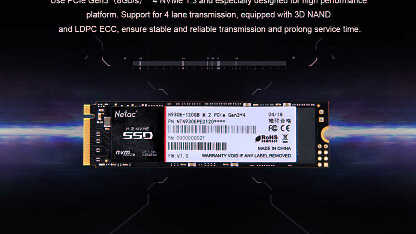
The Netac N535N 120GB is a no-frills M.2 SATA III SSD that targets budget builders who need NVMe-slot compatibility without NVMe pricing — a compact 2280 drive capped at SATA speeds.
Controller & Memory
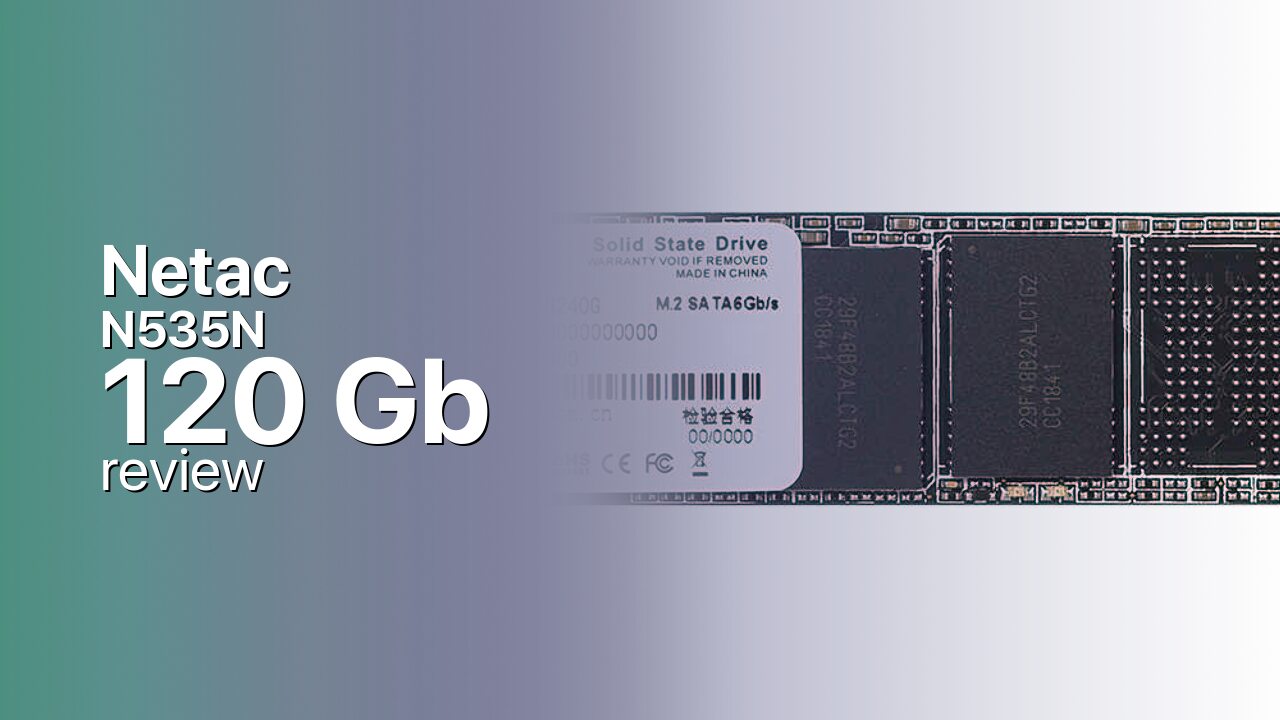
The N535N is Netac's entry-level M.2 SSD, using the SATA III 6 Gb/s interface rather than NVMe PCIe. This matters because many modern motherboards and laptops have M.2 slots that support both SATA and NVMe protocols, and the N535N plugs into those slots while delivering SATA-class performance — roughly 560 MB/s reads and 500 MB/s writes. It uses a DRAM-less controller design paired with 3D NAND flash, which keeps costs down but means sustained random I/O performance will dip during heavy workloads when the drive can't cache the flash translation layer in dedicated memory.
The 120 GB capacity makes this a basic boot drive — enough for Windows and a handful of applications, but not much room for games or media. Netac offers the N535N in larger capacities up to 2 TB, and the larger variants benefit from higher write speeds simply because more NAND dies can be addressed in parallel. The 120 GB model has the fewest dies and therefore the lowest throughput in the lineup.
Netac is a Shenzhen-based storage brand that has gained traction in Asian and emerging markets by offering aggressive pricing. The N535N doesn't have the brand recognition of Kingston, Samsung, or Western Digital, and independent reviews are sparse. For a secondary boot drive, a low-cost NAS cache, or a budget office PC upgrade, it covers the basics. For primary storage in a daily-driver machine, spending a bit more on a drive with a longer track record and DRAM cache is the safer bet.
Direct competitors include the Kingston A400 in M.2 SATA form, the WD Green SN350, and Team Group's budget M.2 SATA offerings. The N535N differentiates itself mainly on price, not performance or features.
Storage Comparisons:
N535N Performance & Benchmarks
The Netac N535N 120GB is rated at up to 560 MB/s sequential reads and 500 MB/s sequential writes over its SATA III 6 Gb/s interface. These figures sit near the practical ceiling for SATA — the interface itself tops out around 600 MB/s, so there's no meaningful headroom left. The DRAM-less controller design means random 4K performance will be modest, likely in the 3,000–5,000 IOPS range for reads, which is typical for budget SATA drives without dedicated cache memory. During light desktop tasks — web browsing, office applications, OS boot — the drive will feel responsive enough, since those workloads don't saturate the interface or exhaust any SLC cache. Under sustained writes like large file copies or video editing, the absence of DRAM becomes visible: the controller has to manage the flash translation layer in system RAM via HMB or handle it inline, both of which add latency. The 120 GB capacity is the slowest variant in the N535N family because it has the fewest NAND dies to stripe data across. Larger 240 GB, 480 GB, and 960 GB models reach the same or slightly higher sequential speeds. There are no independent benchmark reviews of the N535N specifically, so these assessments are based on the manufacturer's rated specs and the known behavior of DRAM-less SATA controllers. For a budget boot drive, the performance is adequate; for anything write-intensive, a DRAM-equipped NVMe drive is a significantly better investment.
Netac N535N 120 GB vs M.2 SATA III peers
Switch between sequential throughput and random IOPS to see how this drive stacks up against other M.2 SATA III SSDs in our database. The highlighted bar is the drive on this page — click any other bar to open that drive.
- Netac N535N 120 GB (this drive): 560 MB/s read, 500 MB/s write
- Netac N535N 240 GB: 560 MB/s read, 510 MB/s write
- Netac N535N 480 GB: 560 MB/s read, 515 MB/s write
- Netac N535N 960 GB: 560 MB/s read, 520 MB/s write
Endurance, TBW & Warranty
Netac offers a three-year limited warranty on the N535N, which is standard for budget SSDs but shorter than the five-year coverage on mid-range and flagship drives. The company does not publish a TBW (terabytes written) endurance rating for the N535N series in its public documentation, which makes it difficult to calculate the precise write lifespan. For a 120 GB drive using 3D NAND with a DRAM-less controller, a reasonable estimate would be in the 40–80 TBW range — enough for typical desktop use over the three-year warranty period, but not something you'd want to use as a heavy-write scratch disk. Netac does not publish an MTBF figure either. Warranty claims are handled through Netac's distributor network, and international buyers should verify local support availability before purchasing. The three-year warranty is adequate for the price segment, though the absence of published endurance specs means there's less transparency than on drives from established brands like Kingston or Western Digital.
Netac N535N 120 GB Specifications
| Category | Value |
|---|---|
| Capacity [?] | 120 GB |
| Interface [?] | M.2 SATA III |
| Controller [?] | Silicon Motion SM2258XT |
| Memory type [?] | TLC |
| DRAM [?] | No |
| Read speed (MB/s) [?] | 560 |
| Write speed (MB/s) [?] | 500 |
| Read IOPS [?] | 80000 |
| Write IOPS [?] | 65000 |
| Endurance (TBW) [?] | 70 |
| MTBF (million hours) [?] | 1500000 |
| Warranty (years) [?] | 3 |
Verdict: Is the N535N Worth It in 2026?
The Netac N535N 120GB is a budget M.2 SATA SSD that delivers exactly what it promises — SATA-class performance in the M.2 2280 form factor at a low price. The 560 MB/s reads are near the SATA ceiling, and the compact form factor fits laptops and small-form-factor builds that lack 2.5-inch drive bays. But 120 GB is tight even for a boot drive, the DRAM-less controller limits sustained performance, and Netac's lack of published endurance specs makes long-term reliability harder to assess. Buyers who prioritize brand trust and endurance should consider the Kingston A400 or WD Blue SA510 instead. The N535N makes sense only for the most cost-sensitive builds.
+ Pros
- 560 MB/s reads near SATA ceiling
- M.2 2280 fits compact systems
- SATA III compatibility with mixed M.2 slots
- 3-year manufacturer warranty
- Cons
- Only 120 GB capacity
- DRAM-less controller limits random I/O
- No published TBW endurance rating
- Minimal independent review coverage
- 120 GB variant is slowest in lineup
Buy this or similar SSD Storage:



Video Review
M.2 SATA SSD Netac N535N 128GB NT01N535N-128G-N8X