MyDigitalSSD BPX 120 GB — Phison E7 MLC NVMe SSD (2026)
Quick answer
The MyDigitalSSD BPX 120 GB is a relic of a brief window when MLC NAND was still viable in consumer SSDs — and that is precisely its appeal to the right buyer.
Read: 2600 MB/s Write: 1300 MB/s Endurance: 350 TBW Warranty: 5 years Interface: M.2 3.0 x 4
The MyDigitalSSD BPX 120 GB uses Toshiba 15nm MLC NAND — one of the last consumer MLC SSDs — giving it exceptional write endurance for its capacity and a niche following among enthusiasts building high-durability boot drives.
Controller & Memory
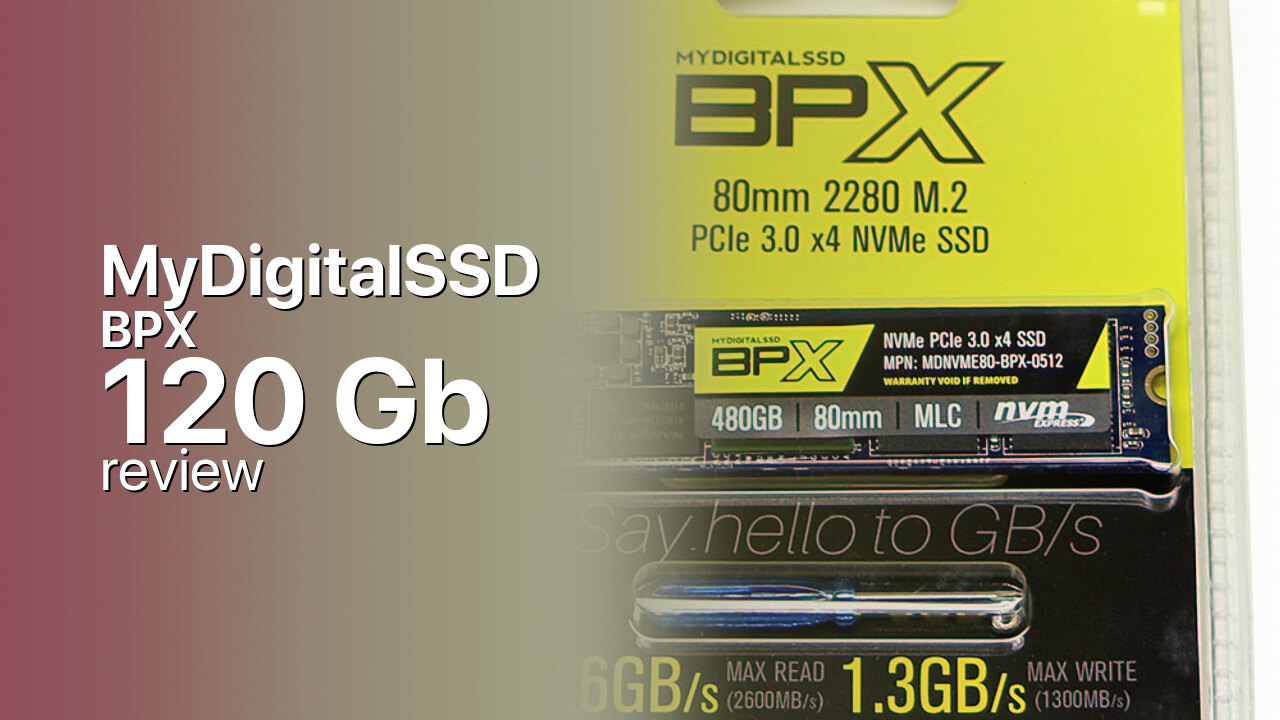
The MyDigitalSSD BPX is built on the Phison PS5007-E7, an 8-channel PCIe 3.0 x4 controller that was Phison's first flagship NVMe platform, launched in 2016. What distinguishes the BPX from most consumer SSDs — then and now — is its use of Toshiba 15nm toggle MLC (2-bit-per-cell) NAND rather than the TLC (3-bit) or QLC (4-bit) flash used by the vast majority of consumer drives. MLC NAND offers higher write endurance per cell, better sustained write performance, and lower latency than TLC, at the cost of higher manufacturing cost per gigabyte. The BPX paired this MLC with a Nanya DDR3L DRAM cache, making it a premium-tier drive dressed in a budget brand's clothing.
The 120 GB variant is the entry-level capacity, with MyDigitalSSD also offering 240 GB and 480 GB versions. The smaller capacity uses fewer NAND dies, which reduces peak sequential write performance — the 120 GB model writes at up to 1,300 MB/s, compared to the 480 GB flagship's 1,600 MB/s. Where the 120 GB BPX shines is endurance: rated at 350 TBW, it can absorb an extraordinary amount of writes for a 120 GB drive — roughly 8 full drive writes per day over the 5-year warranty period. This made the BPX 120 GB popular among enthusiasts for use as a high-endurance boot drive or write-cache device in homelab and small-server deployments.
In its era, the BPX competed against early TLC NVMe drives like the Samsung 960 EVO and the Intel 600p. The 960 EVO offered faster sequential speeds and more capacity for the money, but the BPX's MLC NAND meant it sustained writes far better and carried a higher proportional endurance rating. The trade-off was cost per gigabyte — the BPX 120 GB was priced closer to TLC 250 GB drives. In 2026, the BPX 120 GB is a niche curiosity: too small for a primary drive, but its MLC endurance and 5-year warranty make it a sought-after used-market find for specialised small-write-intensive applications.
Storage Comparisons:
BPX Performance & Benchmarks
MyDigitalSSD rates the BPX 120 GB at 2,600 MB/s sequential reads and 1,300 MB/s sequential writes. The read speed is competitive with early PCIe 3.0 x4 TLC drives, while the write speed reflects the reduced NAND die count of the 120 GB variant — the 480 GB model reaches 1,600 MB/s writes with more dies in parallel. Random performance is rated at up to 250,000 IOPS read and 210,000 IOPS write, figures that were near the top of the PCIe 3.0 consumer market in 2016–2017 and remain respectable today.
MyDigitalSSD BPX 120 GB vs M.2 3.0 x 4 peers
Switch between sequential throughput and random IOPS to see how this drive stacks up against other M.2 3.0 x 4 SSDs in our database. The highlighted bar is the drive on this page — click any other bar to open that drive.
- ADATA SX 8800 Pro 512 GB: 3,500 MB/s read, 2,700 MB/s write
- ADATA SX 8800 Pro 1 TB: 3,500 MB/s read, 2,700 MB/s write
- ADATA XPG Spectrix S40G RGB 256 GB: 3,500 MB/s read, 3,000 MB/s write
- ADATA XPG Spectrix S40G RGB 512 GB: 3,500 MB/s read, 3,000 MB/s write
- MyDigitalSSD BPX 120 GB (this drive): 2,600 MB/s read, 1,300 MB/s write
Where the BPX 120 GB differentiates itself from TLC contemporaries is sustained write performance. MLC NAND has a higher native write speed than TLC, meaning the drive relies less on SLC caching to maintain throughput. Once the SLC cache fills — which happens more quickly on a 120 GB drive due to the small total capacity — the BPX drops to its MLC native write speed rather than the much slower TLC native speed. The result is a smaller but less severe write cliff. For a boot drive handling OS and application workloads, this characteristic is rarely exercised. For a write-cache or logging drive, it is a meaningful advantage. The 8-channel E7 controller with Nanya DRAM keeps random I/O latency low, though the Phison E7's firmware was less refined than later E12 and E16 controllers — high queue-depth random performance can be inconsistent under sustained load.
MyDigitalSSD BPX vs Competitors
See how the BPX stacks up against other M.2 3.0 x 4 drives in our database:
Compare with rival drives:
Endurance, TBW & Warranty
MyDigitalSSD backs the BPX 120 GB with a 5-year limited warranty and rates endurance at 350 TBW — an exceptional figure for a 120 GB drive. To put this in perspective: 350 TBW on a 120 GB capacity means the drive is rated for roughly 2,900 full drive writes over its lifetime, or approximately 160 GB of writes per day over the 5-year warranty period. This is several times the endurance of typical 120–128 GB TLC SSDs from the same era, which often carried 40–80 TBW ratings. The MLC NAND is the enabling factor — MLC cells withstand far more program/erase cycles than TLC. MyDigitalSSD's warranty is US-based; international buyers should confirm coverage through their retailer. For niche applications like boot drives in write-intensive embedded systems or ZFS SLOG devices, the BPX 120 GB's endurance-to-capacity ratio remains compelling even in 2026.
MyDigitalSSD BPX 120 GB Specifications
| Category | Value |
|---|---|
| Capacity [?] | 120 GB |
| Interface [?] | M.2 3.0 x 4 |
| Controller [?] | Phison 5007-E7 |
| Memory type [?] | SanDisk MLC |
| DRAM [?] | 512MB Nanya 512MB DDR3 1600 DRAM |
| Read speed (MB/s) [?] | 2600 |
| Write speed (MB/s) [?] | 1300 |
| Read IOPS [?] | 150000 |
| Write IOPS [?] | 265000 |
| Endurance (TBW) [?] | 350 |
| MTBF (million hours) [?] | 2 |
| Warranty (years) [?] | 5 |
Verdict: Is the BPX Worth It in 2026?
The MyDigitalSSD BPX 120 GB is a relic of a brief window when MLC NAND was still viable in consumer SSDs — and that is precisely its appeal to the right buyer. Buy it on the used market if you need a small, high-endurance NVMe drive for a specialised role: a boot drive in a write-heavy embedded system, a cache device in a homelab server, or a collector's piece from the MLC era. The 350 TBW endurance for a 120 GB drive is exceptional, and the 5-year warranty (if still active) backs it up. Skip it for any general-purpose use — 120 GB is impractically small in 2026, the write speed is pedestrian, and a modern 256 GB TLC drive costs very little and offers more capacity. Skip it also if your system supports PCIe 4.0 — the interface gap is too large. For the enthusiast who appreciates what MLC brought to the table, the BPX 120 GB is a charming artifact. For everyone else, it is a historical footnote.
+ Pros
- Toshiba 15nm MLC NAND — exceptional endurance for capacity
- 350 TBW endurance on a 120 GB drive — ~8 DWPD over 5 years
- Phison E7 8-channel controller with Nanya DRAM cache
- 2,600 MB/s reads — competitive with early PCIe 3.0 TLC drives
- 5-year warranty — among the longest in the consumer market
- MLC sustained write performance exceeds TLC alternatives
- Cons
- 120 GB capacity — impractically small for general use in 2026
- 1,300 MB/s writes — lower than larger capacities in the lineup
- Phison E7 firmware less refined than later E12/E16 controllers
- No PCIe 4.0 support — not PS5 compatible
- Higher cost per gigabyte compared to TLC alternatives
Buy this or similar SSD Storage:
Video Review
NVMe vs Sata iii - How much faster is it? - MyDigitalSSD BPX Review