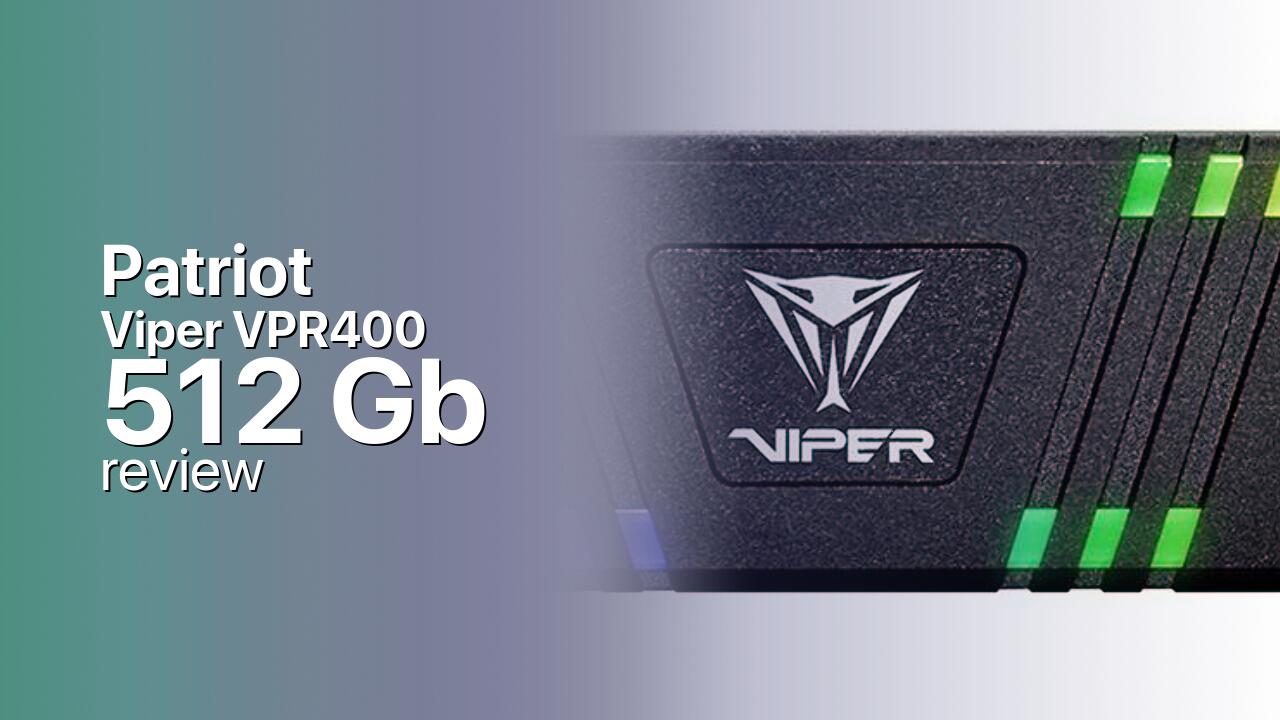
Patriot Viper VPR400 512GB - RGB PCIe 4.0 NVMe SSD (2026)
Quick answer
The Patriot Viper VPR400 512 GB is the obvious pick for builders who want addressable RGB lighting on their M.2 slot and motherboard RGB sync support that few other SSDs provide.
Read: 4600 MB/s Write: 3600 MB/s Endurance: 400 TBW Warranty: 5 years Interface: M.2 4.0 x 4
The Patriot Viper VPR400 512GB is the first PCIe 4.0 M.2 NVMe to ship with built-in RGB lighting - Innogrit IG5220 controller, integrated aluminium heatsink with addressable RGB, and full motherboard RGB sync support.
Controller & Memory
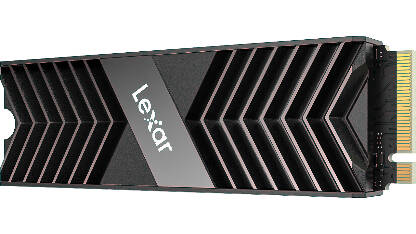
The Patriot Viper VPR400 512 GB pairs the Innogrit IG5220 four-channel PCIe 4.0 controller with Micron 3D TLC NAND and an aluminium heatsink that doubles as the housing for an addressable RGB strip. The IG5220 is Innogrit's mainstream PCIe 4.0 part - smaller and less power-hungry than the flagship IG5236 - and is used in several other budget-to-mainstream PCIe 4.0 drives including the Acer Predator GM7000. The drive ships as a complete factory-assembled module with the heatsink already attached, which makes it taller than a bare PCB and incompatible with thin laptop slots, but ready to drop into a desktop M.2 bay with full RGB integration.
Patriot sells the Viper VPR400 in 512 GB and 1 TB capacities. The 512 GB SKU on this page reaches the same 4,600 MB/s sequential read rating as the 1 TB but drops sequential writes from 4,400 to 3,600 MB/s because the IG5220 has fewer NAND dies to fan out across at this capacity. Random IOPS hold steady at 600,000 read and 500,000 write across the line. The RGB lighting is the main differentiator - the VPR400 was the world's first Gen4x4 RGB M.2 SSD when it launched in 2022, and the Viper RGB 3.0 software integrates with ASUS Aura Sync, MSI Mystic Light, Gigabyte RGB Fusion, and ASRock Polychrome Sync for board-wide colour coordination.
The Viper VPR400 512 GB targets RGB-build enthusiasts who want lighting in their M.2 slot rather than the conventional motherboard-heatsink-covered look. Direct rivals at this capacity are the WD Black SN770 500 GB (faster, no RGB), the Crucial P3 Plus 500 GB (cheaper, no RGB), and the Sabrent Rocket 4 Plus G 500 GB (no RGB, similar tier). Within that field the VPR400 is the niche RGB pick rather than the value or performance pick. The integrated heatsink also acts as a thermal advantage in desktop builds without an M.2 motherboard cooler.
Storage Comparisons:
Viper VPR400 Performance & Benchmarks
Manufacturer ratings for the Viper VPR400 512 GB land at 4,600 MB/s sequential reads and 3,600 MB/s sequential writes, with random performance up to 600,000 read and 500,000 write IOPS at high queue depths. Independent reviewers at Tom's Hardware, TweakTown, ThinkComputers, FunkyKit and Vortez consistently measured CrystalDiskMark sequential reads within a few percent of the rating, with the IG5220 demonstrating snappy QD1 random response thanks to its mature firmware tuning.
Patriot Viper VPR400 512 GB vs M.2 4.0 x 4 peers
Switch between sequential throughput and random IOPS to see how this drive stacks up against other M.2 4.0 x 4 SSDs in our database. The highlighted bar is the drive on this page — click any other bar to open that drive.
- Patriot Viper PV593 1 TB: 14,500 MB/s read, 14,000 MB/s write
- Patriot Viper PV593 2 TB: 14,500 MB/s read, 14,000 MB/s write
- Patriot Viper PV593 4 TB: 14,500 MB/s read, 14,000 MB/s write
- Patriot Viper PV573 2 TB: 14,000 MB/s read, 12,000 MB/s write
- Patriot Viper VPR400 512 GB (this drive): 4,600 MB/s read, 3,600 MB/s write
Sustained writes show the constraint of a 512 GB capacity. The drive holds peak SLC-cached writes for roughly 80-120 GB of continuous transfer before the cache exhausts, after which writes fall toward a TLC direct-write rate around 900-1,200 MB/s. For boot, application, and gaming workloads that profile is invisible. The integrated aluminium heatsink does meaningful work here - reviewers consistently find the VPR400 holds peak performance better under sustained workloads than bare-PCB peers because the heatsink keeps the controller well below thermal-throttling thresholds even in poorly-ventilated cases. DirectStorage operates as expected on a supported PCIe 4.0 platform. The 512 GB capacity is the practical constraint for modern gaming rather than the controller's performance ceiling.
Patriot Viper VPR400 vs Competitors
See how the Viper VPR400 stacks up against other M.2 4.0 x 4 drives in our database:
Compare with rival drives:
Endurance, TBW & Warranty
Patriot backs the Viper VPR400 512 GB with a five-year limited warranty and a 400 TBW endurance budget. The TBW scales linearly across the range at roughly 800 TBW per terabyte of capacity, so the 1 TB SKU rates 800 TBW. At a heavy 50 GB/day sustained write workload the 512 GB endurance lasts roughly 22 years, far beyond the warranty period and any realistic service life. Patriot does not publish an explicit MTBF figure for the consumer VPR400 spec sheet, though comparable IG5220 drives quote 1.5-1.8 million hours. RMA handling runs through Patriot's North American support team at patriotmemory.com with serial-number registration; the company also has European distribution for in-warranty replacements. The 400 TBW figure exceeds the WD Black SN770 500 GB (300 TBW) and trails the Samsung 970 EVO Plus 500 GB at the same capacity.
Patriot Viper VPR400 512 GB Specifications
| Category | Value |
|---|---|
| Capacity [?] | 512 GB |
| Interface [?] | M.2 4.0 x 4 |
| Controller [?] | Innogrit Rainier IG5220 |
| Memory type [?] | Micron TLC |
| DRAM [?] | HMB |
| Read speed (MB/s) [?] | 4600 |
| Write speed (MB/s) [?] | 3600 |
| Read IOPS [?] | 600000 |
| Write IOPS [?] | 500000 |
| Endurance (TBW) [?] | 400 |
| MTBF (million hours) [?] | 1500000 |
| Warranty (years) [?] | 5 |
Verdict: Is the Viper VPR400 Worth It in 2026?
The Patriot Viper VPR400 512 GB is the obvious pick for builders who want addressable RGB lighting on their M.2 slot and motherboard RGB sync support that few other SSDs provide. Anyone whose case has a window facing the M.2 area benefits from the visible lighting in a way that no bare-PCB drive can match. Buyers chasing pure performance per dollar should look at the WD Black SN770 500 GB or Samsung 980 500 GB, both of which deliver higher sequential speeds at lower prices but without RGB. Skip the VPR400 if you need a single-sided slim PCB for thin laptops or PS5 - the integrated heatsink makes it incompatible with those form factors. For RGB desktop builds at 512 GB the VPR400 is the cleanest factory-RGB M.2 NVMe on the market.
+ Pros
- 4,600 MB/s sequential reads on PCIe 4.0
- Integrated addressable RGB heatsink
- Full motherboard RGB ecosystem sync support
- 400 TBW endurance with 5-year warranty
- Innogrit IG5220 controller runs cool under load
- 600,000 IOPS rated random reads
- Cons
- Integrated heatsink prevents fit in thin laptops or PS5
- 3,600 MB/s writes lag WD Black SN770 500 GB at similar price
- DRAM-less HMB lags DRAM-equipped peers on random writes
- Higher retail price than bare-PCB rivals at 512 GB
- 512 GB capacity tight for modern game libraries
Buy this or similar SSD Storage:



Video Review
Patriot Viper VPN100 512Gb M.2 NVMe🔥 - доверяй, но проверяй!