Solidigm P41 Plus 2TB Review — A Cache-Tiered QLC PCIe 4.0 NVMe SSD (2026)
Quick answer
The Solidigm P41 Plus 2 TB is the best QLC SSD you can buy for endurance and one of the cheapest PCIe 4.0 2 TB drives from a tier-one brand, period.
Read: 4125 MB/s Write: 3325 MB/s Endurance: 800 TBW Warranty: 5 years Interface: M.2 4.0 x 4
The Solidigm P41 Plus 2 TB is the QLC drive that tries hardest to not feel like one — Solidigm's cache-tiering architecture gives it endurance numbers that embarrass TLC competitors, even if the peak throughput tells a more modest story.
Controller & Memory
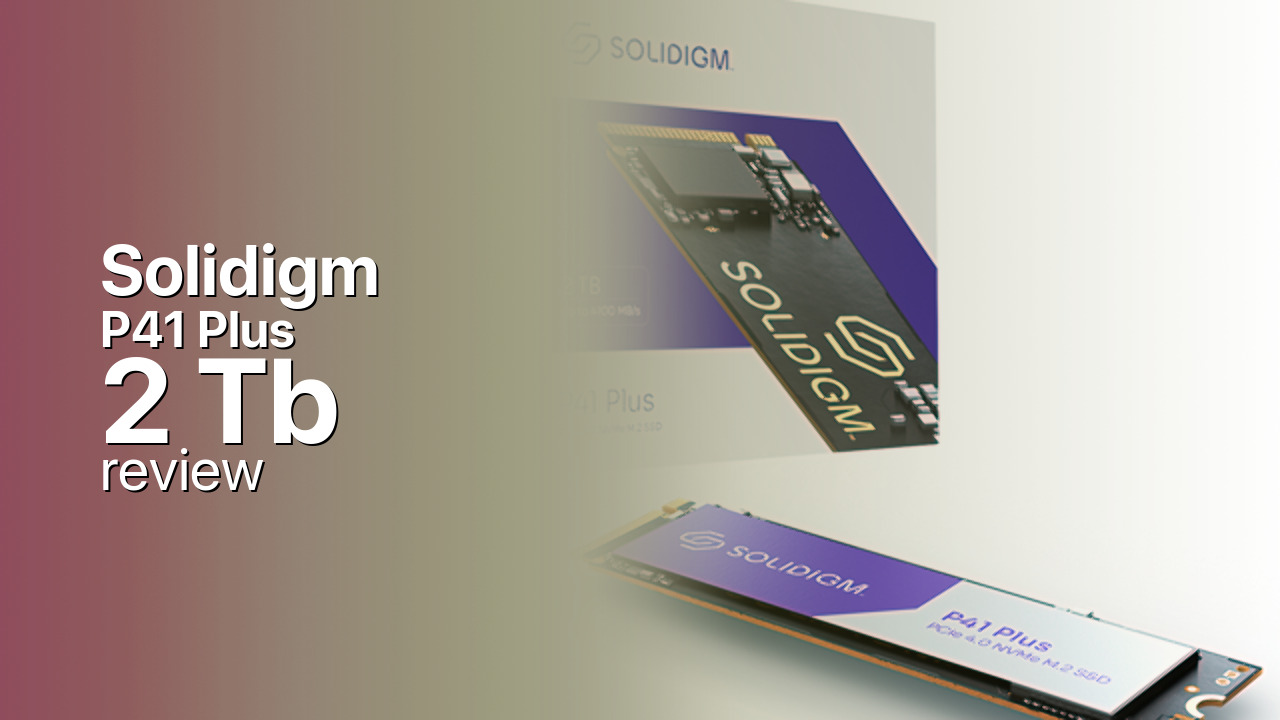
The Solidigm P41 Plus uses the Silicon Motion SM2269XT controller — a four-channel, DRAM-less PCIe 4.0 design — paired with Solidigm's own 144-layer 3D QLC NAND and no onboard DRAM. Instead of a dedicated buffer, the SM2269XT relies on Host Memory Buffer (HMB) via NVMe 1.4, borrowing up to 64 MB of system RAM for its flash translation layer mapping table. Solidigm is the former Intel NAND and SSD division, sold to SK hynix in 2021, and the P41 Plus is one of the first drives to ship under the new brand. The single-sided M.2 2280 PCB is laptop-friendly and runs remarkably cool — reviewers measured peak temperatures of 48 degrees Celsius under sustained load, barely half the throttle point of most Gen4 controllers.
The headline feature is Solidigm's cache-tiering architecture, branded as Synergy. Traditional QLC SSDs use a portion of NAND in pseudo-SLC mode as a temporary write buffer: data is written to the fast SLC cache, then later rewritten to slow QLC cells, incurring extra write amplification that eats into endurance. Solidigm's approach is different: NAND cells dynamically transition between SLC and QLC states without an intermediate rewrite step, cutting write amplification to approximately 1.1x versus the 2-to-3x typical of standard QLC drives. Additionally, frequently-accessed data is retained in pSLC mode indefinitely, functioning as a read cache as well as a write buffer — hot game files, frequently launched applications, and OS components stay fast. The Synergy driver that manages this is Windows-only; Linux and macOS users get standard SSD behavior without the cache-tiering benefits.
The 2 TB P41 Plus is the capacity sweet spot. At 800 TBW of endurance, it nearly doubles the Crucial P3 Plus 2 TB's 440 TBW and approaches the WD Blue SN580 2 TB's 900 TBW — a TLC drive. This is a genuine technical achievement and not just marketing: the cache-tiering architecture's lower write amplification means the QLC NAND wears out more slowly, and Solidigm backs it with a full 5-year warranty. The drive competes against the Crucial P3 Plus (faster sequential and random IOPS, half the endurance), the WD Blue SN580 (TLC, better all-around, slightly more expensive), and the Samsung 990 EVO (TLC, faster, significantly more expensive). The P41 Plus typically undercuts all three on price, making it the budget choice among brand-name PCIe 4.0 2 TB drives.
Storage Comparisons:
P41 Plus Performance & Benchmarks
The Solidigm P41 Plus 2 TB is rated for 4,125 MB/s sequential reads and 3,325 MB/s sequential writes, with random performance of up to 390,000 IOPS reads and 540,000 IOPS writes. These numbers place it in the lower half of PCIe 4.0 drives — the DRAM-less SM2269XT and four-channel architecture simply cannot match eight-channel controllers — but for a budget QLC drive, the read speed is competitive and the write speed is adequate for consumer workloads. Independent reviewers at KitGuru measured 4,139 MB/s reads and 3,336 MB/s writes in CrystalDiskMark, confirming the rated figures.
Solidigm P41 Plus 2 TB vs M.2 4.0 x 4 peers
Switch between sequential throughput and random IOPS to see how this drive stacks up against other M.2 4.0 x 4 SSDs in our database. The highlighted bar is the drive on this page — click any other bar to open that drive.
- Patriot Viper PV593 1 TB: 14,500 MB/s read, 14,000 MB/s write
- Patriot Viper PV593 2 TB: 14,500 MB/s read, 14,000 MB/s write
- Patriot Viper PV593 4 TB: 14,500 MB/s read, 14,000 MB/s write
- Patriot Viper PV573 2 TB: 14,000 MB/s read, 12,000 MB/s write
- Solidigm P41 Plus 2 TB (this drive): 4,125 MB/s read, 3,325 MB/s write
The real-world performance story depends heavily on what you are measuring. KitGuru's testing found the P41 Plus delivering the fastest Final Fantasy XIV: Endwalker total load time in their testing history — the Synergy cache tiering appears to benefit game loads by keeping frequently-accessed game assets in the low-latency pSLC tier. PCMark 10 storage bandwidth of 478 MB/s placed it in the top ten of all tested drives, competitive with mid-range TLC SSDs. 3DMark storage benchmarks showed 623 MB/s gaming bandwidth with 85-microsecond latency — strong for a budget drive. Where the P41 Plus falters is sustained heavy writes and mixed enterprise-style workloads. StorageReview measured 119 ms average latency in SQL Server testing, among the slowest drives they have tested, confirming that DRAM-less QLC is not the right tool for database or server use. Sustained sequential writes after the pSLC cache fills drop to approximately 200 MB/s — the native QLC write speed — and the cache shrinks as the drive fills, meaning a nearly-full P41 Plus performs worse than an empty one.
Thermally, the P41 Plus is exceptional. KitGuru recorded idle temperatures of 35 degrees Celsius and peak stress temperatures of 48 degrees Celsius, well below the 70-degree maximum rated operating temperature. The drive never throttled during testing. This makes it an excellent choice for laptops, compact ITX builds, and the PS5 — anywhere thermal headroom is limited. For the PS5 specifically, the 4,125 MB/s read speed falls below Sony's 5,500 MB/s recommendation, so the console may flag it in the speed test, though the drive fits physically and will function for PS4 game storage.
Solidigm P41 Plus vs Competitors
See how the P41 Plus stacks up against other M.2 4.0 x 4 drives in our database:
Compare with rival drives:
Endurance, TBW & Warranty
Solidigm backs the P41 Plus 2 TB with a 5-year limited warranty and an endurance rating of 800 TBW. At 800 TBW, the drive can absorb approximately 438 GB of writes per day for the warranty period — far beyond typical consumer workloads of 20 to 50 GB per day. The endurance rating is the P41 Plus's standout specification: it is nearly double the Crucial P3 Plus 2 TB's 440 TBW and approaches the WD Blue SN580 2 TB's 900 TBW, despite the P41 Plus using QLC NAND while the SN580 uses TLC. Solidigm achieves this through the Synergy cache-tiering architecture, which reduces write amplification to approximately 1.1x versus the 2-to-3x typical of traditional QLC SSDs. The 1 TB variant carries 400 TBW, and the 512 GB variant carries 200 TBW — all double the TBW of the equivalent Crucial P3 Plus capacities. The MTBF is rated at 1.6 million hours. Solidigm provides the Solidigm Storage Tool (which includes the Synergy driver) for firmware updates and drive health monitoring. As a subsidiary of SK hynix, Solidigm benefits from the parent company's NAND supply chain and warranty infrastructure, giving it more stability than some smaller SSD brands.
Solidigm P41 Plus 2 TB Specifications
| Category | Value |
|---|---|
| Capacity [?] | 2 TB |
| Interface [?] | M.2 4.0 x 4 |
| Controller [?] | Silicon Motion SM2269XT |
| Memory type [?] | Solidigm 3D QLC |
| DRAM [?] | HMB |
| Read speed (MB/s) [?] | 4125 |
| Write speed (MB/s) [?] | 3325 |
| Read IOPS [?] | 390000 |
| Write IOPS [?] | 540000 |
| Endurance (TBW) [?] | 800 |
| MTBF (million hours) [?] | 1600000 |
| Warranty (years) [?] | 5 |
Verdict: Is the P41 Plus Worth It in 2026?
The Solidigm P41 Plus 2 TB is the best QLC SSD you can buy for endurance and one of the cheapest PCIe 4.0 2 TB drives from a tier-one brand, period. The Synergy cache tiering is not marketing fluff — it measurably reduces write amplification, doubles the endurance versus competing QLC drives, and provides a genuine game-load performance advantage that is visible in benchmarks. Buy it as a game library drive, a media storage volume, or a general-purpose secondary SSD where capacity-per-dollar matters most. Skip it if your workload involves sustained heavy writes — video editing, database work, or running VMs — where the DRAM-less architecture and QLC write cliff become real liabilities. For similar money, the WD Blue SN580 2 TB offers TLC NAND and better all-around performance, but less capacity per dollar. The P41 Plus occupies a specific and valuable niche: maximum terabytes per dollar with unexpectedly good endurance, from a brand with Intel's SSD engineering DNA behind it.
+ Pros
- 800 TBW endurance — nearly double the Crucial P3 Plus at 2 TB
- Cache-tiering architecture reduces write amplification and retains hot data in fast pSLC
- Excellent game load times — fastest FFXIV load in KitGuru testing
- Often one of the cheapest PCIe 4.0 2 TB drives available
- 5-year warranty backed by SK hynix subsidiary Solidigm
- Exceptionally cool operation — peaks at 48°C without throttling
- Single-sided PCB fits thin laptops and ultrabooks
- Cons
- QM NAND: sustained writes drop to approximately 200 MB/s after pSLC cache fills
- DRAM-less HMB design — random I/O lags behind DRAM-equipped drives
- Performance degrades as drive fills — pSLC cache shrinks with lower free space
- Synergy cache-tiering driver is Windows-only
- Poor database and server performance — not suitable for write-heavy workloads
- Below PS5 recommended speed — console may flag drive in speed test
Buy this or similar SSD Storage:



Video Review
Solidigm, which bought Intel's SSD business, offers P41 Plus QLC NVMe SSD.