Corsair Force MP400 2TB — QLC NVMe SSD Review (2026)
Quick answer
Gamers and general desktop users who want high-capacity NVMe storage with burst speeds matching TLC alternatives will find the Corsair Force MP400 2 TB a solid pick, especially if sustained writes rarely exceed 500 GB at a time.
Read: 3480 MB/s Write: 3000 MB/s Endurance: 400 TBW Warranty: 5 years Interface: M.2 4.0 x 4
The Corsair Force MP400 2TB brings QLC NAND to the mainstream, offering large capacities at consumer-friendly prices — but the QLC trade-offs in endurance and sustained write performance are real.
Controller & Memory
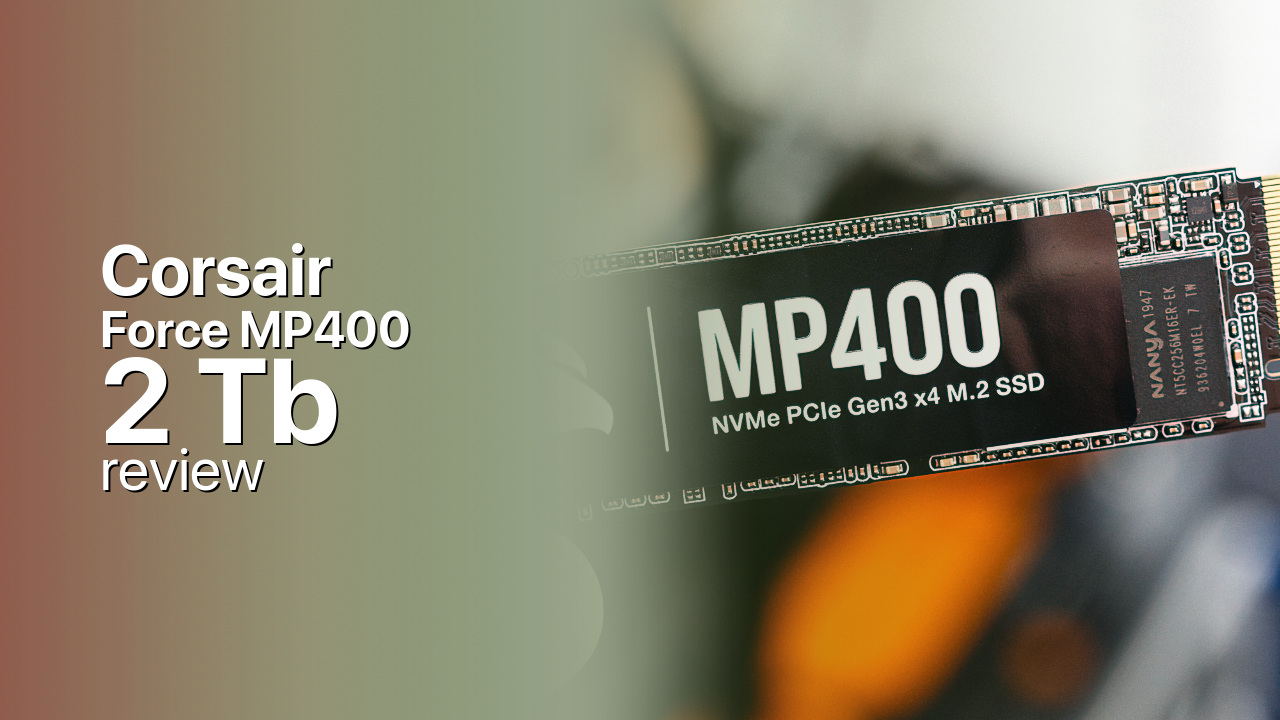
The Force MP400 2TB uses the Phison PS5012-E12S controller with Micron 96-layer 3D QLC NAND and 2GB of NANYA DDR3L DRAM (1GB per 1TB). It's a PCIe 3.0 x4 NVMe 1.3 drive in the M.2 2280 form factor. The 2TB model is double-sided due to NAND placement on both sides of the PCB.
Sequential performance is rated at up to 3,480 MB/s reads and 3,000 MB/s writes. Random IOPS are rated at up to 380K reads and 560K writes for the 2TB model. These numbers are competitive with TLC-based Gen3 drives on paper, but QLC NAND's characteristics become apparent under sustained writes.
The MP400 line is available in 1TB, 2TB, 4TB, and 8TB capacities. The 1TB model has a lower write speed rating (1,880 MB/s), while the 2TB, 4TB, and 8TB models all share the same 3,000 MB/s write rating. The 2TB is the sweet spot for most users.
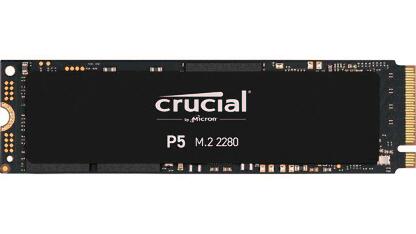
QLC NAND stores 4 bits per cell, which increases density and reduces cost but comes with lower endurance and slower write speeds compared to TLC. The MP400's 550 TBW rating is lower than TLC competitors — the Crucial P5 2TB, for example, is rated at 1,200 TBW. For typical consumer workloads, 550 TBW is still more than enough, but it's a meaningful difference for write-heavy workloads.
Key rivals include the Sabrent Rocket Q 2TB (similar QLC design), the Crucial P5 2TB (TLC, higher endurance), and the WD Black SN750 2TB (TLC, similar performance).
Storage Comparisons:
Force MP400 Performance & Benchmarks
The Corsair Force MP400 2TB is rated at up to 3,480 MB/s sequential reads and 3,000 MB/s sequential writes. In testing, the drive hits these numbers in optimal conditions — KitGuru measured 3,497 MB/s reads and 3,010 MB/s writes in their sequential tests. ATTO results were slightly lower at 3,190/2,830 MB/s.
Corsair Force MP400 2 TB vs M.2 4.0 x 4 peers
Switch between sequential throughput and random IOPS to see how this drive stacks up against other M.2 4.0 x 4 SSDs in our database. The highlighted bar is the drive on this page — click any other bar to open that drive.
- Patriot Viper PV593 1 TB: 14,500 MB/s read, 14,000 MB/s write
- Patriot Viper PV593 2 TB: 14,500 MB/s read, 14,000 MB/s write
- Patriot Viper PV593 4 TB: 14,500 MB/s read, 14,000 MB/s write
- Patriot Viper PV573 2 TB: 14,000 MB/s read, 12,000 MB/s write
- Corsair Force MP400 2 TB (this drive): 3,480 MB/s read, 3,000 MB/s write
Random 4K performance is rated at up to 380K IOPS reads and 560K IOPS writes. In practice, standard 4-threaded tests show around 161K read IOPS and 271K write IOPS at QD32. With 8-threaded testing, read IOPS climb to 424K, exceeding the rated figure.
The SLC cache handles burst writes well, but QLC NAND's direct write speed is significantly lower than TLC. During sustained writes that exceed the cache, throughput drops noticeably. This is the main QLC trade-off — fast for typical consumer workloads, but slower than TLC under heavy, sustained write pressure.
Thermals are a concern: without a heatsink, the MP400 reached 73°C in testing, exceeding the 70°C operating limit. With a third-party heatsink, temperatures dropped to 43–49°C. A heatsink is strongly recommended.
Corsair Force MP400 vs Competitors
See how the Force MP400 stacks up against other M.2 4.0 x 4 drives in our database:
Compare with rival drives:
Endurance, TBW & Warranty
Corsair covers the Force MP400 2 TB with a five-year limited warranty, ending at 400 TBW of writes or the warranty period, whichever comes first. At 20 GB of writes per day, the 400 TBW budget lasts roughly 54 years, well beyond any realistic consumer usage scenario. Even at a heavier 50 GB per day, the endurance ceiling is over 21 years. The MP400 uses Phison SmartECC third-generation LDPC error correction and SmartRefresh for periodic block refresh. Factory overprovisioning of approximately 9 percent of the raw NAND capacity helps maintain consistent performance and reliability over the service life. For comparison, TLC-based 2 TB drives like the Samsung 970 EVO Plus carry 1,200 TBW, roughly triple the MP400 rated endurance, reflecting the lower program-erase cycle rating of QLC cells.
Corsair Force MP400 2 TB Specifications
| Category | Value |
|---|---|
| Capacity [?] | 2 TB |
| Interface [?] | M.2 4.0 x 4 |
| Controller [?] | Phison E16 |
| Memory type [?] | Micron 96L QLC |
| DRAM [?] | DDR3L |
| Read speed (MB/s) [?] | 3480 |
| Write speed (MB/s) [?] | 3000 |
| Read IOPS [?] | 380000 |
| Write IOPS [?] | 560000 |
| Endurance (TBW) [?] | 400 |
| MTBF (million hours) [?] | 1.8 |
| Warranty (years) [?] | 5 |
Verdict: Is the Force MP400 Worth It in 2026?
Gamers and general desktop users who want high-capacity NVMe storage with burst speeds matching TLC alternatives will find the Corsair Force MP400 2 TB a solid pick, especially if sustained writes rarely exceed 500 GB at a time. Video editors and content creators working with large media files should step up to a TLC drive like the Samsung 970 EVO Plus or WD Black SN770, both of which sustain writes at speed long after the MP400 SLC cache runs dry. For the price-sensitive buyer focused on reads and everyday responsiveness, the MP400 2 TB delivers where it counts most and is one of the better QLC options at this capacity.
+ Pros
- 3,480 MB/s reads — near the PCIe 3.0 ceiling
- Available up to 8TB capacity
- 5-year warranty
- AES 256-bit hardware encryption
- Competitive price per gigabyte
- Cons
- QLC NAND: 550 TBW is lower than TLC competitors
- Sustained write speed drops after SLC cache exhausts
- No included heatsink — runs hot under load
- Double-sided PCB may not fit all laptops
- 1TB model has much lower write speed (1,880 MB/s)
Buy this or similar SSD Storage:



Video Review
Corsair MP400 Review - Up to 8TB of FAST SSD - TechteamGB