Team Group MP33 2TB Review (2026)
Quick answer
The Team Group MP33 2TB is a straightforward budget NVMe drive that delivers high capacity at a low price per GB.
Read: 1800 MB/s Write: 1500 MB/s Endurance: 775 TBW Warranty: 5 years Interface: M.2 3.0 x 4
The Team Group MP33 2TB offers a large capacity NVMe drive at a budget price point, using Toshiba 3D TLC NAND and a DRAM-less Phison E13T controller.
Controller & Memory
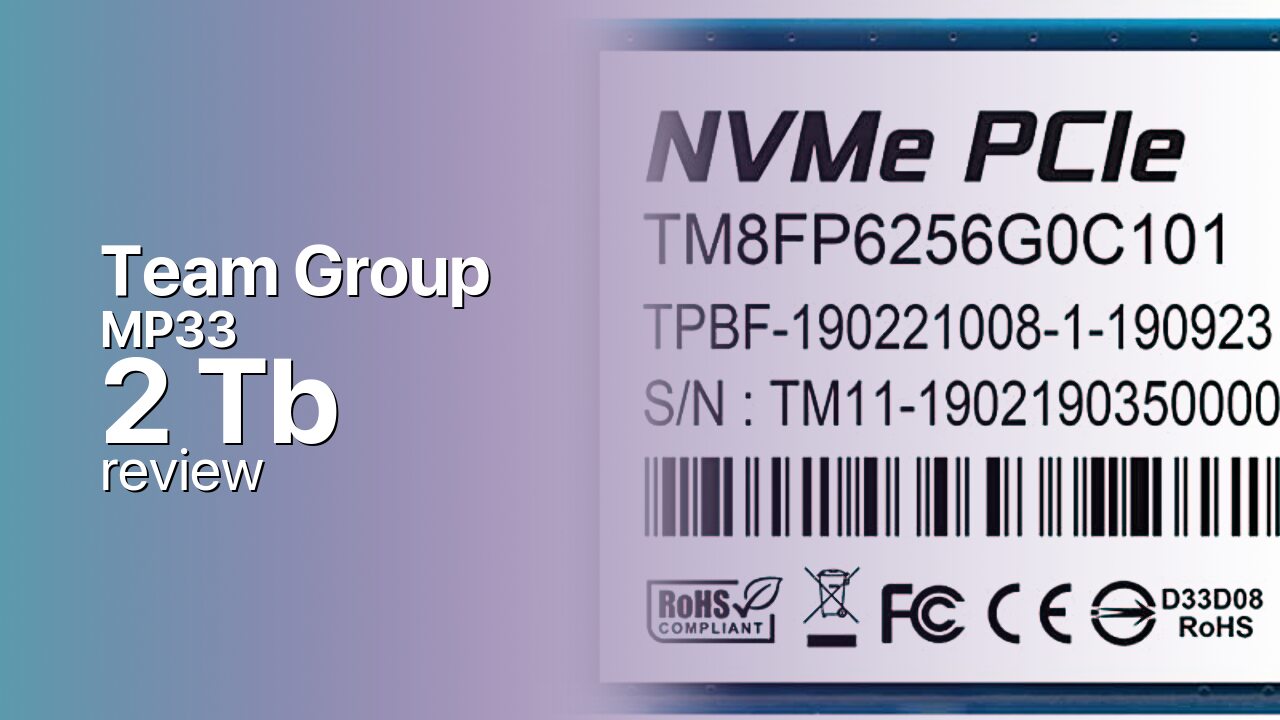
Team Group positions the MP33 as its budget NVMe lineup, and the 2TB model represents the high-capacity end of the range. The drive uses the Phison PS5013-E13T controller, a DRAM-less design that relies on the NVMe Host Memory Buffer (HMB) for mapping table management. This keeps the cost low while delivering acceptable performance for everyday computing.
The 2TB capacity uses Toshiba 3D TLC NAND, providing a large amount of storage at a price per GB that competes with SATA SSDs. The MP33 2TB is rated at 1,800 MB/s sequential reads and 1,500 MB/s writes with 220,000/200,000 IOPS random performance. These are entry-level NVMe speeds, roughly 3x faster than SATA in sequential throughput.
The M.2 2280 form factor fits standard desktop and laptop NVMe slots. The drive is single-sided, making it compatible with thin notebooks. Team Group covers the MP33 with a 5-year warranty and rates endurance at 775 TBW for the 2TB model. The MP33 competes with drives like the Kingston NV2, Sabrent Rocket Q, and Silicon Power A60 in the budget NVMe segment.
Storage Comparisons:
MP33 Performance & Benchmarks
The Team Group MP33 2TB is rated at 1,800 MB/s sequential reads and 1,500 MB/s sequential writes. These speeds place it in the entry-level NVMe tier, roughly 3x faster than SATA SSDs in sequential throughput but well below premium PCIe 3.0 drives that reach 3,000-3,500 MB/s. The 2TB model maintains the same speed ratings as smaller capacities in the MP33 lineup.
Team Group MP33 2 TB vs M.2 3.0 x 4 peers
Switch between sequential throughput and random IOPS to see how this drive stacks up against other M.2 3.0 x 4 SSDs in our database. The highlighted bar is the drive on this page — click any other bar to open that drive.
- ADATA SX 8800 Pro 512 GB: 3,500 MB/s read, 2,700 MB/s write
- ADATA SX 8800 Pro 1 TB: 3,500 MB/s read, 2,700 MB/s write
- ADATA XPG Spectrix S40G RGB 256 GB: 3,500 MB/s read, 3,000 MB/s write
- ADATA XPG Spectrix S40G RGB 512 GB: 3,500 MB/s read, 3,000 MB/s write
- Team Group MP33 2 TB (this drive): 1,800 MB/s read, 1,500 MB/s write
Random performance is rated at 220,000 IOPS reads and 200,000 IOPS writes. The 2TB capacity benefits from more NAND die for parallelization, which helps random I/O compared to smaller MP33 models. The Phison E13T controller handles HMB management and basic SLC caching. The pseudo-SLC cache on the 2TB model is proportionally larger than on smaller capacities, typically providing around 20-40 GB of cached write performance before dropping to native TLC speeds.
For users moving from a SATA SSD, the MP33 2TB delivers a meaningful improvement in boot times, application launches, and file operations. The 1,800 MB/s read speed is adequate for gaming and everyday computing. The DRAM-less architecture means random I/O consistency can vary under heavy multitasking compared to drives with dedicated DRAM caches, but for typical consumer workloads the performance is acceptable. The 2TB capacity is the real selling point, offering enough space for a full game library and media collection.
Team Group MP33 vs Competitors
See how the MP33 stacks up against other M.2 3.0 x 4 drives in our database:
Compare with rival drives:
Endurance, TBW & Warranty
Team Group backs the MP33 series with a 5-year warranty. The 2TB model is rated at 775 TBW endurance, which is competitive for this capacity tier. In practical terms, writing 50 GB per day would take over 42 years to reach 775 TBW. Even heavy users writing 100 GB daily would need roughly 21 years.
The 5-year warranty matches the coverage offered by Samsung, WD, and Crucial on their consumer drives. Team Group handles warranty through regional distributors. The drive includes S.M.A.R.T. health monitoring and wear-leveling. The 2TB capacity means the drive is likely to be replaced for technology reasons long before endurance becomes a factor.
Team Group MP33 2 TB Specifications
| Category | Value |
|---|---|
| Capacity [?] | 2 TB |
| Interface [?] | M.2 3.0 x 4 |
| Controller [?] | Phison PS5013-E13-31 |
| Memory type [?] | Toshiba 3D TLC |
| DRAM [?] | HMB |
| Read speed (MB/s) [?] | 1800 |
| Write speed (MB/s) [?] | 1500 |
| Read IOPS [?] | 220000 |
| Write IOPS [?] | 200000 |
| Endurance (TBW) [?] | 775 |
| MTBF (million hours) [?] | 1.5 |
| Warranty (years) [?] | 5 |
Verdict: Is the MP33 Worth It in 2026?
The Team Group MP33 2TB is a straightforward budget NVMe drive that delivers high capacity at a low price per GB. The 1,800/1,500 MB/s speeds are entry-level for NVMe but represent a real improvement over SATA. The 5-year warranty and 775 TBW endurance provide peace of mind. Buy it if you want maximum storage capacity on a budget and do not need premium NVMe speeds.
Skip it if you can spend more for a DRAM-equipped drive like the Samsung 970 EVO Plus 2TB or WD Black SN750 2TB, which deliver significantly higher sequential throughput and better random I/O consistency. The MP33 2TB is best suited for budget gaming builds, media storage, or as a secondary game install drive where capacity matters more than peak performance.
+ Pros
- 2TB capacity at a competitive price per GB
- 1,800/1,500 MB/s — 3x faster than SATA
- Toshiba 3D TLC NAND for reliability
- 775 TBW endurance generous for 2TB tier
- 5-year warranty
- Cons
- DRAM-less design limits random I/O consistency
- 1,800 MB/s well below premium PCIe 3.0 drives (3,000+ MB/s)
- Entry-level NVMe performance tier
- Phison E13T is a basic controller without advanced features
Buy this or similar SSD Storage:
Video Review
TeamGroup MP33 M.2 NVMe SSD Review