Crucial P1 2TB QLC NVMe SSD Review (2026)
Quick answer
The Crucial P1 2 TB is the only capacity where QLC's density advantage produces a tangible price-per-GB benefit.
Read: 2000 MB/s Write: 1750 MB/s Endurance: 400 TBW Warranty: 5 years Interface: M.2 3.0 x 4
The Crucial P1 2 TB is the largest capacity in Crucial's QLC NVMe line, offering 400 TBW endurance, 2 GB DDR4 DRAM, and the biggest SLC cache in the family -- but it is double-sided, limiting laptop compatibility.
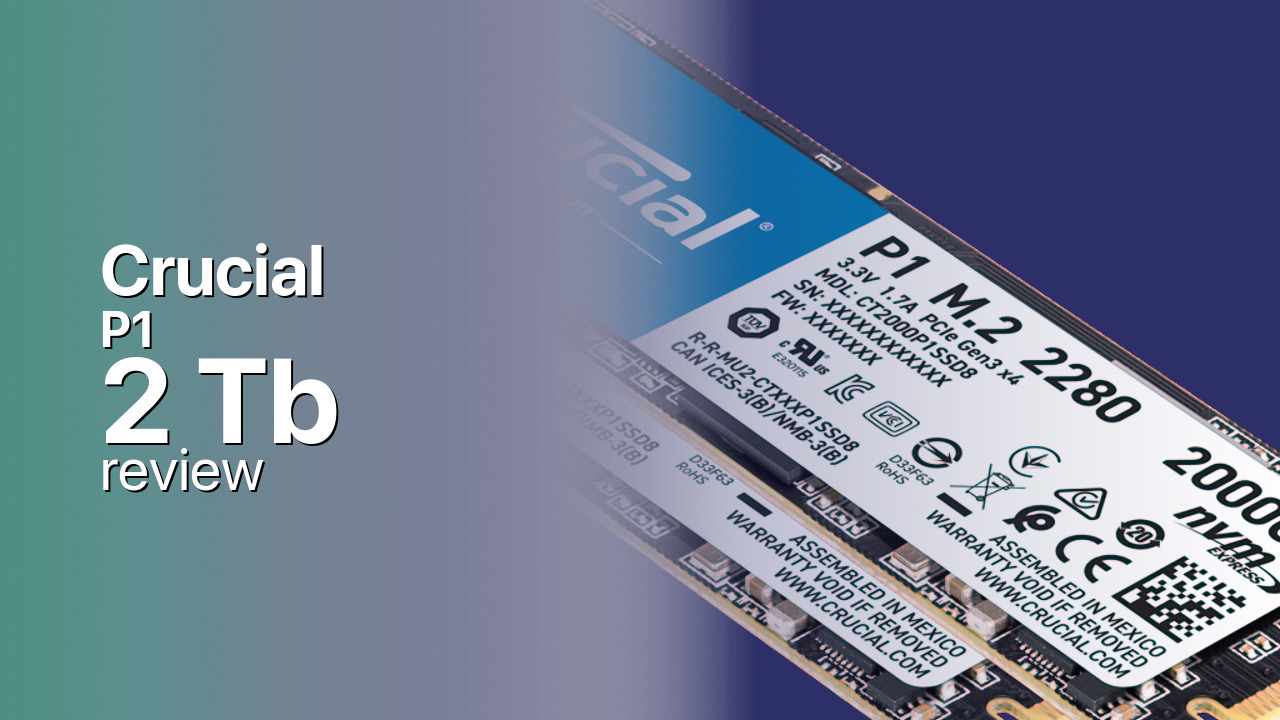
Controller & Memory
The P1 2 TB uses the same Silicon Motion SM2263 four-channel NVMe controller and Micron 64-layer 3D QLC NAND as the rest of the lineup, but steps up to 2 GB of DDR4 DRAM (the smaller capacities use DDR3). The 2 TB model is the only capacity in the P1 line that is double-sided, with NAND and DRAM on both sides of the M.2 2280 PCB. This limits compatibility with some slim laptops and devices that only accept single-sided modules.
The 2 TB capacity maximizes the P1's QLC economics: the SLC write cache spans from 24 GB minimum to 200 GB maximum on a fresh drive, which is enormous. The rated 2,000/1,750 MB/s read/write speeds and 400 TBW endurance are the best in the P1 family. Also available in 512 GB and 1 TB capacities.
The P1 was one of the first consumer QLC NVMe SSDs alongside the Intel 660p. Both share the same SM2263 controller and Micron QLC NAND. The P1 differentiates with more DRAM and slightly more overprovisioning. The 2 TB capacity is the only model where QLC's density advantage produces a meaningful price-per-GB benefit over TLC alternatives.
Storage Comparisons:
P1 Performance & Benchmarks
Crucial rates the 2 TB P1 for up to 2,000 MB/s sequential reads and 1,750 MB/s sequential writes over PCIe 3.0 x4, with 250,000 random read IOPS and 250,000 random write IOPS. The 200 GB SLC cache on a fresh drive provides a large buffer for write bursts.
Crucial P1 2 TB vs M.2 3.0 x 4 peers
Switch between sequential throughput and random IOPS to see how this drive stacks up against other M.2 3.0 x 4 SSDs in our database. The highlighted bar is the drive on this page — click any other bar to open that drive.
- ADATA SX 8800 Pro 512 GB: 3,500 MB/s read, 2,700 MB/s write
- ADATA SX 8800 Pro 1 TB: 3,500 MB/s read, 2,700 MB/s write
- ADATA XPG Spectrix S40G RGB 256 GB: 3,500 MB/s read, 3,000 MB/s write
- ADATA XPG Spectrix S40G RGB 512 GB: 3,500 MB/s read, 3,000 MB/s write
- Crucial P1 2 TB (this drive): 2,000 MB/s read, 1,750 MB/s write
The P1's variable SLC cache is the largest in the family at 2 TB, which means most consumer write workloads will stay within the cache. AnandTech found the caching strategy -- which retains data in SLC for read acceleration and folds to QLC only when necessary -- effective for lightweight consumer workloads.
The QLC write cliff remains the fundamental limitation. When the 200 GB cache fills, writes must pass through the SLC layer before being folded into QLC blocks, creating a throughput bottleneck. For the 2 TB capacity, the cache is large enough that this is less of an issue in daily use compared to the 512 GB model, but sustained writes of hundreds of gigabytes will still trigger the cliff.
Crucial P1 vs Competitors
See how the P1 stacks up against other M.2 3.0 x 4 drives in our database:
Compare with rival drives:
Endurance, TBW & Warranty
Crucial rates the 2 TB P1 for 400 TBW of write endurance under a five-year limited warranty, equating to approximately 0.1 DWPD. At 20 GB of writes per day, 400 TBW lasts roughly 55 years. The P1 includes partial power loss protection through its write-through SLC caching. The 400 TBW is the highest in the P1 lineup but still low compared to TLC drives: the Samsung 970 EVO Plus 2 TB offers 1,200 TBW, three times the P1's rating.
Crucial P1 2 TB Specifications
| Category | Value |
|---|---|
| Capacity [?] | 2 TB |
| Interface [?] | M.2 3.0 x 4 |
| Controller [?] | Silicon Motion SM2263 |
| Memory type [?] | Micron 3D QLC |
| DRAM [?] | DDR3 / DDR4 |
| Read speed (MB/s) [?] | 2000 |
| Write speed (MB/s) [?] | 1750 |
| Read IOPS [?] | 250000 |
| Write IOPS [?] | 250000 |
| Endurance (TBW) [?] | 400 |
| MTBF (million hours) [?] | 1.5 |
| Warranty (years) [?] | 5 |
Verdict: Is the P1 Worth It in 2026?
The Crucial P1 2 TB is the only capacity where QLC's density advantage produces a tangible price-per-GB benefit. The massive SLC cache (up to 200 GB) handles most consumer write patterns, and the 400 TBW endurance is adequate for read-heavy desktop use. However, the double-sided PCB limits laptop compatibility, and the underlying QLC limitations persist. For users who need 2 TB of NVMe storage and are confident their workload is read-heavy, the P1 offers value. For any write-heavy or professional use, a TLC drive like the Samsung 970 EVO Plus or SK hynix Gold P31 is worth the premium.
+ Pros
- 2,000 MB/s reads, 1,750 MB/s writes
- Massive SLC cache (up to 200 GB on fresh drive)
- 2 GB DDR4 DRAM
- 400 TBW endurance
- 250K/250K random IOPS
- Five-year warranty
- Cons
- QLC NAND with slow native write speed
- Double-sided M.2 2280 (limited laptop compatibility)
- Only 400 TBW vs 1,200 TBW on TLC alternatives
- Performance cliff when SLC cache fills
- Not suitable for write-heavy workloads
- SM2263 four-channel controller is entry-level
Buy this or similar SSD Storage:
Video Review
Crucial P1 1TB NVMe m.2 SSD - The best budget NVMe SSD!