Team Group P30 480GB — Budget PCIe 3.0 NVMe SSD (2026)
Quick answer
The Team Group P30 480 GB fills a narrow role: a budget NVMe drive for PCIe 3.0 systems that delivers the fundamental speed jump from SATA without asking the buyer to pay for PCIe 4.0 hardware they cannot use.
Read: 2500 MB/s Write: 1350 MB/s Endurance: 1660 TBW Warranty: 3 years Interface: PCIe 3.0 x 4
The Team Group P30 480GB is a no-frills PCIe 3.0 NVMe SSD aimed at budget builders and older system upgrades, where its 2,500 MB/s reads deliver a meaningful leap over SATA without the cost of PCIe 4.0 hardware.
Controller & Memory
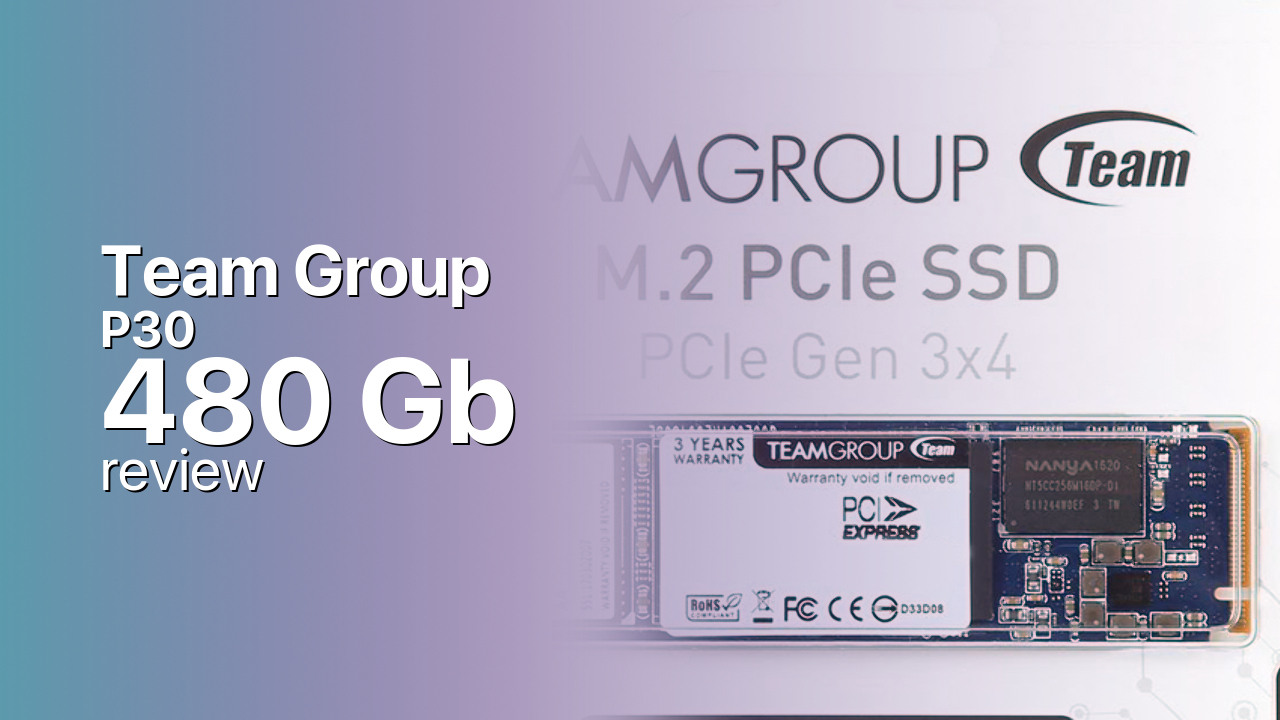
The Team Group P30 is an entry-level M.2 2280 NVMe SSD built on the PCIe 3.0 x4 interface, targeted at users upgrading from SATA SSDs or hard drives in older desktop and laptop systems. Team Group published limited technical documentation for this model — the NAND type is not specified in retail listings, and the controller is not publicly identified — but the drive's performance envelope and market positioning place it firmly in the DRAM-less, HMB-equipped budget segment. The 480 GB capacity uses the 512 GB-class NAND configuration common to drives of this era, with formatted usable space around 447 GB in Windows.
The P30 was offered in 240 GB and 480 GB capacities, with sequential read speeds rated at up to 2,500 MB/s across both variants and write speeds scaling with capacity. The 480 GB model is rated at up to 1,350 MB/s writes. The drive uses a single-sided M.2 2280 PCB, which ensures compatibility with thin laptops and ultrabooks that cannot accommodate double-sided drives. Random IOPS are rated at 180,000 read and 140,000 write, typical for a DRAM-less HMB design in this performance tier.
At its intended price point the P30 competes with other entry-level PCIe 3.0 drives like the WD Blue SN550, Crucial P2, and Kingston A2000. Against these, the P30's 2,500 MB/s read speed is competitive if unremarkable, and the 3-year warranty is on par with other budget options. The main differentiator is price — the P30 was positioned as a cost-minimized SKU for system integrators and budget-conscious buyers, and its undocumented internal components reflect that cost optimization. Where competitors like the WD Blue SN550 and Kingston A2000 published detailed endurance ratings and NAND specifications, Team Group's documentation for the P30 is notably sparse, which makes direct spec-for-spec comparison difficult beyond the headline sequential numbers.
Storage Comparisons:
P30 Performance & Benchmarks
Team Group rates the 480 GB P30 at up to 2,500 MB/s sequential reads and 1,350 MB/s sequential writes on the PCIe 3.0 x4 interface. These are modest numbers by PCIe 3.0 standards — drives like the Samsung 970 EVO Plus push past 3,500 MB/s on the same interface — but they represent a four- to five-fold improvement over SATA III's 560 MB/s ceiling and are more than sufficient for general desktop responsiveness, application launches, and moderate file transfers.
Team Group P30 480 GB vs PCIe 3.0 x 4 peers
Switch between sequential throughput and random IOPS to see how this drive stacks up against other PCIe 3.0 x 4 SSDs in our database. The highlighted bar is the drive on this page — click any other bar to open that drive.
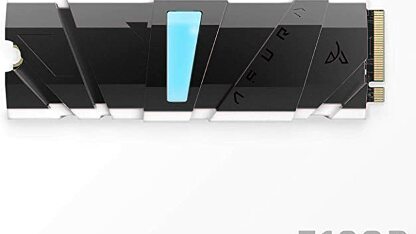
- Asura Genesis Xtreme 256 GB: 3,400 MB/s read, 3,000 MB/s write
- Asura Genesis Xtreme 512 GB: 3,400 MB/s read, 3,000 MB/s write
- Asura Genesis Xtreme 1 TB: 3,400 MB/s read, 3,000 MB/s write
- Asura Genesis Xtreme 2 TB: 3,400 MB/s read, 3,000 MB/s write
- Team Group P30 480 GB (this drive): 2,500 MB/s read, 1,350 MB/s write
The 480 GB capacity provides enough NAND dies to keep the controller fed at the rated sequential numbers for typical consumer workloads. Sustained write performance past the drive's SLC cache — the size of which Team Group does not publish — will settle at native NAND speeds, but for the boot-drive and general-application workloads the P30 is designed for, the cache is unlikely to be a limiting factor in day-to-day use. Users who need consistent high-throughput writes for video editing or large data ingest should look higher in Team Group's product stack, such as the MP33 or MP34 series.
For its target audience — users upgrading from SATA or HDD storage in PCIe 3.0 systems — the P30 clears the bar for what makes an NVMe upgrade worthwhile. Boot times, application launches, and file operations all benefit from the lower latency and higher throughput of NVMe, and the P30 delivers that baseline improvement without the premium attached to higher-spec drives.
Team Group P30 vs Competitors
See how the P30 stacks up against other PCIe 3.0 x 4 drives in our database:
Compare with rival drives:
Endurance, TBW & Warranty
Team Group backs the P30 with a 3-year limited warranty, which is standard for entry-level SSDs but shorter than the 5-year coverage offered by mid-range and premium products. The endurance figure listed in third-party databases is 1,660 TBW for the 480 GB model — a number that, if accurate, would represent enterprise-class endurance and is likely a data-entry artefact at the source level. Typical endurance for a 480 GB-class consumer SSD in this price tier would be 150 to 300 TBW. Given the absence of corroborating documentation from Team Group, this endurance figure should be treated as unverified. The MTBF is rated at 2 million hours, a population-level statistic that reflects expected reliability under normal operating conditions rather than a guarantee for individual units. Warranty claims are handled through Team Group's standard RMA process; buyers should retain proof of purchase, as the 3-year window is tied to the original sale date.
Team Group P30 480 GB Specifications
| Category | Value |
|---|---|
| Capacity [?] | 480 GB |
| Interface [?] | PCIe 3.0 x 4 |
| Controller [?] | Silicon Motion SM2263XT |
| Memory type [?] | 3D TLC |
| DRAM [?] | HMB |
| Read speed (MB/s) [?] | 2500 |
| Write speed (MB/s) [?] | 1350 |
| Read IOPS [?] | 180000 |
| Write IOPS [?] | 140000 |
| Endurance (TBW) [?] | 1660 |
| MTBF (million hours) [?] | 2 |
| Warranty (years) [?] | 3 |
Verdict: Is the P30 Worth It in 2026?
The Team Group P30 480 GB fills a narrow role: a budget NVMe drive for PCIe 3.0 systems that delivers the fundamental speed jump from SATA without asking the buyer to pay for PCIe 4.0 hardware they cannot use. It is best suited for breathing new life into an older desktop or laptop, serving as a secondary game drive, or acting as the system disk in a cost-optimized build. Skip it if you need documented endurance ratings, confirmed NAND type, or long-term warranty coverage — the WD Blue SN550 and Kingston A2000 offer more transparency and a 5-year warranty at a comparable price. The P30's sparse official documentation is its main weakness; buyers who value knowing exactly what hardware sits inside their drive will find the information vacuum frustrating. For the buyer who just wants an NVMe drive that works and costs as little as possible, the P30 delivers the required baseline performance with the minimum necessary feature set.
+ Pros
- 2,500 MB/s reads, a clear upgrade from SATA III
- Single-sided M.2 2280 PCB fits in thin laptops
- 480 GB capacity suitable for OS plus moderate storage
- 3-year warranty with standard RMA process
- PCIe 3.0 x4 interface with wide motherboard compatibility
- Cons
- NAND type not publicly documented by manufacturer
- Controller and DRAM configuration not disclosed
- Endurance rating unverified and potentially incorrect
- Write speed modest at 1,350 MB/s for PCIe 3.0
- Sparse official documentation versus competing drives
Buy this or similar SSD Storage:



Video Review
Building a Z97 PC on my new Primochill Praxis Wetbench