Team Group T-Force Cardea II 256GB NVMe SSD Review (2026)
Quick answer
The Cardea II 256GB is a niche product: the finned heatsink is visually striking and thermally effective, but the 256GB capacity's 1,000 MB/s write speed undermines the enthusiast positioning.
Read: 3400 MB/s Write: 1000 MB/s Endurance: 380 TBW Warranty: 3 years Interface: M.2 3.0 x 4
The Team Group T-Force Cardea II 256GB wraps Phison E12 NVMe performance in a patented finned aluminum heatsink — but at 256GB, the limited NAND parallelism caps write speeds to 1,000 MB/s.
Controller & Memory
The Cardea II uses the Phison PS5012-E12 controller — the same proven PCIe 3.0 platform found in Corsair's MP510, ADATA's SX8200 Pro, and numerous other high-end NVMe drives. Team Group pairs it with Toshiba 64-layer 3D TLC NAND and DDR3 or DDR4 DRAM for the flash translation layer. The drive is available in 256GB, 512GB, and 1TB capacities, each with significantly different performance specs.
At 256GB, the Cardea II is rated for 3,000 MB/s sequential read but only 1,000 MB/s sequential write — a stark contrast to the 1TB model's 3,400/3,000 MB/s. Random performance is also reduced: 180K read and 150K write IOPS versus 180K/160K at 1TB. The write speed limitation is a direct consequence of having fewer NAND dies for interleaving at this capacity.
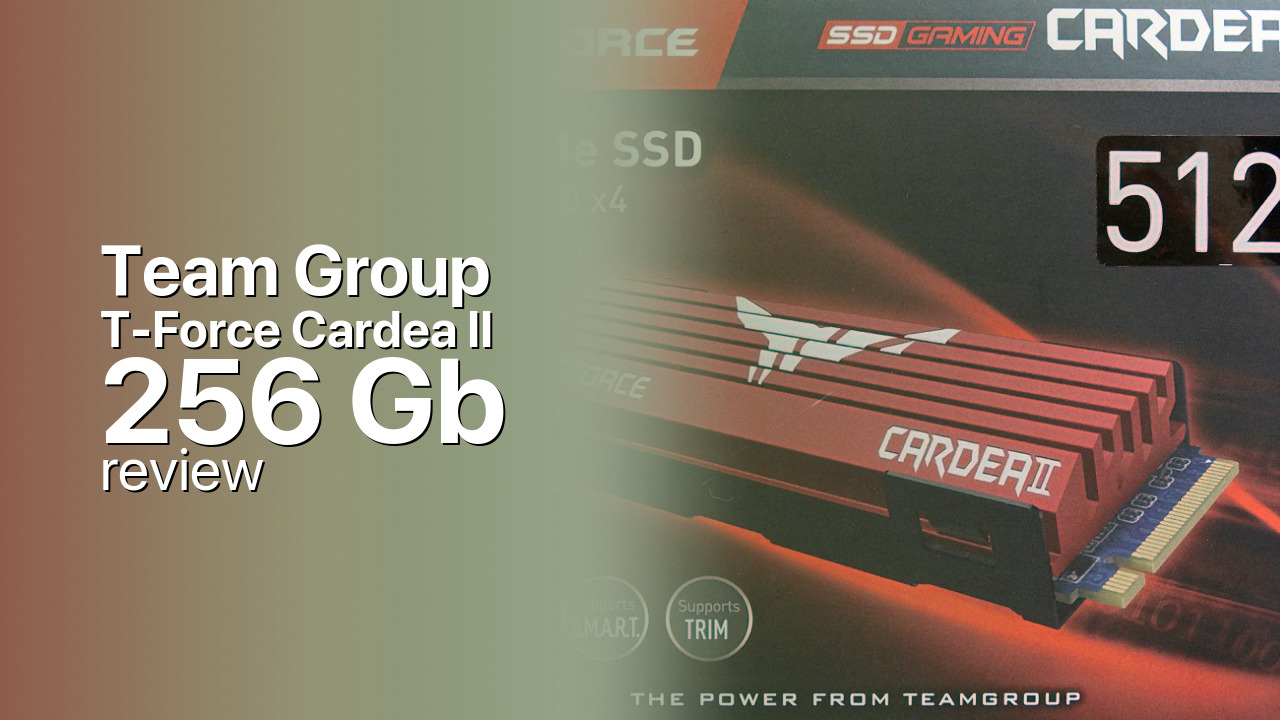
The Cardea II's defining feature is its patented gaming-fin aluminum heatsink (Taiwan Utility Model Patent No. M541645). Team Group claims it reduces temperatures by up to 10 degrees in a closed chassis and 30 degrees in open air, with 15 percent better radiation performance than traditional cooling modules. The heatsink adds significant height and is removable for systems with integrated motherboard M.2 cooling.
Storage Comparisons:
T-Force Cardea II Performance & Benchmarks
Team Group rates the Cardea II 256GB at 3,000 MB/s sequential read and 1,000 MB/s sequential write. The read speed is competitive for a PCIe 3.0 drive at this capacity, but the write speed is barely above SATA territory. This is a platform limitation, not a design flaw — all Phison E12 drives at 256GB show similarly reduced write speeds due to limited NAND parallelism.
Team Group T-Force Cardea II 256 GB vs M.2 3.0 x 4 peers
Switch between sequential throughput and random IOPS to see how this drive stacks up against other M.2 3.0 x 4 SSDs in our database. The highlighted bar is the drive on this page — click any other bar to open that drive.
- ADATA SX 8800 Pro 512 GB: 3,500 MB/s read, 2,700 MB/s write
- ADATA SX 8800 Pro 1 TB: 3,500 MB/s read, 2,700 MB/s write
- ADATA XPG Spectrix S40G RGB 256 GB: 3,500 MB/s read, 3,000 MB/s write
- ADATA XPG Spectrix S40G RGB 512 GB: 3,500 MB/s read, 3,000 MB/s write
- Team Group T-Force Cardea II 256 GB (this drive): 3,400 MB/s read, 1,000 MB/s write
Random performance at 180K read and 150K write IOPS is adequate for desktop use. At QD1 — the queue depth most relevant to gaming and OS use — the drive performs similarly to other E12 SSDs regardless of capacity. The finned heatsink keeps temperatures well below throttling, which is beneficial during extended use. For primarily read-heavy workloads like OS boot and game loading, the Cardea II 256GB delivers responsive performance. For write-heavy tasks like game installs and file transfers, the 1,000 MB/s ceiling is a noticeable bottleneck.
Team Group T-Force Cardea II vs Competitors
See how the T-Force Cardea II stacks up against other M.2 3.0 x 4 drives in our database:
Compare with rival drives:
Endurance, TBW & Warranty
The Cardea II 256GB carries a 380 TBW endurance rating with a 3-year warranty. Team Group's T-Force gaming line typically offers shorter warranties than premium competitors with 5-year terms. At 20 GB of daily writes — reasonable for a boot drive — the 380 TBW rating translates to roughly 52 years. The MTBF is rated at 2.0 million hours. The finned heatsink may help extend flash life by keeping operating temperatures lower, though TBW is primarily determined by program-erase cycle counts rather than temperature within normal operating ranges.
Team Group T-Force Cardea II 256 GB Specifications
| Category | Value |
|---|---|
| Capacity [?] | 256 GB |
| Interface [?] | M.2 3.0 x 4 |
| Controller [?] | Phison PS5012-E12 |
| Memory type [?] | Toshiba 64L 3D TLC |
| DRAM [?] | DDR3 or DDR4 |
| Read speed (MB/s) [?] | 3400 |
| Write speed (MB/s) [?] | 1000 |
| Read IOPS [?] | 180000 |
| Write IOPS [?] | 150000 |
| Endurance (TBW) [?] | 380 |
| MTBF (million hours) [?] | 2 |
| Warranty (years) [?] | 3 |
Verdict: Is the T-Force Cardea II Worth It in 2026?
The Cardea II 256GB is a niche product: the finned heatsink is visually striking and thermally effective, but the 256GB capacity's 1,000 MB/s write speed undermines the enthusiast positioning. For a boot drive where reads dominate, it works well and looks good doing it. For any write-heavy use case, the 512GB or 1TB model delivers dramatically better write speeds at a modest price increase. Competitors like the ADATA XPG SX8200 Pro 256GB offer similar read performance without the heatsink premium. The heatsink makes sense for builds where visible M.2 cooling is desired and the motherboard lacks integrated M.2 heatsinks.
+ Pros
- 3,000 MB/s sequential read on PCIe 3.0
- Patented finned aluminum heatsink
- Phison E12 with DRAM cache
- 380 TBW endurance
- Cons
- 1,000 MB/s write speed is barely above SATA
- 256GB capacity fills quickly
- Heatsink too tall for laptops and some motherboards
- 3-year warranty on a gaming-branded product
Buy this or similar SSD Storage:



Video Review
World's First Liquid M.2 NVMe ! The TEAM GROUP T-FORCE Cardea Liquid SSD