MyDigitalSSD SBXe 480GB SSD — In-Depth Review & Specs (2026)
Quick answer
The MyDigitalSSD SBXe 480GB is a straightforward, honest budget NVMe drive.
Read: 1700 MB/s Write: 1550 MB/s Endurance: 390 TBW Warranty: 5 years Interface: M.2 3.0 x 4
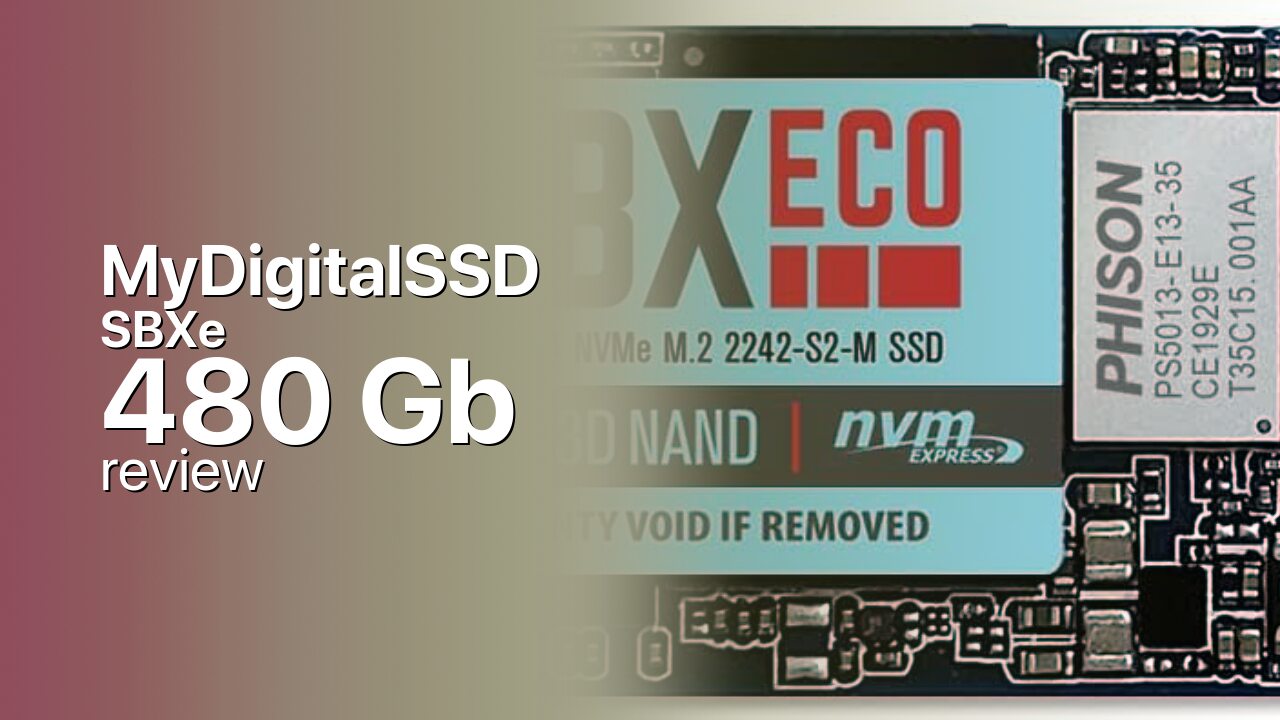
The MyDigitalSSD SBXe 480GB is the practical mid-capacity entry in MyDigitalSSD's budget NVMe line. Built on the Phison PS5013-E13T — a DRAM-less 4-channel PCIe 3.0 controller that uses Host Memory Buffer (HMB) instead of a dedicated DRAM chip — the SBXe pairs Toshiba BiCS3 64-layer 3D TLC NAND with a compact single-sided M.2 2280 form factor. At 480GB, it strikes a balance between price and usable capacity for OS-plus-essentials builds. This review examines how the DRAM-less E13T platform performs in practice, where it excels, and where it gives ground to DRAM-equipped alternatives.
Controller & Memory
The Phison PS5013-E13T is a purpose-built DRAM-less NVMe controller with four NAND channels and a PCIe 3.0 x4 link. Instead of a dedicated DRAM chip for the flash translation layer (FTL) mapping table, the E13T uses NVMe 1.3's Host Memory Buffer feature to borrow a small slice of system RAM — typically 32-64 MB — over the PCIe bus. This keeps the bill of materials lower than a DRAM-equipped drive while preserving most of the random-I/O responsiveness that makes NVMe worthwhile over SATA. The tradeoff is that HMB access adds a few microseconds of latency compared to on-controller DRAM, and the drive cannot maintain peak random performance under heavy mixed-workload pressure the way a dedicated-DRAM design can.
MyDigitalSSD pairs the E13T with Toshiba BiCS3 64-layer 3D TLC NAND — the same generation of flash that powered many mid-range drives of the era. An SLC write cache absorbs burst writes at high speed; once the cache is exhausted, write throughput folds to native TLC rates around 400-500 MB/s. For the typical desktop workload — OS boots, application launches, game loads, and moderate file transfers — the cache is large enough that most users will never see the folding point.
The SBXe comes in a single-sided M.2 2280 form factor, which is critical for thin laptops and Ultrabooks that cannot physically accommodate double-sided drives. Power draw is low enough to work in PCIe 3.0 laptop slots without thermal throttling concerns under typical workloads. Endurance and warranty are competitive for the budget segment, with the E13T's LDPC error correction and end-to-end data path protection providing the baseline reliability features expected of a modern NVMe SSD.
Storage Comparisons:
SBXe Performance & Benchmarks
Rated sequential throughput is 1,700 MB/s read and 1,550 MB/s write — about one-third below the PCIe 3.0 x4 ceiling of ~3,500 MB/s, which reflects the E13T's 4-channel DRAM-less design constraints. In practice, this is still 3-3.5x faster than a SATA SSD's ~550 MB/s ceiling, so the user-experience leap from SATA to the SBXe is dramatic: Windows boots in under 15 seconds, large game levels load in single-digit seconds, and file copies between two NVMe drives fly at the drive's rated throughput.
MyDigitalSSD SBXe 480 GB vs M.2 3.0 x 4 peers
Switch between sequential throughput and random IOPS to see how this drive stacks up against other M.2 3.0 x 4 SSDs in our database. The highlighted bar is the drive on this page — click any other bar to open that drive.
- ADATA SX 8800 Pro 512 GB: 3,500 MB/s read, 2,700 MB/s write
- ADATA SX 8800 Pro 1 TB: 3,500 MB/s read, 2,700 MB/s write
- ADATA XPG Spectrix S40G RGB 256 GB: 3,500 MB/s read, 3,000 MB/s write
- ADATA XPG Spectrix S40G RGB 512 GB: 3,500 MB/s read, 3,000 MB/s write
- MyDigitalSSD SBXe 480 GB (this drive): 1,700 MB/s read, 1,550 MB/s write
Random 4K performance is where the HMB design shows its character. Lightly-threaded random reads and writes feel snappy — application launches and alt-tab multitasking are responsive — but heavy queue-depth workloads (virtual-machine storage, database servers, or content-creation scratch duties) push the E13T past where HMB can keep up, and latency spikes compared to a DRAM-equipped alternative. For a home/office PC, student laptop, or secondary game drive, this limitation is academic; for a workstation that sustains high queue depths, a DRAM-equipped drive is the better fit.
Thermally, the single-sided E13T runs cool. Even under sustained sequential writes, the controller rarely reaches throttle temperatures in a case with modest airflow. Laptop users in particular benefit: no heatsink gymnastics required, and battery-life impact is negligible thanks to NVMe autonomous power-state transitions and low L1.2 idle power.
MyDigitalSSD SBXe vs Competitors
See how the SBXe stacks up against other M.2 3.0 x 4 drives in our database:
Compare with rival drives:
Endurance, TBW & Warranty
MyDigitalSSD provides a 5-year limited warranty for the SBXe series, capped at the endurance rating for each capacity. The warranty applies to the original purchaser and does not cover data recovery. Endurance scales with capacity across the SBXe line — the 480GB model is rated for 390 TBW, which works out to roughly 0.45 drive-writes-per-day over the warranty period.
MyDigitalSSD SBXe 480 GB Specifications
| Category | Value |
|---|---|
| Capacity [?] | 480 GB |
| Interface [?] | M.2 3.0 x 4 |
| Controller [?] | Phison PS5013-E13T |
| Memory type [?] | Toshiba TLC |
| DRAM [?] | HMB |
| Read speed (MB/s) [?] | 1700 |
| Write speed (MB/s) [?] | 1550 |
| Read IOPS [?] | 295000 |
| Write IOPS [?] | 240000 |
| Endurance (TBW) [?] | 390 |
| MTBF (million hours) [?] | 2000000 |
| Warranty (years) [?] | 5 |
Verdict: Is the SBXe Worth It in 2026?
The MyDigitalSSD SBXe 480GB is a straightforward, honest budget NVMe drive. It doesn't pretend to be a performance flagship — the Phison E13T with HMB is a cost-optimized platform, and the 1,700/1,550 MB/s throughput reflects that. What it delivers is a genuine NVMe experience at a SATA-adjacent price, with a single-sided form factor that fits every M.2 slot and Toshiba BiCS3 NAND that was a proven workhorse of its generation. For a budget desktop build, a laptop rescued from a spinning hard drive, or a secondary game library drive in a PCIe 3.0 system, the SBXe 480GB does exactly what it says on the box — no more, but no less. Buyers who need sustained mixed-workload consistency should look at DRAM-equipped alternatives, but for the light-to-moderate workloads that define most consumer PCs, the SBXe is a capable and affordable pick.
+ Pros
- Single-sided M.2 2280 — universal fit including Ultrabooks
- 1,700/1,550 MB/s — genuine NVMe speeds, 3x+ over SATA
- Toshiba BiCS3 64L 3D TLC — mature, proven NAND generation
- Cool-running — no heatsink required even in constrained laptop bays
- 5-year warranty — longer than many budget-drive competitors
- Phison E13T with HMB — cost-effective NVMe without the SATA compromise
- Cons
- DRAM-less HMB design — latency rises under heavy mixed workloads
- Post-cache TLC write speed drops to ~400-500 MB/s
- 480GB capacity — tight for a large game library plus OS
- Phison E13T is only 4-channel — not competitive with 8-channel Gen3 drives
- Limited brand recognition and retail availability vs. major OEMs
- No hardware encryption support (TCG Opal / Pyrite)
Buy this or similar SSD Storage:



Video Review
Video Unbox Técnico MyDigitalSSD M.2 NVMe BPX 480GB SSD MLC