Transcend PCIe SSD 220S 1 TB Review — PCIe 3.0 NVMe (2026)
Quick answer
The Transcend PCIe SSD 220S 1 TB is the right pick if you are upgrading an older or mid-life PCIe 3.0 desktop or laptop and you want a TLC drive with a real DRAM cache and an unusually high 2,200 TBW endurance rating at 1 TB.
Read: 3500 MB/s Write: 3200 MB/s Endurance: 2200 TBW Warranty: 5 years Interface: M.2 3.0 x 4
The Transcend PCIe SSD 220S 1 TB is a DRAM-equipped PCIe 3.0 NVMe drive that pushes the Gen 3 envelope on both sequential speed and a generous 5-year, 2,200 TBW warranty.
Controller & Memory
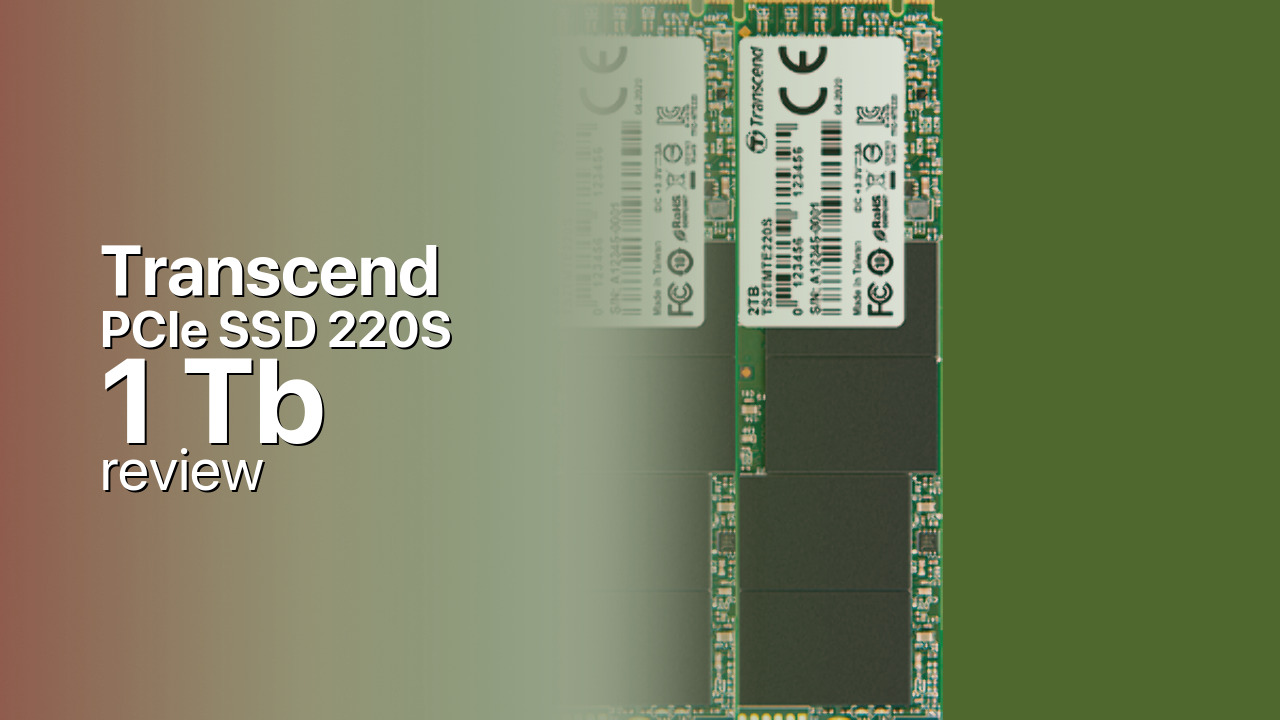
The Transcend PCIe SSD 220S 1 TB — sold under the part number TS1TMTE220S — is the middle-volume capacity of Transcend’s mainstream PCIe 3.0 NVMe family, built around the Silicon Motion SM2262EN, an eight-channel controller paired with Micron 64-layer 3D TLC NAND and a 1 GB DDR3 DRAM cache. The PCB is M.2 2280 and double-sided, with NAND packages on both faces. Transcend markets the 220S at digital audio/video creators, gamers, and prosumers who want the practical ceiling of Gen 3 NVMe at a sensible price point.
At 1 TB the 220S inherits the rated 3,500 MB/s sequential read figure of the family, and a 3,200 MB/s sequential write that is faster than the smaller 256 GB and 512 GB capacities (which top out at roughly 1,700 MB/s and 2,100 MB/s respectively). The closest direct rivals on PCIe 3.0 at 1 TB are the Samsung 970 EVO Plus 1 TB (DRAM, TLC, broader benchmark coverage), the WD Blue SN570 1 TB (DRAM-less HMB, cheaper), and the Crucial P2 1 TB (entry tier, lower endurance). The 220S’s case against the SN570 is the dedicated DRAM cache and the unusually high 2,200 TBW endurance figure; its weakness against the 970 EVO Plus is firmware maturity and broader independent benchmark coverage.
The 220S 1 TB is a fit for older or mid-life desktops and laptops with a PCIe 3.0 M.2 slot, especially as a creator scratch disk where the high write endurance matters. It is not a PS5 candidate — the PS5 expansion bay requires PCIe 4.0 and a 5,500 MB/s sequential read floor, both of which rule the 220S out regardless of capacity. The double-sided PCB also pushes it outside the PS5 envelope physically.
Storage Comparisons:
PCIe SSD 220S Performance & Benchmarks
Transcend rates the PCIe SSD 220S 1 TB at up to 3,500 MB/s sequential reads, essentially the practical ceiling of the PCIe 3.0 x4 bus, and up to 3,200 MB/s sequential writes — fast for any Gen 3 drive and well above the 1 TB Samsung 970 EVO Plus’s 3,300 MB/s rated reads and 3,300 MB/s rated writes. The family datasheet quotes “up to 340,000 read IOPS and 370,000 write IOPS” for the lineup; on the 1 TB capacity independent reviewers typically measure mid-to-high 200,000 IOPS read and high 300,000 IOPS write at standard 4K-block queue depth. In everyday use that translates to near-instant Windows boots, very fast game level loads on PCIe 3.0 platforms, and snappy mass-asset reads in creative apps.
Transcend PCIe SSD 220S 1 TB vs M.2 3.0 x 4 peers
Switch between sequential throughput and random IOPS to see how this drive stacks up against other M.2 3.0 x 4 SSDs in our database. The highlighted bar is the drive on this page — click any other bar to open that drive.
- Transcend PCIe SSD 220S 1 TB (this drive): 3,500 MB/s read, 3,200 MB/s write
- ADATA SX 8800 Pro 512 GB: 3,500 MB/s read, 2,700 MB/s write
- ADATA SX 8800 Pro 1 TB: 3,500 MB/s read, 2,700 MB/s write
- ADATA XPG Spectrix S40G RGB 256 GB: 3,500 MB/s read, 3,000 MB/s write
- ADATA XPG Spectrix S40G RGB 512 GB: 3,500 MB/s read, 3,000 MB/s write
The SLC cache behaviour is the part to be aware of on any 1 TB TLC drive. Independent reviewers consistently find the 220S delivers initial bulk writes near its rated 3,200 MB/s while the SLC cache is open, then drops to a low-hundreds-of-MB/s direct-to-TLC mode once the cache is exhausted, typically after several dozen gigabytes on the 1 TB capacity. For gamers, OS users, and people writing small or medium files this is invisible. For video editors dumping multi-hundred-gigabyte projects onto the drive the post-cache speed is the relevant number, and a TLC drive with a more aggressive direct-mode floor like the Samsung 970 EVO Plus is steadier.
Transcend PCIe SSD 220S vs Competitors
See how the PCIe SSD 220S stacks up against other M.2 3.0 x 4 drives in our database:
Compare with rival drives:
Endurance, TBW & Warranty
Transcend rates the PCIe SSD 220S 1 TB at 2,200 TBW (terabytes written) over a 5-year limited warranty, whichever limit is reached first. That is an unusually high TLC endurance figure for the 1 TB capacity — derived from Transcend’s 1.2 drive-writes-per-day rating across a 5-year warranty period — and corresponds to roughly 1.2 TB of host writes every single day for five straight years. At a more realistic 30 GB/day workload the rated 2,200 TBW corresponds to over 200 years of nominal life before the counter is exhausted. Transcend publishes a family MTBF figure of 2 million hours, which is a statistical population metric rather than a guaranteed lifespan for any individual drive. Warranty service is handled directly via Transcend RMA with proof of purchase, and the company’s SSD Scope utility provides SMART monitoring and firmware updates on Windows.
Transcend PCIe SSD 220S 1 TB Specifications
| Category | Value |
|---|---|
| Capacity [?] | 1 TB |
| Interface [?] | M.2 3.0 x 4 |
| Controller [?] | Silicon Motion SM2262EN |
| Memory type [?] | Micron 64-layer 3D TLC |
| DRAM [?] | Samsung 512MB DDR3 |
| Read speed (MB/s) [?] | 3500 |
| Write speed (MB/s) [?] | 3200 |
| Read IOPS [?] | 360000 |
| Write IOPS [?] | 425000 |
| Endurance (TBW) [?] | 2200 |
| MTBF (million hours) [?] | 2 |
| Warranty (years) [?] | 5 |
Verdict: Is the PCIe SSD 220S Worth It in 2026?
The Transcend PCIe SSD 220S 1 TB is the right pick if you are upgrading an older or mid-life PCIe 3.0 desktop or laptop and you want a TLC drive with a real DRAM cache and an unusually high 2,200 TBW endurance rating at 1 TB. Skip it if your platform is already PCIe 4.0 and a Gen 4 drive is the same money, because the 220S cannot stretch beyond the Gen 3 ceiling and you would give up future-proofing for no benefit. The cleanest alternative on PCIe 3.0 at this capacity is the Samsung 970 EVO Plus 1 TB, which has broader firmware support and wider benchmark coverage at a similar price; the WD Blue SN570 1 TB is the cheaper choice if you accept the DRAM-less HMB compromise. Overall the 220S 1 TB is one of the most endurance-friendly TLC drives in its Gen 3 generation.
+ Pros
- 3,500 MB/s sequential reads on PCIe 3.0
- 2,200 TBW endurance with 5-year warranty
- 1 GB Samsung DDR3 DRAM cache on board
- Micron 64-layer 3D TLC NAND
- 2 million hour MTBF rating
- Bundled SSD Scope SMART monitoring tool
- Cons
- PCIe 3.0 ceiling caps it on Gen 4 systems
- Writes drop to a few hundred MB/s post-cache
- Double-sided PCB unsuitable for PS5 slot
- Controller throttles above 75 \xc2\xb0C without airflow
- No bundled heatsink in retail box
Buy this or similar SSD Storage:



Video Review
Best Budget NVMe SSD? - Transcend MTE220S Review