Addlink S92 1TB Review — QLC PCIe 4.0 NVMe SSD (2026)
Quick answer
The Addlink S92 1 TB is a QLC drive that makes sense only when you understand and accept its limitations.
Read: 4900 MB/s Write: 3600 MB/s Endurance: 200 TBW Warranty: 5 years Interface: M.2 4.0 x 4
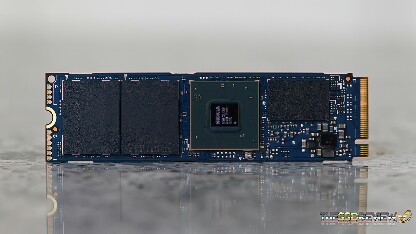
The Addlink S92 1 TB is what happens when you pair QLC NAND with a first-gen Phison E16 controller and a DDR3 DRAM chip — it is a PCIe 4.0 drive that reads fast, writes slowly, and wears out four times faster than a TLC equivalent, but it costs less and comes in capacities the TLC drives of its era could not touch.
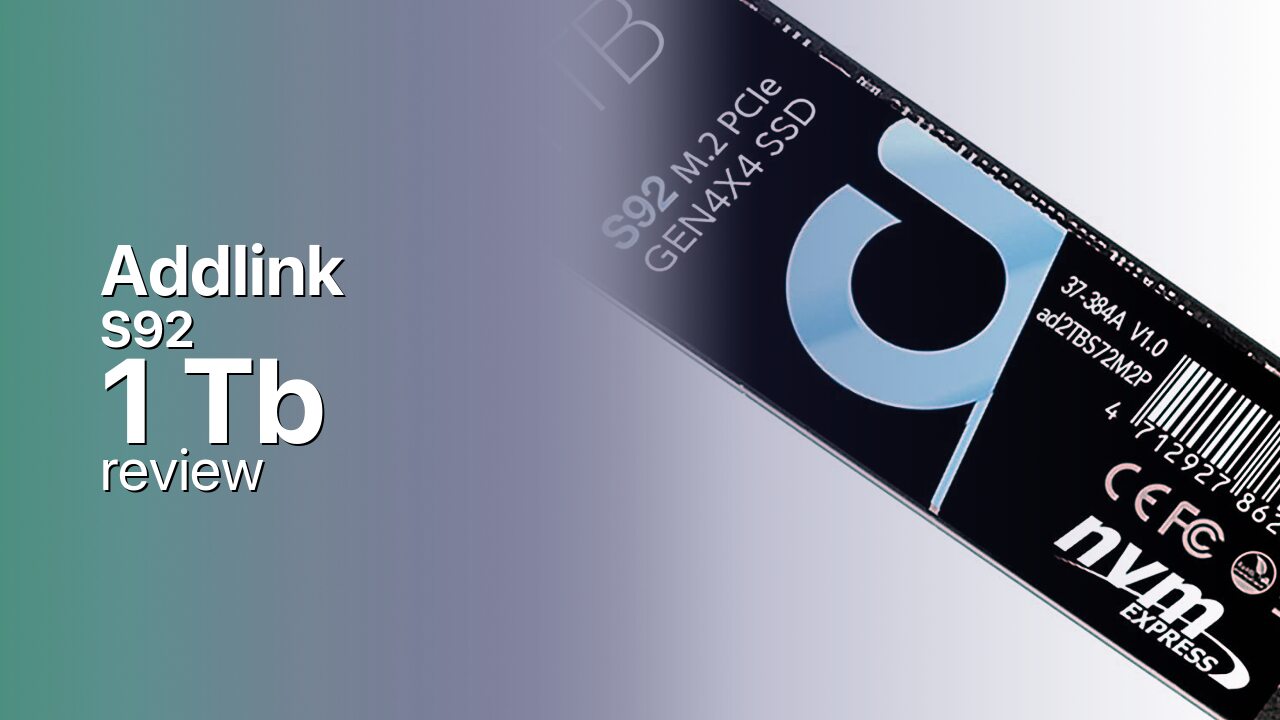
Controller & Memory
The Addlink S92 is built on the Phison PS5016-E16, the same 8-channel PCIe 4.0 controller found in the enthusiast S50 and first-wave Gen 4 drives. What sets the S92 apart is the NAND: Micron 3D QLC instead of TLC. QLC stores 4 bits per cell, which increases density and lowers cost per gigabyte but brings two significant trade-offs — lower write speeds and dramatically lower endurance. The S92 pairs the E16 with a DDR3 DRAM cache, a cost-saving choice over the DDR4 found in most E16 designs. The drive uses the M.2 2280 form factor and the PCIe 4.0 x4 interface.
Addlink offers the S92 in 1 TB, 2 TB, and 4 TB capacities — the 4 TB option was unusual for consumer SSDs when the S92 launched and remains a distinguishing feature of the QLC E16 platform. The 1 TB variant reviewed here is the entry point, with 200 TBW endurance that drops further on the 500 GB SKU and scales up on the 2 TB and 4 TB models. The S92 competes against other QLC PCIe drives like the Corsair MP400, Sabrent Rocket Q, and Intel 670p — all of which share the same basic trade-off: maximum capacity per dollar in exchange for endurance and sustained write speed.
The S92 is not a boot-drive candidate for anyone who writes more than a few GB per day. It is a secondary drive — a game library, a media archive, a Steam folder — where reads dominate writes and the QLC endurance ceiling is a theoretical concern rather than a practical one. The DRAM cache helps with bursty reads, but sustained writes to a QLC drive are an exercise in patience: after the SLC cache fills, direct-to-QLC write speeds can drop into the hundreds of MB/s.
Storage Comparisons:
S92 Performance & Benchmarks
Addlink rates the S92 1 TB at up to 4,900 MB/s sequential reads and 3,600 MB/s sequential writes — figures that place it slightly below the TLC-equipped S50 on writes but comparable on reads. Random performance is rated at up to 350,000 read IOPS and 700,000 write IOPS. In practice, game load times and OS responsiveness are determined by read performance, which the S92 handles well — the 4,900 MB/s reads are more than fast enough for any consumer workload. Writes are a different story.
Addlink S92 1 TB vs M.2 4.0 x 4 peers
Switch between sequential throughput and random IOPS to see how this drive stacks up against other M.2 4.0 x 4 SSDs in our database. The highlighted bar is the drive on this page — click any other bar to open that drive.
- Patriot Viper PV593 1 TB: 14,500 MB/s read, 14,000 MB/s write
- Patriot Viper PV593 2 TB: 14,500 MB/s read, 14,000 MB/s write
- Patriot Viper PV593 4 TB: 14,500 MB/s read, 14,000 MB/s write
- Patriot Viper PV573 2 TB: 14,000 MB/s read, 12,000 MB/s write
- Addlink S92 1 TB (this drive): 4,900 MB/s read, 3,600 MB/s write
Like all QLC SSDs, the S92 uses a portion of its NAND as a pSLC write cache to absorb burst writes at full speed. On the 1 TB model, this cache is typically 60—100 GB when the drive is empty, shrinking as the drive fills. Once the cache exhausts, direct-to-QLC write speeds collapse to roughly 200—400 MB/s — slower than a hard drive in sequential transfers. For a game library drive where writes are mostly large initial installs that complete within the cache, this is manageable. For a mixed-workload OS drive where background writes happen continuously, the QLC penalty is felt constantly. The E16 controller runs warm and benefits from a heatsink, though the QLC NAND's lower write throughput means the controller spends less time at full power than in TLC implementations.
Addlink S92 vs Competitors
See how the S92 stacks up against other M.2 4.0 x 4 drives in our database:
Compare with rival drives:
Endurance, TBW & Warranty
The 1 TB Addlink S92 carries a 200 TBW endurance rating and a 5-year limited warranty — one of the lowest TBW figures available in a consumer NVMe SSD. At a typical desktop write rate of 20 GB per day, this works out to roughly 27 years of service — still longer than the 5-year warranty period, but substantially less headroom than the 700—1,800 TBW found on TLC drives. At 50 GB/day — a plausible rate for a drive used for video scratch or heavy downloads — the endurance is exhausted in roughly 11 years, which is still beyond the warranty but unusually tight for an SSD. The MTBF is rated at 1.8 million hours. For context, the Intel 670p 1 TB (QLC) is rated at 370 TBW and the Crucial P3 1 TB (QLC) at 220 TBW — the S92's 200 TBW is at the low end of the QLC endurance spectrum. Addlink handles warranty through its distribution network. The 2 TB variant doubles endurance to 400 TBW; the 4 TB quadruples it to 800 TBW.
Addlink S92 1 TB Specifications
| Category | Value |
|---|---|
| Capacity [?] | 1 TB |
| Interface [?] | M.2 4.0 x 4 |
| Controller [?] | Phison PS5016-E16 |
| Memory type [?] | Micron 3D QLC |
| DRAM [?] | DDR3 |
| Read speed (MB/s) [?] | 4900 |
| Write speed (MB/s) [?] | 3600 |
| Read IOPS [?] | 350000 |
| Write IOPS [?] | 700000 |
| Endurance (TBW) [?] | 200 |
| MTBF (million hours) [?] | 1.8 |
| Warranty (years) [?] | 5 |
Verdict: Is the S92 Worth It in 2026?
The Addlink S92 1 TB is a QLC drive that makes sense only when you understand and accept its limitations. It reads fast enough for gaming and general desktop use, it has a DRAM cache, and it costs less than TLC alternatives. But it writes slowly once the cache fills, and its 200 TBW endurance rating is low enough that heavy writers should look elsewhere. Buy the S92 as a secondary game library or media drive — a Steam folder on a budget — where reads dominate and endurance is a non-issue. Do not buy it as a boot drive if you run virtual machines, edit video, or do anything that writes more than a few tens of GB per day. For a primary TLC drive at a similar price, the WD Blue SN580 or the Addlink S93 offer DRAM-less TLC designs with better sustained writes and higher endurance. The S92 is a niche tool for a niche job, and used correctly it does that job well.
+ Pros
- 4,900 MB/s reads on PCIe 4.0 — fast enough for any consumer workload
- DDR3 DRAM cache for consistent read latency
- Available up to 4 TB — among the highest capacities of its era
- 5-year warranty despite QLC endurance limits
- Low cost per gigabyte for a DRAM-equipped PCIe 4.0 drive
- Read-heavy workloads perform similarly to TLC competitors
- Cons
- 200 TBW endurance — among the lowest in the NVMe segment
- Direct-to-QLC write speed drops to 200—400 MB/s after cache fills
- Unsuitable as a boot drive for write-intensive workloads
- DDR3 DRAM is slower than the DDR4 used in most E16 designs
- SLC cache shrinks as the drive fills, worsening write performance
Buy this or similar SSD Storage:



Video Review
Can an Amazon 1TB SSD compete with a Samsung EVO? Actually... yes | Hardware