Mushkin Delta 1TB Review — Budget PCIe 4.0 QLC NVMe SSD (2026)
Quick answer
The Mushkin Delta 1TB occupies a difficult position in the SSD market.
Read: 4975 MB/s Write: 3975 MB/s Endurance: 800 TBW Warranty: 5 years Interface: M.2 4.0 x 4
The Mushkin Delta 1TB is a budget-oriented PCIe 4.0 NVMe SSD built on the first-generation Phison E16 controller and QLC NAND, targeting price-conscious buyers who want PCIe 4.0 compatibility without flagship pricing.
Controller & Memory
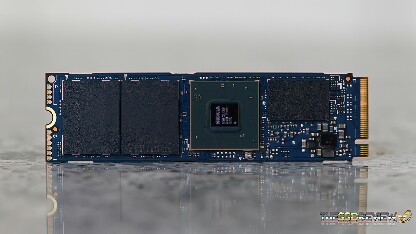
The Mushkin Delta 1TB pairs a Phison PS5016-E16 controller with 3D QLC (quad-level cell) NAND flash. The Phison E16 was the first consumer PCIe 4.0 controller, debuting in 2019 with drives like the Corsair MP600 and Gigabyte AORUS Gen4. By the time the Delta launched, the E16 was already a generation behind Phison's newer E18 design — which powers Mushkin's own Gamma line.
QLC NAND stores four bits per cell, compared to three bits in TLC NAND. The advantage is higher density and lower cost per gigabyte. The trade-off is lower endurance, slower sustained write speeds, and a smaller SLC cache buffer. For read-heavy workloads — booting Windows, loading games, opening applications — QLC performs identically to TLC. The limitations surface during sustained writes: large file transfers, video editing, and database operations will quickly exhaust the SLC cache and drop to much lower direct-QLC write speeds.
The Delta is available in 1TB, 2TB, and 4TB capacities, all in the standard M.2 2280 form factor. The 1TB model is rated at up to 4,975 MB/s reads and 3,975 MB/s writes, with manufacturer-reported figures of 700,000 random read IOPS and 650,000 random write IOPS. Note that Mushkin's current product page lists lower figures (4,700/2,100 MB/s), suggesting either a firmware revision or a discrepancy between launch specifications and retail units.
Mushkin bundles the Delta with its Enhanced Data Protection Suite (MEDS), including LDPC error correction, SLC caching, thermal monitoring, and AES 128/256-bit hardware encryption.
As a PCIe 4.0 drive with a first-gen controller and QLC NAND, the Delta sits in an awkward position: it offers PCIe 4.0 connectivity but doesn't deliver the performance that buyers expect from the interface. Competitors include other E16-based drives like the Sabrent Rocket 4.0, Gigabyte AORUS Gen4, and Silicon Power Gen4 x4 — all of which use TLC NAND and outperform the Delta in sustained workloads.
Storage Comparisons:
Delta Performance & Benchmarks
The Mushkin Delta 1TB is rated at up to 4,975 MB/s sequential reads and 3,975 MB/s sequential writes, with manufacturer-reported 700,000 IOPS random reads and 650,000 IOPS random writes. However, Mushkin's own product page lists lower figures of 4,700 MB/s reads and 2,100 MB/s writes — a significant discrepancy that suggests the drive's real-world performance may fall short of the press-release numbers.
Mushkin Delta 1 TB vs M.2 4.0 x 4 peers
Switch between sequential throughput and random IOPS to see how this drive stacks up against other M.2 4.0 x 4 SSDs in our database. The highlighted bar is the drive on this page — click any other bar to open that drive.
- Patriot Viper PV593 1 TB: 14,500 MB/s read, 14,000 MB/s write
- Patriot Viper PV593 2 TB: 14,500 MB/s read, 14,000 MB/s write
- Patriot Viper PV593 4 TB: 14,500 MB/s read, 14,000 MB/s write
- Patriot Viper PV573 2 TB: 14,000 MB/s read, 12,000 MB/s write
- Mushkin Delta 1 TB (this drive): 4,975 MB/s read, 3,975 MB/s write
Even taking the higher figures at face value, the Delta's performance is unremarkable for a PCIe 4.0 drive. The Phison E16 controller, while capable of near-5,000 MB/s reads, was superseded by the E18 (7,000+ MB/s) and E21T (7,400+ MB/s) generations. Contemporary TLC-based PCIe 4.0 drives like the WD Black SN850X and Samsung 980 Pro achieve roughly 50 percent higher read speeds and significantly faster sustained writes.
The QLC NAND is the Delta's primary performance bottleneck. QLC drives maintain a dynamic SLC cache — a portion of the drive that temporarily writes in faster single-bit mode. Once this cache fills during sustained writes, speeds drop to direct-QLC levels, typically 80–150 MB/s on Phison E16 QLC platforms. For everyday use — booting, application loading, game launches — the SLC cache handles everything transparently and the drive feels fast. But copy a 50 GB file and you'll see the speed collapse once the cache exhausts.
Independent reviewers at Tom's Hardware rated the Delta 2.5 out of 5, describing it as "Mediocrity Defined." The review noted that while the drive delivers higher peak numbers than some PCIe 3.0 alternatives, its QLC-based sustained write performance and overall responsiveness lag behind TLC-equipped competitors at similar price points.
Random 4K performance is adequate for a budget drive but won't impress in comparison to TLC-based PCIe 4.0 drives. The QLC architecture's slower program speeds and larger page sizes inherently limit random-write IOPS.
Mushkin Delta vs Competitors
See how the Delta stacks up against other M.2 4.0 x 4 drives in our database:
Compare with rival drives:
Endurance, TBW & Warranty
Mushkin covers the Delta 1TB with a 5-year limited warranty. The drive's endurance rating is listed at 800 TBW in the source data, though this figure is unusually high for a QLC-based 1TB drive — most QLC SSDs at this capacity are rated between 200 and 400 TBW. At the stated 800 TBW, you could write roughly 438 GB per day across the five-year warranty period. For typical desktop workloads of 20–50 GB per day, the drive would take 44 to 110 years to reach the limit. However, QLC NAND's actual endurance in sustained write-heavy scenarios may be lower than TLC, so heavy users should monitor drive health via SMART data. The 5-year warranty matches industry standards for consumer SSDs, though few QLC drives offer coverage this long. Mushkin handles warranty claims directly as a retail brand, making the RMA process straightforward.
Mushkin Delta 1 TB Specifications
| Category | Value |
|---|---|
| Capacity [?] | 1 TB |
| Interface [?] | M.2 4.0 x 4 |
| Controller [?] | Phison E16 |
| Memory type [?] | 3D QLC |
| DRAM [?] | 1GB DDR4 |
| Read speed (MB/s) [?] | 4975 |
| Write speed (MB/s) [?] | 3975 |
| Read IOPS [?] | 700000 |
| Write IOPS [?] | 650000 |
| Endurance (TBW) [?] | 800 |
| MTBF (million hours) [?] | 1.8 |
| Warranty (years) [?] | 5 |
Verdict: Is the Delta Worth It in 2026?
The Mushkin Delta 1TB occupies a difficult position in the SSD market. It offers PCIe 4.0 connectivity but delivers performance that falls short of what the interface can provide, hampered by the first-generation Phison E16 controller and QLC NAND. The 5-year warranty is a positive, but the QLC architecture's inherent limitations — small SLC cache, slow sustained writes, lower endurance — make it a poor fit for write-heavy workloads. If you need a budget PCIe 4.0 drive for light desktop use, the Delta works. But TLC-based PCIe 3.0 drives like the Crucial MX500 and Samsung 870 EVO often cost similarly and deliver better real-world performance. For PCIe 4.0, the WD Blue SN580 and Mushkin's own Gamma line offer significantly better value.
+ Pros
- 5-year limited warranty
- PCIe 4.0 compatibility for future-proofing
- AES 256-bit hardware encryption
- QLC NAND enables competitive pricing per GB
- Adequate for read-heavy everyday workloads
- Cons
- QLC NAND — slow sustained writes after SLC cache fills
- Phison E16 is a first-gen, superseded controller
- Conflicting speed reports between press release and product page
- Outperformed by TLC-based PCIe 3.0 drives at similar prices
- Not ideal for write-heavy workloads
Buy this or similar SSD Storage:



Video Review
Best SSD for Gaming 2021 & Best Solid State Drives 2021!