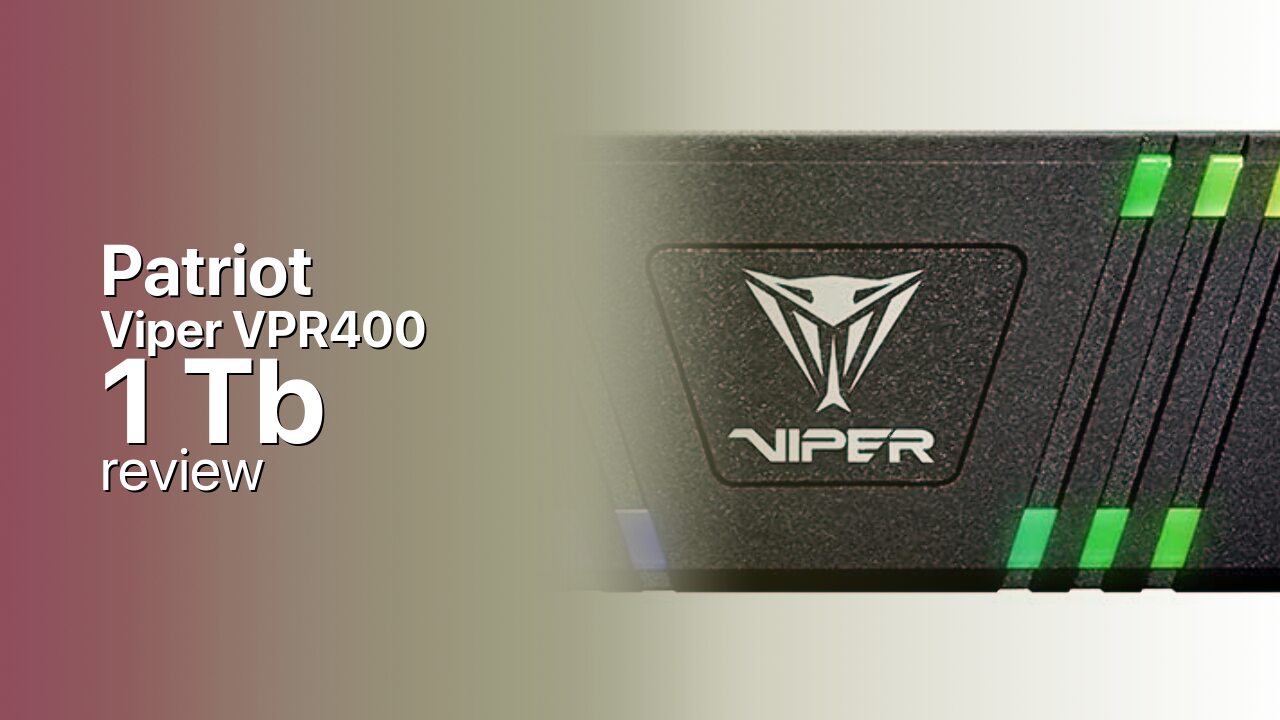
RGB on a Gen4 M.2: the Patriot Viper VPR400 1 TB (2026)
Quick answer
The Patriot Viper VPR400 1 TB earns its place in a desktop build where the SSD sits visible through a case window and lighting on the drive itself matters more than relying on motherboard RGB to do all the work; it is the cleanest way to get addressable RGB on a PCIe 4.0 NVMe module.
Read: 4600 MB/s Write: 4400 MB/s Endurance: 800 TBW Warranty: 5 years Interface: M.2 4.0 x 4
The Patriot Viper VPR400 1 TB is the drive that finally put addressable RGB lighting on a PCIe 4.0 NVMe module, wrapping a sensible InnoGrit IG5220 DRAM-less design in a light-up heat spreader.
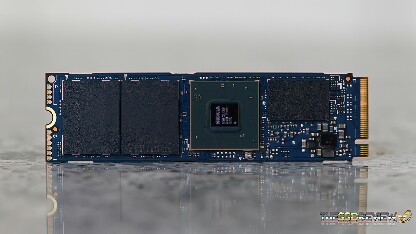
Controller & Memory
The Patriot Viper VPR400 1 TB is built for builders who want their SSD to actually be seen, not just benchmarked. Patriot pitches it as the world's first Gen4x4 RGB M.2 SSD, and that headline is the real selling point: under the lit-up heat spreader sits a workmanlike InnoGrit IG5220 DRAM-less controller paired with Micron 176-layer TLC NAND, rated for 4,600 MB/s sequential reads and 4,400 MB/s writes over a PCIe 4.0 x4 link. Those are solid mid-range Gen4 numbers rather than flagship ones, and the IG5220 sits a tier below InnoGrit's IG5236 that powers the faster drives in this class. With no DRAM on board, the controller leans on Host Memory Buffer (HMB) to hold its mapping table in system RAM, which is the usual cost-versus-complexity trade-off for drives in this bracket.
The VPR400 family is small: 512 GB and 1 TB, and the 1 TB reviewed here is the flagship of the two, carrying the full 800 TBW endurance rating and the lineup's peak read and write speeds. Endurance works out to roughly 438 GB of writes per day across the five-year warranty term, which is generous for a boot-and-games drive. The defining feature is the integrated RGB heat spreader, which both cools the controller and lights up; it connects to a standard motherboard addressable-RGB header rather than running its own lighting controller, so it inherits whatever RGB software the host board already runs. That heat spreader does add height, so the VPR400 is really a desktop part. Laptop upgraders should check slot clearance, and PS5 owners should look elsewhere: 4,600 MB/s reads sit below Sony's 5,500 MB/s recommendation, and the tall RGB spreader is a poor fit for the console's cramped M.2 bay.
Against the wider Gen4 field, the VPR400 sits alongside DRAM-less rivals like the Kingston NV2 1 TB and WD Blue SN580 1 TB while offering meaningfully faster reads, and it is the only one of the three with integrated lighting. Buyers who do not care about RGB and want raw speed will get more from a Phison E18 drive such as the ADATA XPG Gammix S70 Blade 1 TB or the Silicon Power XS70, both of which clear 7,000 MB/s reads. The honest positioning is that the VPR400 is a competent mid-range SSD whose reason to exist is the lighting, not the benchmark chart.
Storage Comparisons:
Viper VPR400 Performance & Benchmarks
The Patriot Viper VPR400 1 TB is rated for 4,600 MB/s sequential reads and 4,400 MB/s sequential writes over its PCIe 4.0 x4 interface, with up to 600,000 random read IOPS and 500,000 random write IOPS. Those are mid-range Gen4 figures: comfortably ahead of entry-level DRAM-less drives like the Kingston NV2, which tops out around 3,500 MB/s, but well behind the 7,000 MB/s-plus ceiling that flagship Phison E18 and InnoGrit IG5236 drives hit.
Patriot Viper VPR400 1 TB vs M.2 4.0 x 4 peers
Switch between sequential throughput and random IOPS to see how this drive stacks up against other M.2 4.0 x 4 SSDs in our database. The highlighted bar is the drive on this page — click any other bar to open that drive.
- Patriot Viper PV593 1 TB: 14,500 MB/s read, 14,000 MB/s write
- Patriot Viper PV593 2 TB: 14,500 MB/s read, 14,000 MB/s write
- Patriot Viper PV593 4 TB: 14,500 MB/s read, 14,000 MB/s write
- Patriot Viper PV573 2 TB: 14,000 MB/s read, 12,000 MB/s write
- Patriot Viper VPR400 1 TB (this drive): 4,600 MB/s read, 4,400 MB/s write
Because the IG5220 is a DRAM-less controller, it relies on a Host Memory Buffer for its flash translation layer and on a pseudo-SLC write cache for burst throughput. In practice that means the rated 4,400 MB/s write speed holds while the SLC cache is absorbing the transfer, then drops to the native Micron TLC rate once the cache fills, which on a 1 TB drive happens only after a sustained write of the sort most consumers never hit. For day-to-day workloads, game loading and OS responsiveness, the drive feels as quick as any PCIe 4.0 part; the gap to a flagship shows up mainly in long, large-file writes. Independent reviewers land on a similar read: FunkyKit scored the VPR400 9.2 out of 10 and struggled to find a real weakness, noting the controller is decent and the spec sheet is honest rather than inflated. Thermals are kept in check by the integrated RGB heat spreader, which doubles as the cooling, with no throttling reported in the standard reviewer test loops.
Patriot Viper VPR400 vs Competitors
See how the Viper VPR400 stacks up against other M.2 4.0 x 4 drives in our database:
Compare with rival drives:
Endurance, TBW & Warranty
Patriot backs the Viper VPR400 1 TB with a five-year limited warranty, terminated early if the 800 TBW endurance rating is exceeded, whichever comes first. That 800 TBW figure is the rating for the 1 TB model reviewed here. At a typical consumer write workload of 20 to 50 GB per day, the drive's NAND would take decades to reach its endurance limit, so in normal use the warranty term, not the flash wear, is what expires first. Patriot rates the drive at 1.5 million hours MTBF, which is a population-reliability statistic calculated across a large fleet of drives rather than a guarantee that any single unit will run for that many hours. Warranty claims are handled direct through Patriot's RMA process, and the Viper Gaming line carries the same support terms as the rest of Patriot's consumer SSD range.
Patriot Viper VPR400 1 TB Specifications
| Category | Value |
|---|---|
| Capacity [?] | 1 TB |
| Interface [?] | M.2 4.0 x 4 |
| Controller [?] | Innogrit Rainier IG5220 |
| Memory type [?] | Micron 176-L TLC |
| DRAM [?] | HMB |
| Read speed (MB/s) [?] | 4600 |
| Write speed (MB/s) [?] | 4400 |
| Read IOPS [?] | 600000 |
| Write IOPS [?] | 500000 |
| Endurance (TBW) [?] | 800 |
| MTBF (million hours) [?] | 1500000 |
| Warranty (years) [?] | 5 |
Verdict: Is the Viper VPR400 Worth It in 2026?
The Patriot Viper VPR400 1 TB earns its place in a desktop build where the SSD sits visible through a case window and lighting on the drive itself matters more than relying on motherboard RGB to do all the work; it is the cleanest way to get addressable RGB on a PCIe 4.0 NVMe module. Buyers chasing peak sequentials should look to a Phison E18 drive like the ADATA XPG Gammix S70 Blade 1 TB, which clears 7,000 MB/s reads and leaves the VPR400's 4,600 MB/s well behind. PS5 upgraders should also pass, both because the read speed sits below Sony's recommendation and because the tall RGB heat spreader fights the console's tight M.2 clearance. Our read: the VPR400 is a competent mid-range Gen4 SSD that earns its place on aesthetics, and buyers who do not value the lighting should pick a faster, non-RGB alternative instead.
+ Pros
- 4,600 MB/s sequential reads over PCIe 4.0
- World's first RGB PCIe 4.0 NVMe SSD
- 800 TBW endurance, five-year warranty
- Micron 176-layer TLC NAND
- RGB heat spreader doubles as cooling
- 1 TB is the flagship capacity
- Cons
- DRAM-less IG5220 trails flagship Gen4
- Reads below Sony's PS5 recommendation
- RGB heat spreader adds height
- Maxes out at 1 TB capacity
- SLC cache smaller than DRAM rivals
Buy this or similar SSD Storage:



Video Review
Un SSD FULMINEO - Recensione Patriot Viper VPR400 RGB