WD Blue SN550 250GB NVMe SSD Review (2026)
Quick answer
The WD Blue SN550 250 GB is a competent DRAM-less NVMe SSD for builders who need a basic boot drive on a PCIe 3.0 platform.
Read: 2400 MB/s Write: 1900 MB/s Endurance: 150 TBW Warranty: 5 years Interface: M.2 3.0 x 4
The WD Blue SN550 250 GB is a DRAM-less PCIe 3.0 NVMe SSD that uses Host Memory Buffer to deliver 2,400 MB/s reads at the entry level of WD's mainstream storage line.
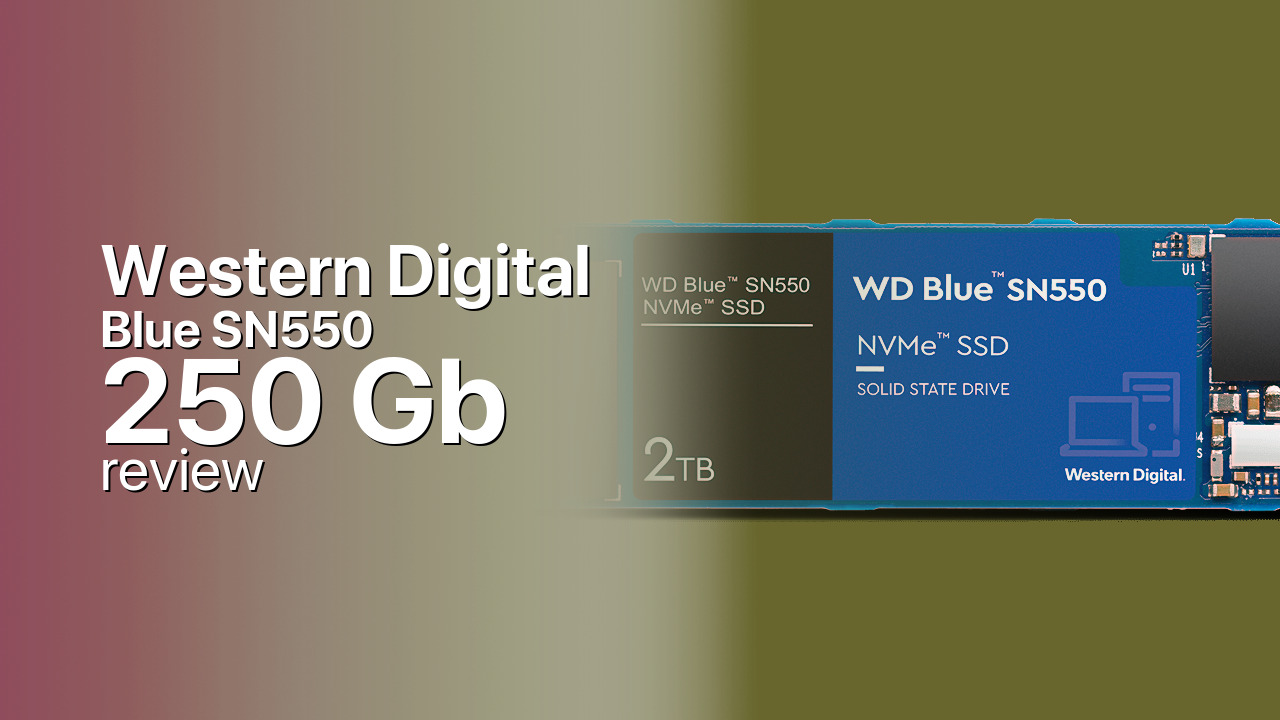
Controller & Memory
The SN550 uses WD's custom DRAM-less NVMe controller (SanDisk 20-82-01008-A1) paired with SanDisk 96-layer 3D TLC NAND. Without onboard DRAM, the drive relies on NVMe's Host Memory Buffer (HMB) feature, which borrows a small portion of the system's RAM to store flash translation layer mapping tables. This keeps costs down while maintaining reasonable performance.
The 250 GB is the smallest capacity in the SN550 lineup. Its specs mirror the 500 GB and 1 TB models for reads (2,400 MB/s) but shares the same rated write speed (1,900 MB/s), which is unusual -- most entry-level NVMe drives drop write speeds at smaller capacities. The SN550 is a single-sided M.2 2280 module compatible with laptops, desktops, and any system with an M.2 NVMe slot.
The SN550 competes with other budget DRAM-less NVMe drives like the Kingston NV2 and Crucial P2. AnandTech described it as "one of the best DRAM-less SSDs on the market" at launch, thanks to its efficient controller design and HMB implementation. It is strictly a PCIe 3.0 drive and not compatible with the PS5, which requires PCIe 4.0.
Storage Comparisons:
Blue SN550 Performance & Benchmarks
WD rates the 250 GB SN550 for up to 2,400 MB/s sequential reads and 1,900 MB/s sequential writes over PCIe 3.0 x4, with up to 410,000 random read IOPS and 405,000 random write IOPS. These specs match the 500 GB and 1 TB models, which is unusual for a budget NVMe line -- most competitors reduce write speed on smaller capacities.
Western Digital Blue SN550 250 GB vs M.2 3.0 x 4 peers
Switch between sequential throughput and random IOPS to see how this drive stacks up against other M.2 3.0 x 4 SSDs in our database. The highlighted bar is the drive on this page — click any other bar to open that drive.
- ADATA SX 8800 Pro 512 GB: 3,500 MB/s read, 2,700 MB/s write
- ADATA SX 8800 Pro 1 TB: 3,500 MB/s read, 2,700 MB/s write
- ADATA XPG Spectrix S40G RGB 256 GB: 3,500 MB/s read, 3,000 MB/s write
- ADATA XPG Spectrix S40G RGB 512 GB: 3,500 MB/s read, 3,000 MB/s write
- Western Digital Blue SN550 250 GB (this drive): 2,400 MB/s read, 1,900 MB/s write
The SN550 uses a dynamic SLC write cache that performs well during burst writes. Once the cache fills, writes drop to native TLC speed. Independent reviewers found the SN550's real-world responsiveness competitive with some DRAM-based drives for light desktop workloads, though it falls behind in sustained write scenarios where the HMB architecture becomes a bottleneck.
The drive lacks hardware encryption and does not support secure erase through Parted Magic. Power efficiency is good, making the SN550 a reasonable choice for thin laptops where power draw matters.
Western Digital Blue SN550 vs Competitors
See how the Blue SN550 stacks up against other M.2 3.0 x 4 drives in our database:
Compare with rival drives:
Endurance, TBW & Warranty
WD rates the 250 GB SN550 for 150 TBW of write endurance under a five-year limited warranty. This is low compared to DRAM-equipped drives at the same capacity but adequate for a boot drive that primarily handles reads. At 8 GB of writes per day -- typical for a light desktop workload -- 150 TBW translates to roughly 50 years of use. Endurance scales up at larger capacities: 300 TBW for 500 GB and 600 TBW for 1 TB.
Western Digital Blue SN550 250 GB Specifications
| Category | Value |
|---|---|
| Capacity [?] | 250 GB |
| Interface [?] | M.2 3.0 x 4 |
| Controller [?] | SanDisk 20-82-01008-A1 |
| Memory type [?] | SanDisk 3D TLC |
| DRAM [?] | HMB |
| Read speed (MB/s) [?] | 2400 |
| Write speed (MB/s) [?] | 1900 |
| Read IOPS [?] | 410000 |
| Write IOPS [?] | 405000 |
| Endurance (TBW) [?] | 150 |
| MTBF (million hours) [?] | 1750000 |
| Warranty (years) [?] | 5 |
Verdict: Is the Blue SN550 Worth It in 2026?
The WD Blue SN550 250 GB is a competent DRAM-less NVMe SSD for builders who need a basic boot drive on a PCIe 3.0 platform. Its 2,400 MB/s reads and HMB-based design deliver responsive everyday performance at a budget price point. Users who need more than a boot drive should consider the 500 GB or 1 TB capacities for triple the endurance. Those who can stretch their budget should look at the Samsung 970 EVO Plus or SK hynix Gold P31 for DRAM-equipped alternatives with better sustained write performance.
+ Pros
- 2,400 MB/s reads on a budget DRAM-less design
- Efficient HMB implementation
- Single-sided M.2 2280 fits laptops
- Good power efficiency
- Write speed matches larger capacities
- Cons
- DRAM-less HMB design limits sustained writes
- Only 150 TBW endurance
- No hardware encryption
- Not compatible with PS5 (PCIe 3.0)
- Sustained writes slow after SLC cache fills
Buy this or similar SSD Storage:
Video Review
WD Blue SN550 NVMe m.2 SSD Review: BEST budget SSD!