Kingston KC2500 250GB NVMe SSD Review (2026)
Quick answer
The Kingston KC2500 250GB is a solid entry-level performance NVMe SSD with a mature controller, hardware encryption, and competitive read speed.
Read: 3500 MB/s Write: 1200 MB/s Endurance: 150 TBW Warranty: 5 years Interface: M.2 3.0 x 4
The Kingston KC2500 250GB is the entry capacity of Kingston's performance NVMe line, pairing the Silicon Motion SM2262EN controller with 96-layer TLC NAND and AES 256-bit hardware encryption.
Controller & Memory
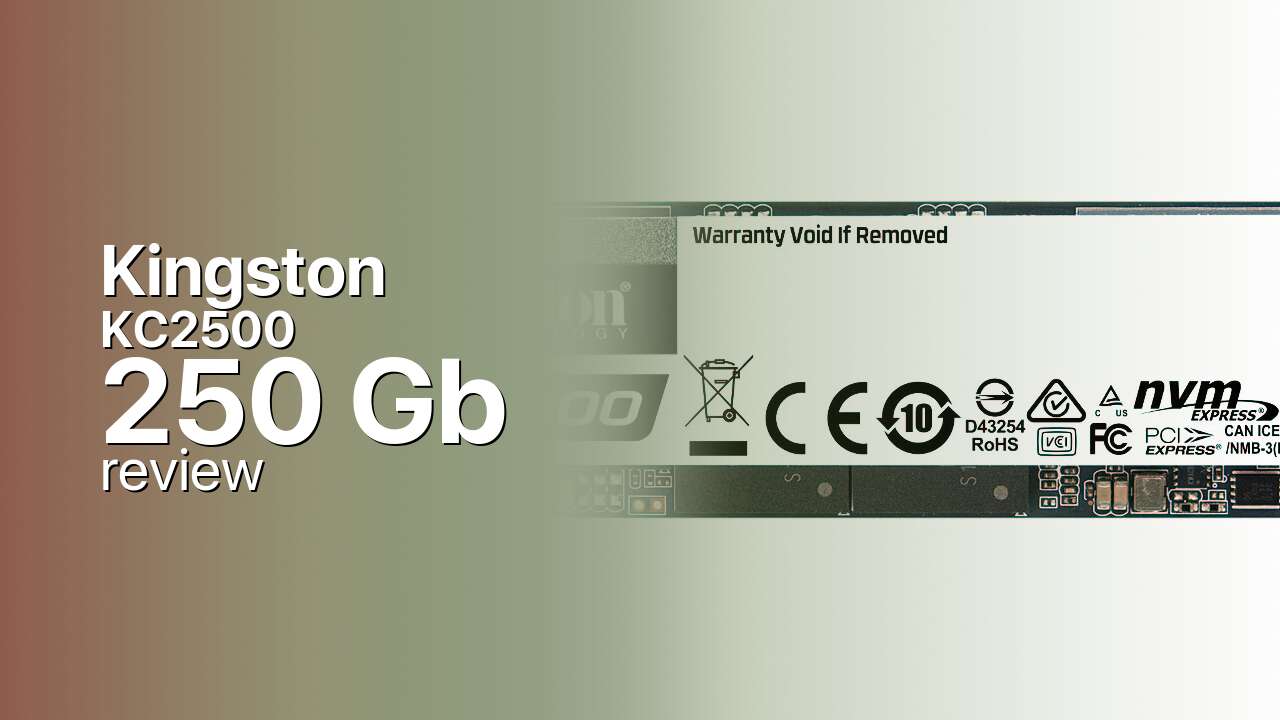
Inside the KC2500 250 GB is the Silicon Motion SM2262EN eight-channel controller paired with 96-layer 3D TLC NAND flash. A DDR3L DRAM chip handles the flash translation layer. The drive is a standard M.2 2280 form factor connecting over PCIe 3.0 x4.
As the smallest capacity in the lineup, the 250 GB model has reduced write speed compared to larger variants: 1,200 MB/s versus 2,900 MB/s on the 1 TB and 2 TB models. Read speed holds at 3,500 MB/s across all capacities. Random IOPS are 375,000 reads and 300,000 writes regardless of capacity. Endurance is 150 TBW over a 5-year warranty.
The KC2500 series also comes in 500 GB, 1 TB, and 2 TB. The 250 GB is best suited as a boot drive for budget builds or as an OS drive paired with a larger secondary SSD. It supports XTS-AES 256-bit encryption, TCG Opal 2.0, and eDrive -- features that business users value. Direct competitors include the Samsung 970 EVO Plus 250 GB and the Crucial P5 250 GB.
Storage Comparisons:
KC2500 Performance & Benchmarks
The KC2500 250 GB reads at 3,500 MB/s sequentially, matching the PCIe 3.0 x4 near-saturation point. Writes are rated at 1,200 MB/s -- a significant drop from the 2,900 MB/s the 1 TB and 2 TB models achieve. This is typical for small NVMe drives: fewer NAND dies mean less write parallelism.
Kingston KC2500 250 GB vs M.2 3.0 x 4 peers
Switch between sequential throughput and random IOPS to see how this drive stacks up against other M.2 3.0 x 4 SSDs in our database. The highlighted bar is the drive on this page — click any other bar to open that drive.
- Kingston KC2500 250 GB (this drive): 3,500 MB/s read, 1,200 MB/s write
- ADATA SX 8800 Pro 512 GB: 3,500 MB/s read, 2,700 MB/s write
- ADATA SX 8800 Pro 1 TB: 3,500 MB/s read, 2,700 MB/s write
- ADATA XPG Spectrix S40G RGB 256 GB: 3,500 MB/s read, 3,000 MB/s write
- ADATA XPG Spectrix S40G RGB 512 GB: 3,500 MB/s read, 3,000 MB/s write
Random IOPS of 375,000 reads and 300,000 writes are strong numbers that hold across all capacities. In everyday use, the 250 GB model feels as snappy as the larger variants for OS tasks, application launches, and web browsing. The write-speed limitation only becomes apparent during large-file transfers or game installations.
Independent reviewers found the KC2500 competitive with the Samsung 970 EVO Plus and ADATA SX8200 Pro at similar capacities, trading blows on synthetic benchmarks and real-world trace tests. The SM2262EN controller is a proven, mature platform.
Kingston KC2500 vs Competitors
See how the KC2500 stacks up against other M.2 3.0 x 4 drives in our database:
Compare with rival drives:
Endurance, TBW & Warranty
Kingston rates the KC2500 250 GB at 150 TBW over its 5-year warranty, which equals roughly 82 GB of writes per day. At 0.3 drive writes per day, this matches the endurance standard for mainstream TLC NVMe drives. The 2 million hour MTBF is a population-level reliability estimate. Kingston provides a 5-year limited warranty with free technical support.
Kingston KC2500 250 GB Specifications
| Category | Value |
|---|---|
| Capacity [?] | 250 GB |
| Interface [?] | M.2 3.0 x 4 |
| Controller [?] | Silicon Motion SM2262EN |
| Memory type [?] | 96-layer 3D TLC |
| DRAM [?] | DDR3L |
| Read speed (MB/s) [?] | 3500 |
| Write speed (MB/s) [?] | 1200 |
| Read IOPS [?] | 375000 |
| Write IOPS [?] | 300000 |
| Endurance (TBW) [?] | 150 |
| MTBF (million hours) [?] | 2 |
| Warranty (years) [?] | 5 |
Verdict: Is the KC2500 Worth It in 2026?
The Kingston KC2500 250GB is a solid entry-level performance NVMe SSD with a mature controller, hardware encryption, and competitive read speed. Its main drawback is the 1,200 MB/s write speed, which is less than half what the 1 TB model offers. For a boot drive in a budget build, it is a practical choice. For anyone doing frequent large-file transfers, stepping up to the 500 GB or 1 TB model brings significantly higher writes at a modest price increase.
+ Pros
- 3,500 MB/s sequential reads
- 375,000 random read IOPS
- XTS-AES 256-bit hardware encryption
- TCG Opal 2.0 and eDrive support
- DRAM cache (DDR3L)
- 5-year warranty with free technical support
- Cons
- 1,200 MB/s writes, less than half the 1 TB model
- Only 250 GB capacity
- PCIe 3.0 only, no PCIe 4.0 upgrade path
- No included heatsink
Buy this or similar SSD Storage:
Video Review
Kingston KC2500 M.2 SSD Review - Insane Speeds