VisionTek Pro 2 250GB Review — Compact PCIe 3.0 NVMe SSD (2026)
Quick answer
Buy the VisionTek Pro 2 250 GB if you need a name-brand NVMe boot drive at the smallest practical capacity and want a 5-year warranty from a US-based company.
Read: 2680 MB/s Write: 1750 MB/s Endurance: 690 TBW Warranty: 5 years Interface: M.2 3.0 x 4
The VisionTek Pro 2 250 GB fills the narrow niche of a name-brand NVMe boot drive at a capacity most manufacturers have abandoned — and it does so with PCIe 3.0 throughput that handily outruns any SATA SSD at the same size.
Controller & Memory
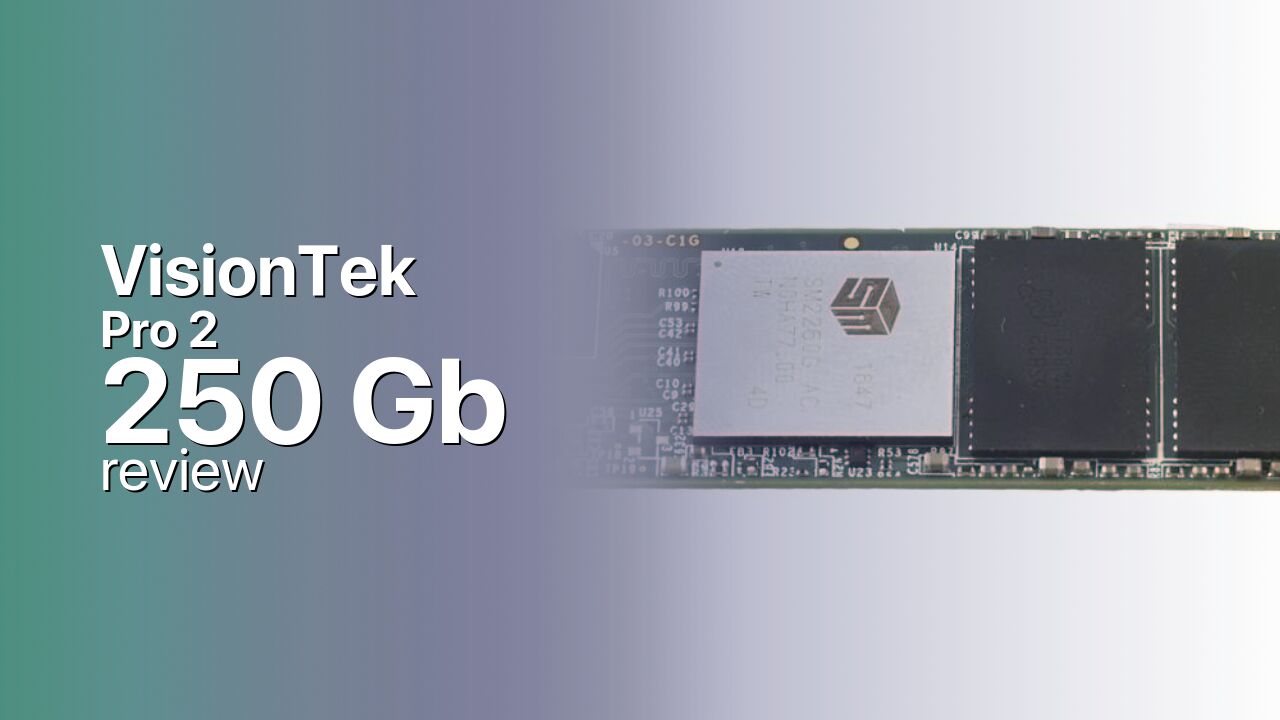
VisionTek builds the Pro 2 around a Silicon Motion NVMe controller paired with an unspecified NAND flash configuration on a standard M.2 2280 PCB running PCIe 3.0 x4. VisionTek does not publish the exact controller model, NAND vendor, or DRAM cache configuration — the product pages list a generic "Silicon Motion" controller and omit NAND and DRAM details entirely. The rated sequential speeds of 2,680 MB/s read and 1,750 MB/s write place the drive in the upper half of PCIe 3.0 consumer drives, suggesting either a DRAM-equipped SM2262EN platform or a well-tuned SM2263XT DRAM-less design with aggressive SLC caching.
The Pro 2 ships in 250 GB, 500 GB, and 1 TB capacities. The 250 GB variant reviewed here targets the boot-drive use case — enough space for Windows or Linux, core applications, and a handful of frequently played games. Sequential throughput is rated at 2,680 MB/s reads and 1,750 MB/s writes, with random IOPS claimed at 232,000 read and 185,000 write. At this capacity, the drive competes against a handful of other name-brand 250 GB NVMe SSDs — the WD Blue SN550 250 GB, the Crucial P2 250 GB (TLC variant), and the Kingston NV1 250 GB — all of which sit in the same entry-level PCIe 3.0 segment.
The 5-year warranty is a meaningful differentiator in the budget NVMe space, where many competitors offer 3-year terms. VisionTek is a US-based company with an established RMA process, which matters for buyers who have been burned by no-name drive failures with no recourse. The single-sided M.2 2280 PCB fits all standard desktop and laptop slots without clearance issues, making the Pro 2 a straightforward drop-in upgrade for older systems moving from SATA or mechanical storage.
Storage Comparisons:
Pro 2 Performance & Benchmarks
The VisionTek Pro 2 250 GB is rated for 2,680 MB/s sequential reads and 1,750 MB/s sequential writes — roughly 5x the peak throughput of a SATA SSD at the same capacity. Random performance is claimed at 232,000 IOPS read and 185,000 IOPS write. These numbers are consistent with a mid-range Silicon Motion PCIe 3.0 platform and place the Pro 2 comfortably ahead of entry-level DRAM-less alternatives like the Phison E13T-based drives that top out around 2,400 MB/s reads.
VisionTek Pro 2 250 GB vs M.2 3.0 x 4 peers
Switch between sequential throughput and random IOPS to see how this drive stacks up against other M.2 3.0 x 4 SSDs in our database. The highlighted bar is the drive on this page — click any other bar to open that drive.
- ADATA SX 8800 Pro 512 GB: 3,500 MB/s read, 2,700 MB/s write
- ADATA SX 8800 Pro 1 TB: 3,500 MB/s read, 2,700 MB/s write
- ADATA XPG Spectrix S40G RGB 256 GB: 3,500 MB/s read, 3,000 MB/s write
- ADATA XPG Spectrix S40G RGB 512 GB: 3,500 MB/s read, 3,000 MB/s write
- VisionTek Pro 2 250 GB (this drive): 2,680 MB/s read, 1,750 MB/s write
At 250 GB, the capacity imposes its own performance ceiling. Smaller SSDs have fewer NAND dies to parallelize writes across, so sustained write speeds under heavy load will be lower than what the 500 GB or 1 TB variants achieve. The SLC write cache on the 250 GB model is proportionally smaller, meaning cache exhaustion occurs sooner during large file transfers. For a boot drive that rarely sees transfers exceeding 20–30 GB at a time, this is a non-issue. Independent performance data for this exact model is sparse — VisionTek products receive less review coverage than Samsung or WD — but the Silicon Motion platform is well-characterised across dozens of other SSDs and performs predictably within its rated envelope.
VisionTek Pro 2 vs Competitors
See how the Pro 2 stacks up against other M.2 3.0 x 4 drives in our database:
Compare with rival drives:
Endurance, TBW & Warranty
VisionTek backs the Pro 2 250 GB with a 5-year limited warranty — longer than the 3-year terms common on entry-level NVMe drives from Kingston, Silicon Power, and TeamGroup. The endurance rating of 690 TBW for the 250 GB model is unusually high for this capacity class; most 250 GB TLC drives carry ratings in the 150–300 TBW range. If accurate, 690 TBW translates to roughly 150 years of service at a typical 20 GB/day consumer workload, far exceeding any realistic deployment. MTBF is rated at 1.5 million hours. As with all VisionTek products, warranty claims are processed through the company's US-based support portal. Buyers should register the drive after purchase to ensure warranty coverage is active, as some VisionTek products require registration within 30 days for full coverage.
VisionTek Pro 2 250 GB Specifications
| Category | Value |
|---|---|
| Capacity [?] | 250 GB |
| Interface [?] | M.2 3.0 x 4 |
| Controller [?] | Silicon Motion |
| Memory type [?] | 3D TLC NAND |
| DRAM [?] | DDR3 |
| Read speed (MB/s) [?] | 2680 |
| Write speed (MB/s) [?] | 1750 |
| Read IOPS [?] | 232000 |
| Write IOPS [?] | 185000 |
| Endurance (TBW) [?] | 690 |
| MTBF (million hours) [?] | 1.5 |
| Warranty (years) [?] | 5 |
Verdict: Is the Pro 2 Worth It in 2026?
Buy the VisionTek Pro 2 250 GB if you need a name-brand NVMe boot drive at the smallest practical capacity and want a 5-year warranty from a US-based company. The 2,680 MB/s read speed is more than adequate for an OS disk, and the single-sided M.2 2280 PCB installs without hassle in any desktop or laptop. Skip it if you need more than 250 GB — at this capacity tier the price-per-gigabyte is poor compared to 500 GB or 1 TB alternatives, and the smaller SLC cache limits sustained write performance. For a few dollars more, the 500 GB Pro 2 or a WD Blue SN570 500 GB doubles both capacity and real-world write headroom. If your use case is strictly a dedicated boot drive and you want warranty accountability, the Pro 2 250 GB does the job without pretense.
+ Pros
- 2,680 MB/s reads — well above SATA for a boot drive
- 5-year warranty from a US-based company
- Single-sided M.2 2280 PCB fits any standard slot
- Competitive random IOPS for the PCIe 3.0 class
- Silicon Motion controller with proven firmware support
- Cons
- 250 GB capacity limits use to boot drive only
- NAND vendor and DRAM configuration are not publicly disclosed
- Smaller SLC cache than higher-capacity variants
- Limited independent review coverage for verification
- Price-per-gigabyte is poor compared to 500 GB alternatives
Buy this or similar SSD Storage:
Video Review
5 Best Fastest M.2 NVMe SSDs 2021