WD Black SN770 250GB PCIe 4.0 NVMe SSD Review (2026)
Quick answer
The WD Black SN770 250GB is a sensible pick for shoppers who only need a small, fast boot drive in a Gen4 system and want the long warranty and clean WD ecosystem.
Read: 4000 MB/s Write: 2000 MB/s Endurance: 200 TBW Warranty: 5 years Interface: M.2 4.0 x 4
The WD Black SN770 250GB is the entry rung of an otherwise capable PCIe 4.0 lineup, and at this capacity its DRAM-less design and halved write rating tell you exactly who it is meant for.
Controller & Memory
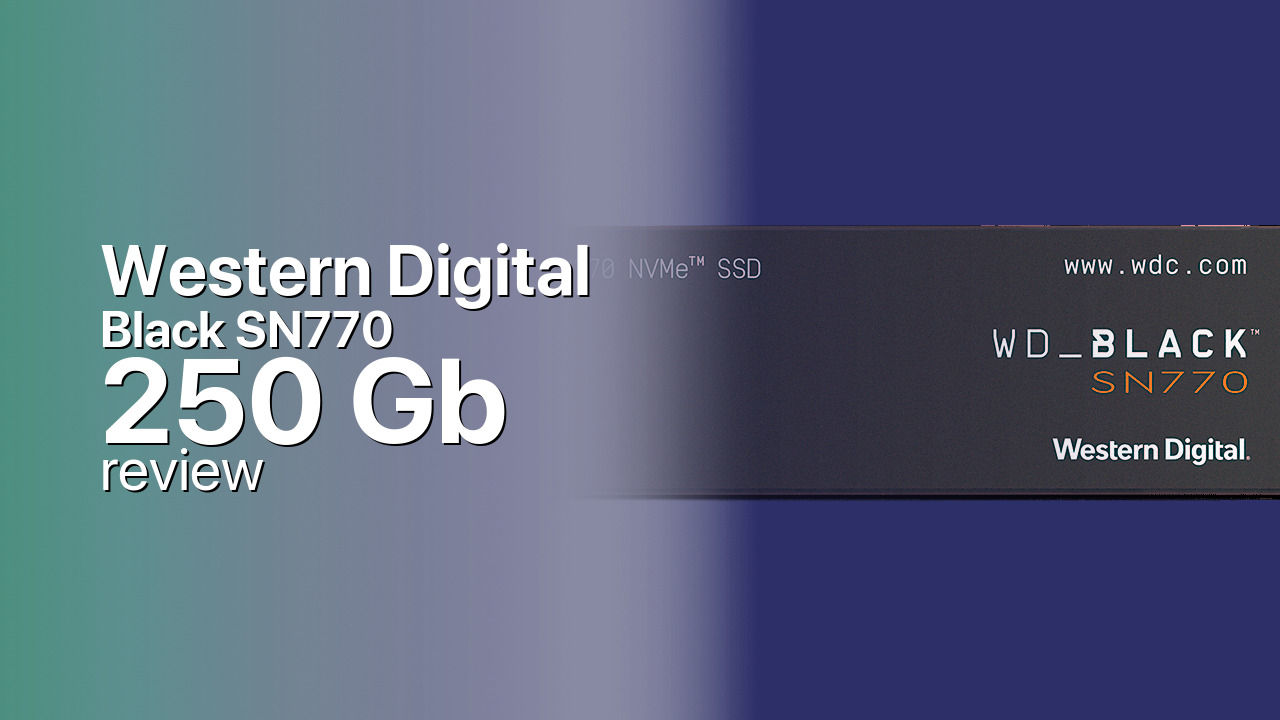
Western Digital builds the SN770 around an in-house SanDisk-designed four-channel NVMe controller paired with BiCS5 112-layer Kioxia 3D TLC NAND. There is no onboard DRAM cache; the drive leans on the NVMe Host Memory Buffer (HMB) feature to borrow a small slice of system RAM for its mapping table. The PCB is single-sided M.2 2280, which is helpful for ultrabooks, mini PCs, and PS5-style enclosures where bottom-side components can foul the slot. No heatsink ships in the box, but the SN770 is a moderate-power drive and rarely throttles in typical desktop use.
The SN770 is sold in 250 GB, 500 GB, 1 TB, and 2 TB capacities, and this is the smallest, lowest-binned variant in the family. WD rates the 250 GB sheet at 4,000 MB/s sequential reads and only 2,000 MB/s sequential writes, with 240,000 random read IOPS and 470,000 random write IOPS. Compared to the 1 TB SKU's 5,150/4,900 MB/s rating, the 250 GB sheet is dramatically slower on writes because fewer NAND dies can be interleaved in parallel. Buyers shopping this size are almost always treating it as a small boot drive, a secondary game volume, or a budget upgrade for an older PCIe 3.0 laptop.
In that role, its direct rivals are the WD Blue SN580 250 GB, the Crucial P3 Plus, the Kingston NV2, and Samsung's older 980 (non-Pro). The SN770 still has the edge in random performance and warranty length among the DRAM-less Gen4 cohort. Anyone considering this drive for a PS5 expansion should look at the 1 TB or 2 TB SN770 instead — the 250 GB is well below Sony's 5,500 MB/s read recommendation.
Storage Comparisons:
Black SN770 Performance & Benchmarks
WD rates the 250 GB SN770 at up to 4,000 MB/s sequential reads and 2,000 MB/s sequential writes, with 240,000 random read IOPS and 470,000 random write IOPS. Those numbers comfortably beat any SATA SSD and roughly match a mid-tier PCIe 3.0 drive on reads, but the 2,000 MB/s write rating is the headline trade-off at this capacity — it is less than half of what the 1 TB SN770 delivers and well under what flagship Gen4 drives manage. For boot, OS, and game-launch workloads this is largely invisible; for large file copies it is the moment the spec sheet starts to bite.
Western Digital Black SN770 250 GB vs M.2 4.0 x 4 peers
Switch between sequential throughput and random IOPS to see how this drive stacks up against other M.2 4.0 x 4 SSDs in our database. The highlighted bar is the drive on this page — click any other bar to open that drive.
- Patriot Viper PV593 1 TB: 14,500 MB/s read, 14,000 MB/s write
- Patriot Viper PV593 2 TB: 14,500 MB/s read, 14,000 MB/s write
- Patriot Viper PV593 4 TB: 14,500 MB/s read, 14,000 MB/s write
- Patriot Viper PV573 2 TB: 14,000 MB/s read, 12,000 MB/s write
- Western Digital Black SN770 250 GB (this drive): 4,000 MB/s read, 2,000 MB/s write
Like most TLC NVMe drives, the SN770 uses a dynamic SLC cache to absorb burst writes. On a 250 GB drive that cache is small, and independent reviewers consistently find that sustained writes drop sharply once the cache fills — into the few-hundred MB/s range on extended transfers. Combined with the DRAM-less HMB design, mixed and queued random workloads also lag behind DRAM-equipped drives such as the WD Black SN850X or Samsung 990 Pro. For everyday gaming, productivity, and even DirectStorage workloads the SN770 250 GB feels snappy, but creators moving multi-gigabyte project files or building a Steam library on this drive will run into the cache wall regularly.
Western Digital Black SN770 vs Competitors
See how the Black SN770 stacks up against other M.2 4.0 x 4 drives in our database:
Compare with rival drives:
Endurance, TBW & Warranty
Western Digital backs the SN770 with a 5-year limited warranty, and on the 250 GB capacity the endurance allowance is 200 TBW — about a fifth of what the 1 TB model carries. That works out to roughly 110 GB of writes every single day for five years before the rating is exhausted, which is more than a typical home user will write to a small system drive in a decade. The warranty ends at whichever boundary is reached first: five calendar years, or 200 TBW of host writes.
WD lists an MTBF of 1,750,000 hours for the SN770 family. As always, MTBF is a fleet-level statistical projection, not a guarantee that an individual drive will live a specific number of hours. Western Digital handles warranty claims directly through its support portal, which is generally faster than going through the retailer once the original return window has closed. Buyers planning sustained heavy writes — large video archives, constant Steam reinstalls, or scratch-disk use for editing — should step up to a higher capacity where the TBW headroom is meaningful.
Western Digital Black SN770 250 GB Specifications
| Category | Value |
|---|---|
| Capacity [?] | 250 GB |
| Interface [?] | M.2 4.0 x 4 |
| Controller [?] | SanDisk |
| Memory type [?] | Kioxia 112-L TLC |
| DRAM [?] | No (HMB) |
| Read speed (MB/s) [?] | 4000 |
| Write speed (MB/s) [?] | 2000 |
| Read IOPS [?] | 240000 |
| Write IOPS [?] | 470000 |
| Endurance (TBW) [?] | 200 |
| MTBF (million hours) [?] | 1.75 |
| Warranty (years) [?] | 5 |
Verdict: Is the Black SN770 Worth It in 2026?
The WD Black SN770 250GB is a sensible pick for shoppers who only need a small, fast boot drive in a Gen4 system and want the long warranty and clean WD ecosystem. It is the wrong drive for PS5 expansion, content creation, or any role that demands sustained write speed, where the 2,000 MB/s write rating and 200 TBW allowance both become liabilities. Anyone willing to spend a little more should jump straight to the SN770 1 TB, the WD Blue SN580 1 TB, or a Crucial P3 Plus at a similar capacity — all three deliver dramatically better write performance and far higher endurance for not much more money. As a 250 GB Gen4 boot drive it is fine; as an everyday workhorse it is undersized.
+ Pros
- 5-year warranty on a budget Gen4 drive
- DRAM-less HMB design keeps power draw low
- Single-sided M.2 2280 fits laptops and PS5 carriers
- In-house SanDisk controller with BiCS5 TLC NAND
- PCIe 4.0 reads up to 4,000 MB/s
- Cons
- 250 GB sheet limited to 2,000 MB/s writes
- Only 200 TBW endurance at this capacity
- Small SLC cache fills quickly on large copies
- No DRAM hurts mixed random performance
- Below Sony PS5 5,500 MB/s read recommendation
Buy this or similar SSD Storage:
Video Review
WD Black SN770 SSD Review – Mid Range Gaming Greatness?